
Torymus auratus
Torymus auratus
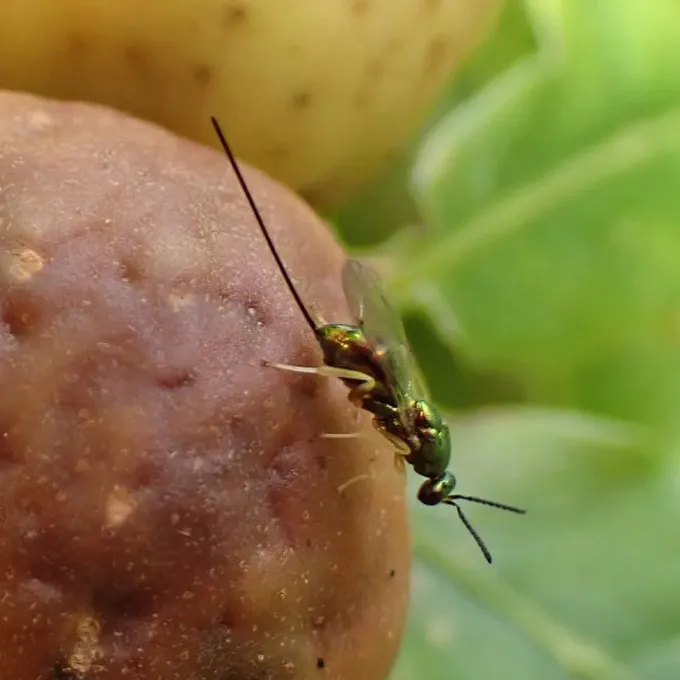
Description
How to identify
Torymus auratus belongs to the Torymidae family within the order Hymenoptera. This small insect is often mistaken for a beneficial parasitoid due to its membership in the vast Chalcidoidea superfamily.
Adult insects are elegant wasps with a distinctive metallic luster. Their coloration ranges from bright green to golden-bronze, which is reflected in the species' common name.
Females possess a long ovipositor that enables them to penetrate hard plant tissues or gall walls. This organ serves as the primary diagnostic feature when examining the insect under magnification.
The larvae of this pest are legless and lead a cryptic lifestyle within plant tissues. They are adapted to feed on plant sap or soft internal tissues, which defines their role as phytophages in certain contexts.
The life cycle is closely linked to the formation of galls on various woody crops. Unlike some relatives that parasitize other insects, this species frequently acts as a phytophage, damaging buds and fruits.
What it damages
The primary crops affected by this pest include ornamental and fruit trees prone to gall formation. Cultivars susceptible to gall wasp infestations are at the highest risk.
The pest targets buds, ovaries, and young shoots, causing significant plant organ deformation. This leads to reduced yields and loss of aesthetic quality in ornamental plantings.
As larvae develop inside the plant tissue, they disrupt nutrient flow, causing necrosis and making the plant susceptible to secondary fungal and bacterial infections.
Economic damage is most severe in nurseries, where damaged buds lead to twisted stems and poor crown development, significantly reducing the market value of the planting material.
In orchards, this pest can trigger premature fruit drop. Surviving fruits are often deformed, unpalatable, and have poor storage longevity.
When it appears
Adult activity occurs during the spring and summer, coinciding with the budding and flowering stages of host plants. This is when females actively search for oviposition sites.
The life cycle involves complete metamorphosis: egg, larva, pupa, and adult. Depending on regional climatic conditions, the pest may produce one to two generations per season.
Larvae overwinter inside plant tissues or within formed galls. This provides them with robust protection against low temperatures and adverse weather conditions.
As temperatures rise, larvae pupate, and young adults emerge. The emergence period is typically extended, which complicates the timing of pest control applications.
Population levels often peak by late summer, especially if conditions have favored the rapid growth of host plants. Monitoring shoot health is critical during this phase.
Signs of infestation
The first indicator of infestation is the appearance of abnormal swellings or galls on leaves and stems. Close inspection reveals tiny exit holes on these growths.
- Yellowing or wilting of young shoots without apparent cause.
- Deformed buds that fail to open in the spring.
- Small entry marks on bark or leaves from the female's ovipositor.
- Premature yellowing and shedding of fruit ovaries.
- Stunted plant growth compared to healthy specimens.
Dissecting a gall often reveals the pest larvae, which are typically white or cream-colored and relatively sedentary, distinguishing them from predatory larvae of other species.
Specific plant deformations that are not attributed to diseases or nutrient deficiencies also suggest the activity of Torymus auratus in the garden.
Control measures
The primary control method is agrotechnical: timely sanitary pruning and the destruction of infested shoots. Galls must be collected and disposed of before adults emerge.
Chemical control requires the use of systemic insecticides during the peak flight period of the adults. Strict adherence to application protocols is essential to avoid harming beneficial pollinators.
Biological control involves maintaining a healthy ecosystem with natural enemies that limit the pest population. Enhancing biodiversity in the garden helps reduce the risk of outbreaks.
Yellow sticky traps can be effective for monitoring population densities and trapping adults during their migratory phases between trees.
Prevention relies on selecting resistant plant varieties and maintaining high agrotechnical standards. Robust, healthy plants are significantly more resilient to pest damage than weakened ones.
Taxonomy
- Latin name
- Torymus auratus
- Order
- Hymenoptera
- Family
- Torymidae
- EPPO code
- TORYAU
Discussion
No discussions yet — be the first.