
Tiphia minuta
Tiphia minuta
Description
How to identify
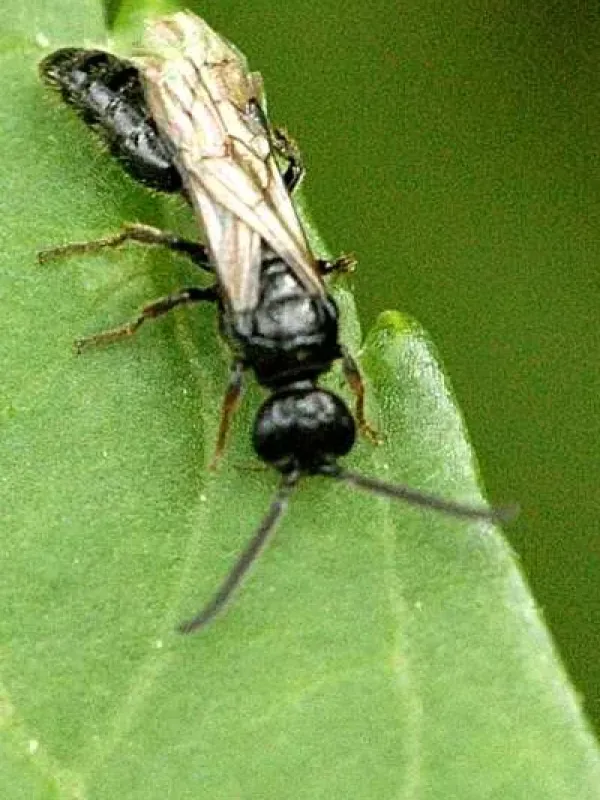
Tiphia minuta is a member of the Tiphiidae family within the order Hymenoptera. Adult specimens are small wasps, typically measuring between 5 to 10 millimeters in length.
Their bodies are predominantly black with a subtle sheen, covered in sparse, fine light-colored hairs. They possess transparent wings with complex venation patterns.
Sexual dimorphism is evident in the antenna structure and abdominal shape, with females being more robust to facilitate burrowing into the soil.
These wasps are often observed near the ground, scurrying across the soil surface in search of hosts, which differentiates them from aerial-nesting wasps.
Taxonomically, they are categorized as parasitoid wasps, specialized in regulating populations of scarab beetle larvae, rather than attacking plant tissues.
What it damages
Tiphia minuta is not a plant pest. It does not feed on leaves, stems, or fruits, and it does not cause mechanical damage to crops during its feeding cycle.
In fact, this species is considered a beneficial insect as its larvae are parasitoids of various soil-dwelling scarab beetle larvae (e.g., May beetle larvae).
By preying on these subterranean pests, Tiphia minuta indirectly protects crop roots from being consumed by beetle larvae, acting as a natural biological control agent.
There is no economic damage associated with this insect; therefore, intervention against the wasp itself is generally counterproductive for a farmer.
The presence of Tiphia minuta is a positive indicator of a functional ecosystem that manages pest populations naturally without heavy chemical reliance.
When it appears
The adult activity of Tiphia minuta peaks during the warmer summer months, typically from late June through August, when soil temperatures are optimal.
The life cycle is closely tied to the development of its host beetle larvae, ensuring that adult wasps are available when host larvae are accessible in the soil.
Females spend the summer locating hosts, laying eggs on them, and ensuring the survival of the next generation through a complete metamorphosis cycle.
Overwintering occurs in the soil, where the larvae spin durable cocoons to protect themselves until the following spring, when they emerge as adults.
This synchronized emergence is a survival strategy, ensuring that the wasps are present exactly when the population density of their host insects is at its peak.
Signs of infestation
Signs of Tiphia minuta presence include spotting small, glossy wasps running across the ground in open areas or near the base of vegetation during the heat of the day.
During soil cultivation, one might find the characteristic oval-shaped, tough cocoons, which signify that the wasp has successfully completed a generation in that soil.
An absence of significant root damage in areas known for high scarab beetle density might suggest that parasitoid populations like Tiphia are providing control.
Visual observation of these insects burrowing into soft soil cracks is a clear sign that the wasps are actively searching for hosts to continue their life cycle.
Unlike true plant pests, there are no specific wilting, yellowing, or leaf-chewing symptoms that can be attributed to the activity of these wasps.
Control measures
Since Tiphia minuta is a beneficial parasitoid, no control measures are required, and efforts should be made to preserve them in the agricultural landscape.
The use of broad-spectrum soil insecticides should be avoided, as these chemicals often eliminate beneficial parasitoids, leading to secondary outbreaks of pests.
Promoting a healthy soil environment and allowing for natural biodiversity are the best ways to keep the Tiphia population stable and effective.
Integrating agricultural practices that favor natural predators helps reduce the dependency on chemical pesticides for controlling underground beetle populations.
- Avoid broad-spectrum chemical treatments in the soil.
- Maintain buffer zones for beneficial insect habitats.
- Utilize integrated pest management (IPM) strategies.
- Monitor scarab beetle larva populations before considering intervention.
Taxonomy
- Latin name
- Tiphia minuta
- Order
- Hymenoptera
- Family
- Tiphiidae
- EPPO code
- TIPHMI
Discussion
No discussions yet — be the first.