
Yellow elm aphid
Tinocallis ulmifolii
Description
How to identify
The yellow elm aphid (Tinocallis ulmifolii) is a species of aphid belonging to the family Aphididae. It is specifically adapted to feed on trees within the genus Ulmus, which includes all common elm species.
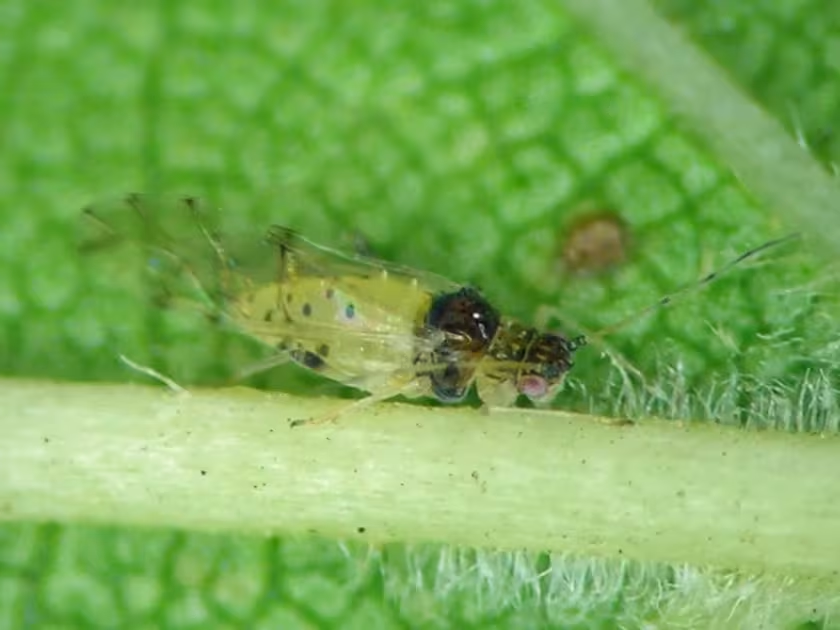
Adult aphids are easily identified by their distinct yellow or pale lemon color. They are small, measuring approximately 1.5 to 2 millimeters in length, and are typically found on the undersides of elm leaves.
Winged adults exhibit characteristic dark markings on their wing veins. Their antennae are remarkably long, often exceeding the length of their body, which serves as a key feature for field identification.
Unlike many other aphid species that form dense, crowded colonies, the yellow elm aphid tends to be more solitary. Individuals are often spread out across the leaf surface, making them somewhat harder to detect in the early stages of infestation.
As a member of the order Hemiptera, this aphid utilizes specialized mouthparts to pierce plant tissues and extract sap, maintaining a strict biological relationship with its host plant throughout the growing season.
What it damages
The primary hosts of this pest are various species of elm trees. The damage is concentrated on the leaves, where the aphids feed by inserting their stylets into the leaf veins and mesophyll tissue.
The extraction of sap causes the leaves to lose vitality, leading to yellowing (chlorosis) and eventually premature leaf drop. This process directly interferes with the tree's ability to perform photosynthesis efficiently.
Urban elms, which are often subjected to environmental stress, are particularly susceptible. Repeated infestations over several seasons can lead to overall canopy thinning and a decline in the tree's vigor and health.
A significant portion of the damage is indirect, caused by the production of honeydew. This sticky substance covers the foliage, creating a perfect medium for the growth of black sooty mold.
The accumulation of sooty mold on the leaf surface blocks sunlight and impairs gas exchange, further weakening the tree and drastically reducing its ornamental and aesthetic value in landscape settings.
When it appears
The lifecycle begins in the spring when eggs, which overwinter in bark crevices, hatch into nymphs. These nymphs quickly develop into the first generation of wingless aphids that begin feeding on emerging elm leaves.
During the summer months, specifically June and July, the population can grow rapidly. Under favorable warm weather conditions, the aphid produces several generations, leading to peak infestation levels by mid-summer.
As the season progresses, winged forms appear, allowing the aphid to disperse to other elm trees. This ensures the survival and spread of the population across local elm tree stands.
In the autumn, sexual reproduction occurs, and females lay cold-hardy eggs on the branches of the host tree. These eggs serve as the sole method of overwintering until the next spring.
Understanding this seasonal timing is crucial for arborists and gardeners. Targeting the early generations before they reach peak numbers is the most effective approach for tree protection.
Signs of infestation
The most visible sign is the presence of small yellow insects on the underside of elm leaves. Close inspection of the foliage will reveal these pale bodies often resting along the leaf veins.
Leaves may exhibit a mottled appearance or generalized yellowing. If the infestation is severe, the leaves may curl slightly or show signs of early senescence and abscission.
The presence of honeydew is a clear indicator. Leaves often feel sticky to the touch, and surfaces below the tree may become coated in a shiny, sugary residue that attracts ants, wasps, and bees.
Sooty mold growth is another reliable sign. This appears as a powdery black coating on the leaves and sometimes the branches, signaling that aphid populations have been present for some time.
- Yellow insects on leaf undersides
- Sticky foliage covered in honeydew
- Black sooty mold on leaves
- Increased ant activity on the tree
- Premature yellowing and leaf drop
Control measures
Proper cultural practices are the foundation of control. Ensuring trees are well-watered and mulched reduces environmental stress, making them more resilient against aphid attacks.
In home gardens or small landscapes, a strong blast of water from a garden hose can physically dislodge aphids from the leaves, significantly reducing their impact without the need for chemicals.
For more severe cases, systemic insecticides can be applied. These products are taken up by the tree's vascular system, providing long-term protection by killing aphids that feed on the sap.
Biological control is highly effective. Encouraging natural predators such as lady beetles, lacewings, and hoverflies can keep aphid numbers below economic thresholds, reducing the need for intervention.
Regular monitoring starting in late spring is vital. Early detection allows for targeted management before the infestation reaches a level that causes significant aesthetic or physiological damage to the tree.
Taxonomy
- Latin name
- Tinocallis ulmifolii
- Order
- Hemiptera (bugs, aphids, leafhoppers)
- Family
- Aphididae
- EPPO code
- TINCUL
Discussion
No discussions yet — be the first.