
Elm aphid
Tinocallis saltans
Description
How to identify
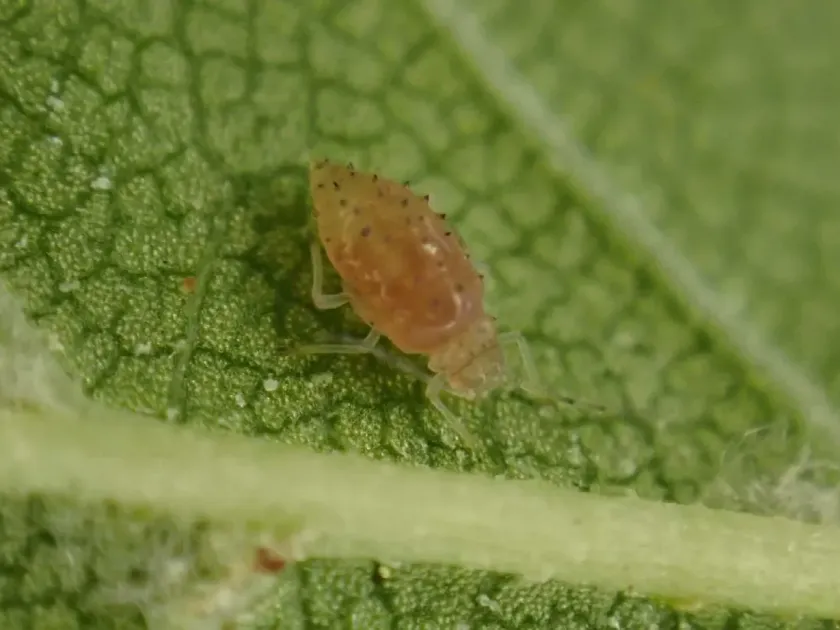
The elm aphid (Tinocallis saltans) is a small insect belonging to the family Aphididae, order Hemiptera. Adult individuals typically exhibit a yellow-green or brownish coloration, often marked with dark patterns on their bodies.
This species is a specialist pest that exclusively infests trees of the genus Ulmus. Unlike some more conspicuous aphids, it tends to dwell on the undersides of leaves, making early detection a significant challenge for arborists and gardeners.
Taxonomically, it is classified within the subfamily Drepanosiphinae. A key biological trait of this species is its high adaptability to varying environmental conditions, allowing it to maintain stable populations throughout the vegetative season.
The nymphs are highly mobile upon emergence from overwintering eggs. They quickly colonize young shoots and foliage to begin feeding, which contributes to the rapid expansion of the population within the canopy.
Due to their ability to reproduce parthenogenetically, a single founder female can establish a large colony in a very short time, which places substantial physiological stress on the host tree during the growing season.
What it damages
The primary hosts of the elm aphid are various species of elm trees. The damage is primarily caused by the aphids extracting phloem sap, which is vital for the tree's metabolic functions and overall health.
Heavy feeding inhibits photosynthesis and reduces the tree's vigor, leading to yellowing and premature leaf drop. This is particularly harmful to young trees or those already struggling with environmental stressors.
A secondary consequence of the infestation is the secretion of honeydew, a sugary substance that coats the leaves. This provides an ideal substrate for the growth of sooty mold, which blocks sunlight and interferes with gas exchange.
Chronic infestations over several years can result in stunted growth, increased susceptibility to secondary infections, and reduced cold hardiness, ultimately compromising the tree's long-term survival.
In urban landscapes, the honeydew secretion and the subsequent sooty mold growth create aesthetic and maintenance problems, necessitating proactive management of the aphid population.
When it appears
The life cycle of Tinocallis saltans is closely synchronized with the phenology of the elm tree. The pest overwinters in the egg stage, with eggs typically deposited in the crevices of bark on branches.
Nymphs emerge in spring, coinciding with bud burst. They immediately begin to feed on young, nutrient-rich tissues, quickly establishing the first generation of the season.
The population density peaks during mid-summer. During this period, warm temperatures facilitate rapid development cycles, allowing for exponential growth in the number of aphids inhabiting the tree canopy.
As day length decreases and temperatures drop in late summer and autumn, sexual forms are produced. After mating, females lay the overwintering eggs, ensuring the species survives until the following spring.
Climate plays a critical role in the population dynamics: hot and dry seasons often accelerate the life cycle, leading to massive outbreaks that can overwhelm the defensive capabilities of the host tree.
Signs of infestation
One of the earliest indicators of an elm aphid infestation is the presence of ants, which are attracted to the honeydew produced by the aphids and often actively defend the colony from natural predators.
Careful examination of the underside of leaves will reveal the presence of aphids and their cast-off skins. The leaves may feel sticky to the touch, and in advanced stages, they exhibit visible wilting or deformation.
The appearance of a dark, powdery film (sooty mold) on the surface of the leaves is a definitive sign of long-term aphid activity within the canopy.
- Leaf curling, twisting, or yellowing of the leaf margins.
- Early leaf senescence and premature leaf drop.
- Sticky branches and trunk surfaces with active ant trails.
- Black sooty mold accumulation on foliage.
Massive migration of winged aphids within the canopy, especially on hot days, is a clear sign that the colony has reached high density and is actively spreading to neighboring branches or trees.
Control measures
Effective management requires a combination of cultural practices and targeted interventions. It is essential to manage nitrogen fertilization, as excessive nitrogen promotes flush growth that is highly attractive to aphids.
Biological control plays an important role; protecting and encouraging natural enemies such as lady beetles, lacewings, and hoverflies can help suppress aphid populations naturally without the need for pesticides.
If population levels exceed an acceptable threshold, systemic or contact insecticides may be necessary. Products based on acetamiprid or similar active ingredients are effective when applied systematically.
Application timing is crucial; treatments should be performed before significant leaf deformation occurs, as the curled leaves protect the aphids from direct spray contact, making control more difficult.
Regular monitoring of urban elm trees allows for early detection, which enables localized treatment and minimizes the total chemical load on the environment, ensuring the long-term health of the ecosystem.
Taxonomy
- Latin name
- Tinocallis saltans
- Order
- Hemiptera (bugs, aphids, leafhoppers)
- Family
- Aphididae
- EPPO code
- TINCSA
Discussion
No discussions yet — be the first.