
Elm leaf aphid
Tinocallis platani
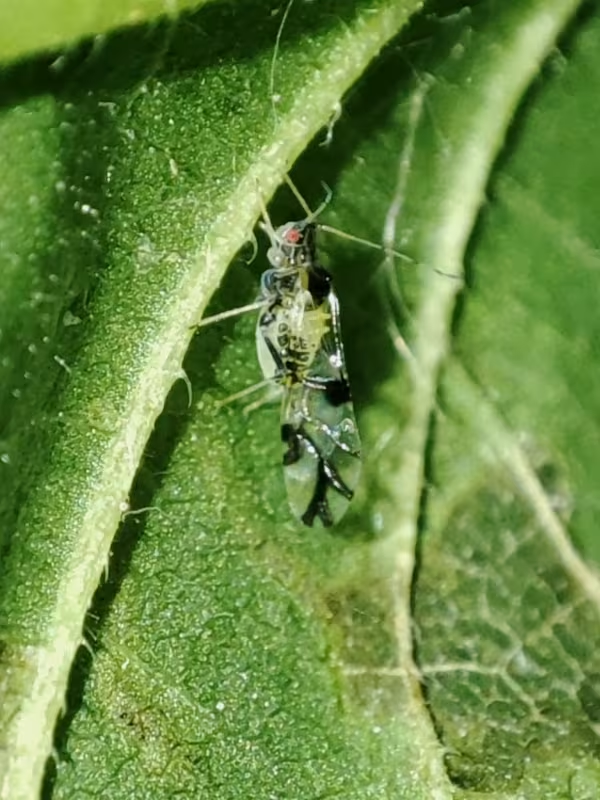
Description
How to identify
The elm leaf aphid (lat. Tinocallis platani) is a small insect belonging to the order Hemiptera and the family Aphididae. Adults typically exhibit a yellowish-green coloration, often marked with dark spots or bands on their bodies.
The body of an adult is elongated, measuring approximately 2 to 3 millimeters in length. Winged forms possess clear wings with distinct venation, which facilitates active movement within tree canopies.
Nymphs are similar in appearance to adults but are smaller in size and lack developed wings. They feed on plant sap while constantly moving across the underside of the leaf surface.
Accurate identification of this species often requires a magnifying glass, as specific features such as the structure of the antennae and cauda are essential for distinguishing it from other aphids. Colonies are frequently associated with ants that feed on the honeydew produced by the aphids.
These pests lead a relatively concealed life, preferring to colonize young shoots and the undersides of leaves, making them difficult to notice during a casual inspection of the tree.
What it damages
The primary host plants for this species are various members of the genus Ulmus. The pest often prefers weakened trees or young nursery plantings in urban environments, where the local microclimate supports rapid population growth.
The aphid feeds on plant sap by piercing the leaf epidermis with its specialized piercing-sucking mouthparts. This leads to significant physiological stress on the tree, especially during periods of heavy infestation.
Beyond the direct impact of sap extraction, the pest causes damage as a potential vector for various viral and mycoplasma-like diseases that affect woody plants.
Active feeding disrupts the photosynthesis process, resulting in stunted growth of young twigs and overall developmental delays. In severe cases, premature leaf drop occurs.
The aphid also encourages the growth of sooty mold, which thrives on the sticky honeydew excretions, further impeding gas exchange through the leaf stomata.
When it appears
Initial activity is observed in the spring immediately following the start of sap flow and bud break on elm trees. During this time, founder colonies are established, marking the beginning of the new season's population.
Peak population levels are typically reached in mid-summer, when environmental temperatures are optimal for the rapid reproductive cycles of the insect.
Multiple generations develop throughout the growing season. The high reproductive rate allows these colonies to spread quickly to new areas of the canopy and neighboring trees.
In autumn, sexual forms of the aphid produce eggs that are deposited into bark crevices on young shoots. The insect successfully overwinters in this egg stage.
The cycle restarts in the spring: nymphs hatch from the overwintering eggs and initiate a new generation, colonizing the newly emerged young foliage.
Signs of infestation
One of the most prominent signs of an infestation is the curling and distortion of young leaves. Leaf blades may turn yellow and show distinct spots where the insects have been feeding.
The presence of a shiny, sticky substance known as honeydew on the upper surface of leaves located below the colonies is a clear indication of a heavy aphid infestation.
Large numbers of ants moving actively along the trunk and branches serve as a reliable indicator that the tree is infested with sap-sucking insects.
Black sooty mold growth on leaves and branches is a secondary symptom, indicating that the aphid colony has been feeding on the tree for an extended period.
Upon closer inspection of the underside of the leaf, one can find numerous clusters of small insects that react to disturbance by moving rapidly or falling from the leaf surface.
Control measures
Management often involves the use of systemic insecticides, which are absorbed into the plant tissues, effectively making the sap toxic to the feeding aphids.
Pyrethroid-based products are often effective, though they should be applied judiciously to minimize negative impacts on beneficial entomophages such as lady beetles.
Biological control methods include encouraging natural predators like lacewings, syrphid fly larvae, and predatory bugs, which play a crucial role in suppressing aphid populations.
Cultural practices are essential for protection: regular watering and proper fertilization increase the overall vigor of elm trees, making them less susceptible to pest colonization.
- Frequent monitoring of the canopy throughout the spring and summer months.
- Sanitary pruning of infested shoots when early signs are detected.
- Application of insecticidal soap for localized treatment on young or ornamental trees.
Taxonomy
- Latin name
- Tinocallis platani
- Order
- Hemiptera (bugs, aphids, leafhoppers)
- Family
- Aphididae
- EPPO code
- TINCPL
Discussion
No discussions yet — be the first.