

Description
How to identify
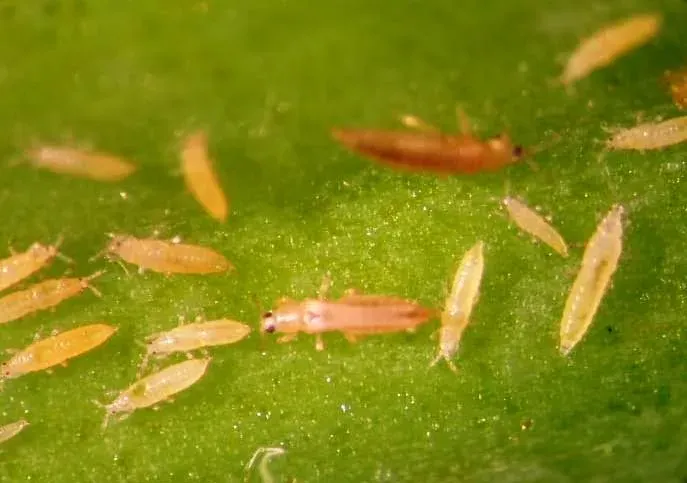
The onion thrips (Thrips tabaci) belongs to the order Thysanoptera and the family Thripidae. This tiny insect is approximately 1 mm long, featuring a narrow, slender body that ranges from yellow to light brown in color.
Adult thrips possess two pairs of wings with characteristic hair-like fringes, though their extremely small size and cryptic behavior make them difficult to spot without magnification.
Nymphs (larvae) resemble the adults in appearance but are wingless, smaller in size, and exhibit a paler, translucent yellowish coloration compared to the mature insects.
The life cycle encompasses several stages: egg, two larval instars, prepupa, pupa, and adult, with the pupal stages typically occurring in the soil rather than on the plant.
They overwinter as adults, finding shelter beneath plant debris, in the upper soil layers, or within onion bulbs stored in facilities with inadequate temperature controls.
What it damages
Onion thrips are highly polyphagous, attacking a wide range of agricultural and horticultural crops including onions, garlic, cucumbers, tomatoes, and various ornamental plants.
The primary economic damage occurs on onion crops, where the insects pierce leaf tissues and suck out the sap, resulting in significant loss of vigor and photosynthetic area.
In greenhouse environments, they can be particularly devastating to cucumber crops, reproducing rapidly and causing severe wilting and stunted development.
Beyond direct physical damage, thrips serve as critical vectors for plant viruses, most notably the Tomato Spotted Wilt Virus (TSWV), which poses a major threat to crop security.
Their high reproductive rate and mobility between host plants make onion thrips one of the most challenging pests to manage in both commercial and home garden settings.
When it appears
Activity begins in late spring, typically when temperatures consistently exceed 15-18 degrees Celsius, signaling the emergence of adults from their overwintering sites.
During a single growing season, thrips can complete several generations, with the speed of development accelerating significantly under warm, dry weather conditions.
Mid-summer is usually the period of peak infestation, as high temperatures facilitate rapid population growth and the colonization of neighboring plants.
Monitoring efforts should be intensified during these hot, dry spells, as the population can reach economic damage thresholds in a very short period.
As autumn approaches and temperatures drop, the adult thrips seek out protected habitats to enter diapause, effectively surviving until the following spring.
Signs of infestation
The earliest symptom of thrips infestation is the appearance of small, white to silvery streaks or patches on the leaves, which eventually coalesce into a mottled appearance.
As the infestation progresses, leaves show signs of yellowing from the tips downward, eventually drying out, curling, and dying, which negatively impacts bulb development.
Severe infestations lead to stunted growth and deformed bulbs, which not only reduces the overall yield but also lowers the storage quality of the harvested produce.
Small, dark, tar-like specks of excrement are often visible in the leaf axils and the center of the plant, serving as a clear indicator of active thrips presence.
Close inspection of the neck of the onion bulb and the tightly curled inner leaves is essential for early detection, as these are preferred feeding sites.
Control measures
Effective management begins with strict crop rotation and physical distance between new plantings and previous year's fields to minimize re-infestation.
Good sanitation practices, such as the removal and destruction of crop debris after harvest and deep plowing, help reduce the number of overwintering insects.
The use of blue or yellow sticky traps is recommended for early detection and for suppressing the population of adult thrips in the field or greenhouse.
Chemical control involves the application of appropriate insecticides, ensuring the rotation of chemical classes to prevent the development of resistance in the population.
- Implement systematic crop rotation.
- Remove alternative host weeds surrounding the fields.
- Use reflective mulches to deter thrips landing.
- Apply biological control agents like predatory mites.
- Monitor populations regularly with sticky traps.
Content graph
Connections · Onion thrips
Most often together:
Marketplace
Products · 1
Biology
Taxonomy
- Latin name
- Thrips alliorum
- Order
- Thrips
- Family
- Thripidae
- EPPO code
- TAETAL
Community
Discussion
No discussions yet — be the first.