
Thelaxes
Thelaxes
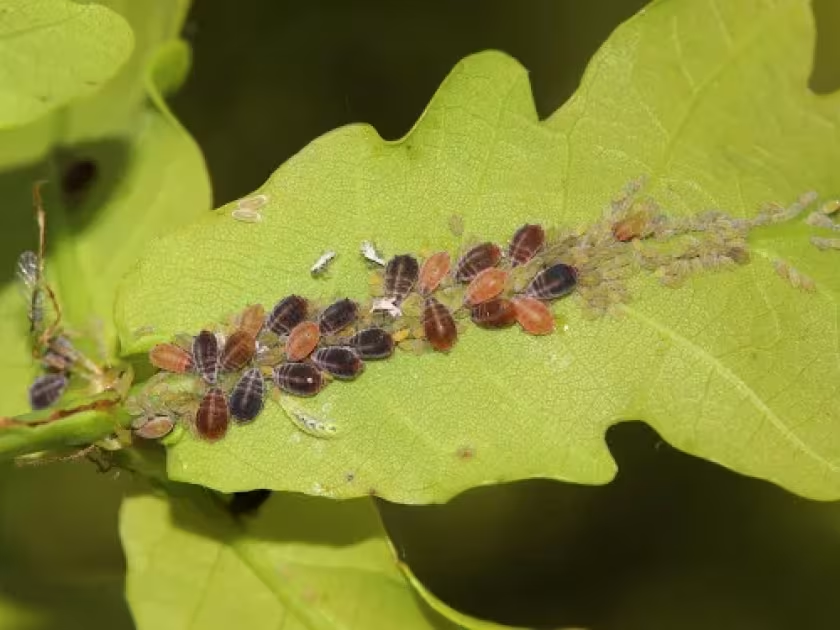
Description
How to identify
Thelaxes is a genus of aphids belonging to the family Thelaxidae. These insects are highly host-specific, having adapted to live on specific woody plants over millions of years.
Adults and nymphs possess morphology typical of the superfamily Aphidoidea, though they exhibit unique adaptations for anchoring themselves firmly to tree bark.
The body is often covered with a protective waxy secretion, which serves as a defensive barrier against environmental stress and natural predators.
The population consists of both apterous (wingless) and alate (winged) forms, which facilitates the rapid dispersal of the colony across the canopy.
Accurate identification is usually performed through microscopic examination of morphological traits, such as siphunculi structures and head characteristics.
What it damages
The primary hosts for Thelaxes dryophila and related species are trees within the genus Quercus (oak).
These pests prefer to congregate on young shoots, leaf petioles, and deep crevices in the bark, where they can easily access phloem sap.
While oak is the main host, certain species may inhabit other deciduous broad-leaved trees depending on the regional ecological distribution.
The damage is caused by the continuous extraction of plant fluids, which weakens the host tree and makes it susceptible to secondary stressors.
Heavy infestations lead to leaf senescence, stunted growth, and in severe cases, the dieback of small twigs on young trees.
When it appears
The life cycle begins in early spring when nymphs hatch from overwintering eggs deposited in the bark crevices of the host tree.
The population peaks in late spring and early summer, corresponding with the tree's most active growth phase and high sap flow.
Throughout the season, they produce multiple generations, with development rates being highly dependent on ambient temperature conditions.
As autumn approaches, the production of sexual forms occurs, leading to mating and the deposition of hardy eggs that will survive the winter.
Warmer winter temperatures significantly improve egg survival, often leading to increased pest pressure during the following spring season.
Signs of infestation
The first signs of infestation include the curling and distortion of young leaves, which may also show signs of chlorosis or wilting.
The presence of honeydew on leaf surfaces is a clear indicator of aphid feeding activity, as it creates a sticky, sugary residue on the foliage.
Sooty mold frequently colonizes the honeydew, resulting in a black, powdery coating on leaves that hinders the plant's ability to perform photosynthesis.
Closer inspection of branches reveals dense clusters of aphids, which appear as grayish or brownish masses camouflaged against the tree bark.
Increased ant activity on the tree trunk is often a reliable signal, as ants tend the aphids to collect the nutrient-rich honeydew secretions.
Control measures
Management often involves the application of systemic insecticides, which are translocated throughout the plant and target the feeding pests directly.
Sanitary pruning, which involves removing the most heavily infested branches, can significantly reduce the initial population size during the season.
Controlling ant populations is also essential, as ants physically protect aphids from natural predators like lady beetles and lacewing larvae.
Biological control strategies, including the conservation of beneficial insect populations, provide a sustainable way to manage outbreaks.
- Application of systemic insecticides during active growth.
- Sanitary pruning of infested shoots and branches.
- Promoting a healthy ecosystem for natural predator populations.
Taxonomy
- Latin name
- Thelaxes
- Order
- Hemiptera (bugs, aphids, leafhoppers)
- Family
- Aphididae
- EPPO code
- THLXSP
Discussion
No discussions yet — be the first.