
Poplar leaf-folder aphid
Thecabius populi-monilis
Description
How to identify
The poplar leaf-folder aphid (Thecabius populi-monilis) is a small sap-sucking insect of the family Aphididae that creates distinct leaf galls on poplar trees.
The species exhibits a complex host-alternating life cycle, typical for many gall-forming aphids, involving both poplar trees and members of the Ranunculaceae family.
Adult aphids and their nymphs possess specialized mouthparts used to pierce leaf tissues, inducing local abnormal growth that forms protective galls.
The body coloration of these insects is typically greenish or pale yellow, which serves as camouflage within the confined environment of the gall.
The species survives the winter stage as eggs deposited in protected crevices of the poplar bark near buds, ensuring survival through harsh weather.
What it damages
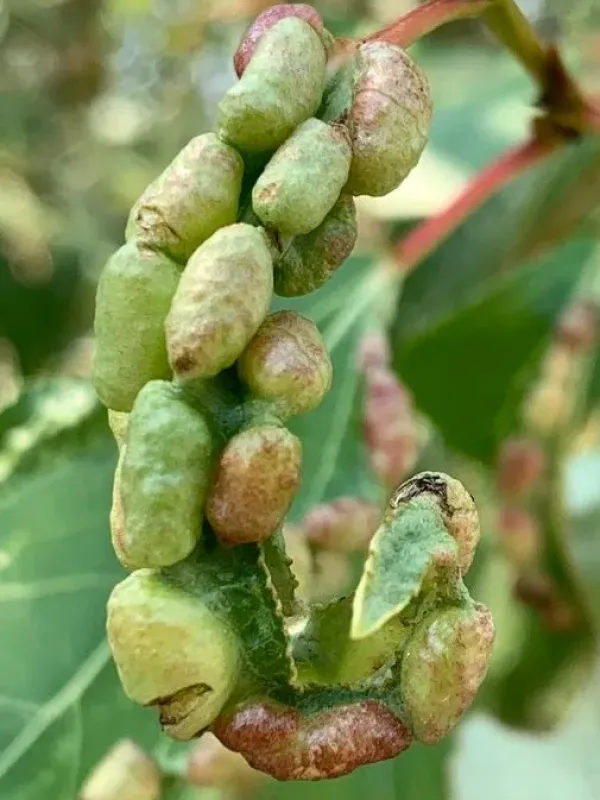
The primary hosts for this pest are poplar species, such as Populus balsamifera, where they form chains of bead-like galls along the leaf margins.
In nursery settings, high population densities can lead to significant stunting of young seedlings and diminished aesthetic value of the plantings.
Secondary damage occurs due to the loss of photosynthetic efficiency as the leaf area is severely deformed and damaged by the aphid's continuous feeding.
Summer migration to herbaceous hosts allows the population to survive when poplar leaves become less suitable for colonization.
Severe infestations can cause premature leaf senescence and leaf drop, leading to the overall physiological weakening of the host tree.
When it appears
Development begins in early spring as soon as leaf buds open, with the fundatrix generation starting the formation of the first galls.
The peak activity period occurs in late spring and early summer when the aphids multiply rapidly inside the protective gall structures.
Mid-summer is marked by the appearance of winged migrants that move away from the poplar trees to find secondary host plants.
As autumn approaches, the cycle completes with the return of sexual forms to the poplar, where mating and egg-laying occur.
The timing of these seasonal events is heavily dependent on local climatic conditions, specifically heat unit accumulation during early spring.
Signs of infestation
The most diagnostic sign of an infestation is the presence of marginal leaf galls, often described as a series of bead-like or rolled leaf folds.
- Thickened and discolored leaf margins along the primary veins.
- Rolled-up leaf edges forming capsule-like protective pockets.
- Presence of honeydew deposits on the leaf surface, leading to sooty mold growth.
- Wilting of terminal leaves in young trees during peak summer heat.
- Premature yellowing of foliage in mid-summer following heavy infestation.
Control measures
Cultural control involves pruning and disposing of infested shoots before the aphids emerge or migrate to their secondary hosts.
Chemical control is most effective when applied at the bud-break stage, targeting the stem mothers before the galls have fully closed.
Natural biological control agents, including coccinellids and syrphid fly larvae, play a crucial role in suppressing aphid populations.
In landscape management, regular monitoring during the early growing season is vital for preventing widespread damage across tree stands.
Maintaining vigorous tree health through appropriate watering and soil management can help trees better tolerate aphid-related stress.
Taxonomy
- Latin name
- Thecabius populi-monilis
- Order
- Hemiptera (bugs, aphids, leafhoppers)
- Family
- Aphididae
- EPPO code
- THEAPM
Discussion
No discussions yet — be the first.