
Poplar-woodrush aphid
Thecabius auriculae
Description
How to identify
The poplar-woodrush aphid (Thecabius auriculae) belongs to the family Aphididae, order Hemiptera. It is a highly specialized species with a complex lifecycle that involves migrating between different host plants.
Adults possess morphology adapted for sap-feeding. The body is typically oval-shaped, with colors ranging from pale green to yellowish-brown, often covered with a fine waxy secretion.
Nymphs resemble the adults but are smaller in size. They undergo several molts during their development, gradually increasing in size and changing their color intensity accordingly.
The species produces both winged and wingless forms depending on the generation. Winged individuals are crucial for migration and dispersion between primary and secondary hosts.
These aphids are cryptic, forming specific leaf galls on poplar trees which act as a defensive barrier against environmental stressors and potential predators.
What it damages
The primary host is the poplar tree (Populus), particularly the balsam poplar. Secondary hosts include plants from the Juncaceae family, most notably woodrush (Luzula species).
On poplar, the aphid induces the formation of leaf galls. This deformation disrupts the leaf structure, significantly hindering photosynthesis and normal gas exchange.
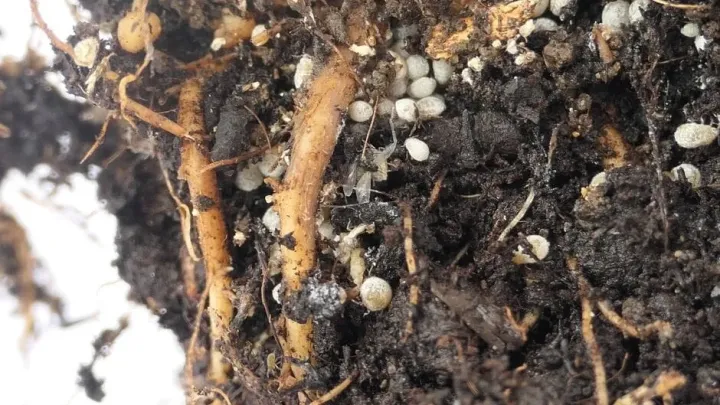
On the secondary host (woodrush), the aphid feeds at the base of the stems or the root collar. This saps the plant's vitality, leading to weakness and stunted growth.
Heavy infestations on poplar trees often cause premature leaf drop, which stresses the tree and increases its susceptibility to secondary pathogens and other pests.
In urban landscapes and ornamental plantings, the aesthetic value of poplars is severely degraded due to distorted foliage and early defoliation during the summer.
When it appears
The species overwinters as eggs located in the cracks and crevices of the poplar tree bark. In early spring, during bud break, the stem mothers hatch from these eggs.
During late spring and early summer, the aphid generations develop on poplar, forming galls. This is the period when the pest is most visible and damaging to the tree.
In mid-summer, winged migrants leave the poplar and move to woodrush plants, where they continue their development on the roots and lower stems until the end of the season.
As autumn approaches, a reverse migration occurs, with the sexual forms returning to the poplar to lay the overwintering eggs, thereby completing the annual cycle.
Environmental conditions, particularly spring temperature and humidity, are critical factors that determine the success of egg hatching and subsequent population size.
Signs of infestation
The most prominent sign is the curling and distortion of poplar leaves. These galls appear as thick, yellowish or light green swellings on the leaf blade.
Opening these galls reveals colonies of tiny aphids, often surrounded by white, woolly waxy secretions which are characteristic of this specific aphid species.
Infested woodrush plants show signs of yellowing or wilting at the base, and close inspection of the root collar often reveals aphid clusters and potential sooty mold growth.
Massive leaf drop on poplar trees in mid-summer, in the absence of drought stress, is a strong indicator of a significant infestation by this aphid.
The presence of ants patrolling the bark of poplar trees is often a secondary indicator, as ants tend these aphids to feed on their nutrient-rich honeydew secretions.
Control measures
The use of systemic insecticides is highly effective, as these chemicals move into the leaf tissues and target the aphids protected inside the galls.
Applications should be timed precisely to target the period when stem mothers hatch, before they have successfully formed the protective leaf galls.
Sanitation through pruning and removing heavily infested branches can help reduce the local population density in young or ornamental poplar stands.
Managing the surrounding vegetation by reducing woodrush plants near poplar groves can help break the lifecycle and minimize the risk of re-infestation.
Promoting the presence of natural enemies, such as lady beetles, lacewings, and hoverflies, is a recommended biological control strategy to keep populations in check.
Taxonomy
- Latin name
- Thecabius auriculae
- Order
- Hemiptera (bugs, aphids, leafhoppers)
- Family
- Aphididae
- EPPO code
- PEMPAU
Discussion
No discussions yet — be the first.