
Avocado whitefly
Tetraleurodes perseae
Description
How to identify
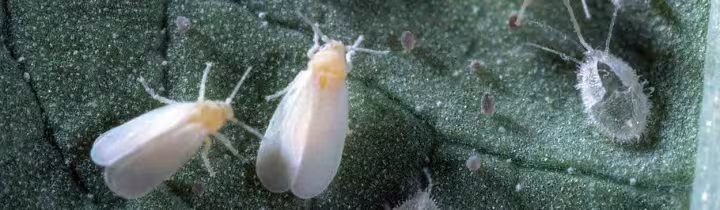
The avocado whitefly, Tetraleurodes perseae, is a member of the Hemiptera order and Aleyrodidae family. Adult insects are minute, featuring white wings covered with a waxy powder that provides excellent camouflage against green foliage.
The life cycle encompasses eggs, four nymphal stages, and the adult phase. Nymphs are characterized by their sedentary nature, firmly attaching themselves to leaves and developing a protective, dark-colored waxy shield.
This species is a specialist pest, primarily thriving on plants within the Lauraceae family. Its population dynamics are heavily influenced by local temperature and relative humidity patterns.
Due to their small size, identifying the species often requires the use of magnification tools, especially when inspecting for the dark, flattened scales of the nymphs on the leaf undersides.
Biological resilience makes this whitefly a challenging pest, capable of adapting to various tropical and subtropical growing conditions throughout the year.
What it damages
The primary host for this pest is the avocado tree (Persea americana). It damages the plant by extracting phloem sap, which deprives the tree of essential nutrients and weakens its physiological state.
Feeding activities cause chlorosis in leaves, where localized yellowing occurs at the puncture sites. This disruption limits the photosynthetic efficiency of the plant, stunting overall growth.
The accumulation of honeydew secreted by larvae promotes the growth of sooty mold, which covers the foliage in a dense black layer, further inhibiting photosynthesis and gas exchange.
Severe infestations can lead to premature leaf drop and fruit damage, significantly reducing marketability and total yield in both commercial orchards and nurseries.
Persistent feeding stress renders the trees more susceptible to secondary infections and environmental stressors, leading to long-term decline in vigor.
Signs of infestation
The earliest symptom is the presence of yellowish spots on the upper leaf surface, which correspond directly to the feeding sites of nymphs located on the underside of the leaf.
The presence of a sticky, shiny substance on the leaves, followed by the appearance of a black sooty mold coating, is a clear indicator of a whitefly outbreak.
Careful inspection of the leaf undersides will reveal dark, flattened nymphs that remain stationary, indicating an established infestation within the canopy.
Disturbing the branches results in a visible "cloud" of small white adults rising into the air, which signifies a high density of the pest population.
General lack of growth or deformation of young shoots is often associated with heavy feeding pressure from these insects during the active growing season.
Control measures
Biological control through the release of beneficial insects, such as parasitic wasps and predatory beetles, is a highly effective long-term management strategy.
Chemical control can be achieved using horticultural oils or specialized insecticides that penetrate the waxy protective shield of the nymphs, ensuring direct contact and mortality.
Pruning trees to improve air circulation within the canopy and ensure proper light penetration creates a less favorable environment for whitefly development.
Yellow sticky traps are essential for monitoring adult populations, allowing growers to time their interventions before the infestation reaches a critical threshold.
- Regular monitoring of the canopy for early detection.
- Cleaning pruning equipment to prevent cross-contamination.
- Quarantine procedures for new nursery stock to avoid introducing the pest to clean areas.
Taxonomy
- Latin name
- Tetraleurodes perseae
- Order
- Hemiptera (bugs, aphids, leafhoppers)
- Family
- Aleyrodidae
- EPPO code
- TETLPE
Discussion
No discussions yet — be the first.