
Mulberry whitefly
Tetraleurodes mori
Description
How to identify
The mulberry whitefly (Tetraleurodes mori) is a small insect belonging to the family Aleyrodidae. Adult insects are about 2-3 mm long, resembling tiny white moths, with wings covered in a powdery, wax-like secretion that gives them their characteristic appearance.
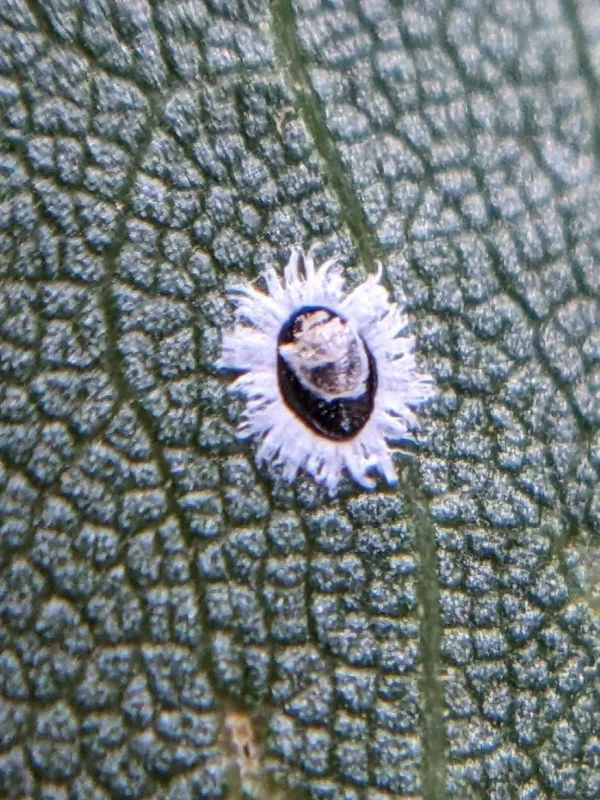
The larval stages are sedentary, oval-shaped, and flattened, often matching the color of the host leaf. As they develop into the pupal stage, they turn black, surrounded by a distinct white wax fringe, which serves as a definitive characteristic for field identification.
The life cycle begins with the eggs laid on the underside of leaves. After hatching, the nymphs go through several instars before transitioning into the pupal stage. The entire development cycle is heavily influenced by ambient temperature and humidity.
The species is capable of completing multiple generations within a single growing season in warm climates. Overwintering occurs primarily as late-stage nymphs or pupae, securely attached to the leaves of evergreen hosts or sheltered areas of deciduous trees.
Populations can grow rapidly under favorable conditions, such as high humidity and lack of heavy rainfall, which allows the nymphs to establish dense colonies across the surface of the foliage.
What it damages
The mulberry whitefly is a polyphagous pest, meaning it feeds on a wide range of plant species. While the mulberry tree is a primary host, it also heavily infests citrus trees, persimmons, laurels, and various landscape shrubs.
Damage is caused by both adults and nymphs piercing the leaf tissue and extracting plant sap. This process saps the plant's vitality, leading to stunted growth, yellowing of leaves, and a general decline in the overall vigor of the host plant.
Like many whiteflies, this species excretes honeydew, a sticky substance that coats the leaves. This honeydew serves as a growth medium for sooty mold, a fungus that covers the foliage in a black layer, obstructing photosynthesis.
Severe infestations lead to leaf senescence and premature defoliation, which can weaken the tree significantly. This makes the affected plants much more susceptible to secondary attacks by other pests, environmental stresses, or disease pathogens.
In ornamental plants and fruit trees, the aesthetic and commercial value is drastically reduced due to the presence of black mold and the visible white wax deposits left behind by the insect populations.
Control measures
Effective management of the mulberry whitefly requires an integrated pest management (IPM) approach. Regular monitoring is essential, specifically focusing on the undersides of leaves, which are the primary feeding sites for nymphs.
Yellow sticky traps are a highly effective tool for detecting the arrival of adult whiteflies and monitoring population spikes. By tracking the population density, growers can time their insecticide applications to coincide with the most vulnerable stages of the pest.
Cultural practices are critical, including maintaining proper plant health and practicing regular pruning. Thinning out the canopy improves air circulation and light penetration, creating an environment that is less conducive to whitefly development.
Chemical control often involves the use of systemic insecticides that are translocated through the plant's vascular system. It is vital to ensure thorough coverage, especially on the undersides of the leaves, to reach the nymphs.
- Utilizing biological control agents such as parasitic wasps (Encarsia spp.).
- Applying horticultural oils or insecticidal soaps to suffocate the nymphs.
- Removing and destroying heavily infested plant parts to reduce the inoculum.
- Avoiding excessive nitrogen fertilization to limit the growth of soft, susceptible shoots.
Taxonomy
- Latin name
- Tetraleurodes mori
- Order
- Hemiptera (bugs, aphids, leafhoppers)
- Family
- Aleyrodidae
- EPPO code
- TETLMO
Discussion
No discussions yet — be the first.