
Tetraleurodes
Tetraleurodes
Description
How to identify
Tetraleurodes belongs to the whitefly family (Aleyrodidae) of the order Hemiptera. These are tiny insects whose adults externally resemble minute white moths, although members of this genus often have darker puparia (the final larval stage).
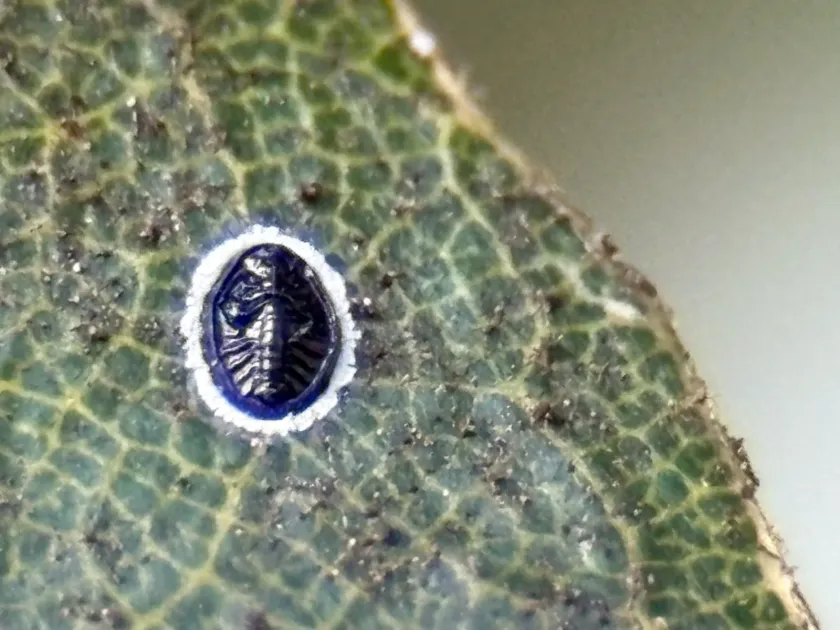
The primary diagnostic feature of the species is the shape and color of the puparium. In Tetraleurodes, it is typically circular or oval, dark (almost black) in color, with a characteristic light-colored fringe along the edges, composed of wax filaments.
The life cycle includes egg, larval (three instars), puparial, and adult stages. Females lay eggs on the undersides of leaf blades, attaching them to the plant tissue with a short stalk.
Adults possess two pairs of wings covered in a white, powdery wax. Unlike the common greenhouse whitefly, Tetraleurodes often leads a more hidden lifestyle, congregating on the undersides of leaves.
Accurate species identification requires the use of a magnifying glass or microscope to examine the structure of the marginal fringe and the shape of the puparial breathing holes, which is essential for choosing a precise management strategy.
What it damages
This pest attacks a wide range of ornamental, vegetable, and fruit crops. It is particularly common on citrus trees, various woody plants, and greenhouse flowers.
Both larvae and adults feed on plant sap by piercing the leaf epidermis. Constant suction of nutrients leads to plant exhaustion, shoot deformation, and premature leaf drop.
During feeding, whiteflies excrete copious amounts of sticky honeydew. Sooty molds actively develop on these sticky excretions, covering the leaf surfaces with a black, fungal layer.
The black layer hinders normal photosynthesis, significantly slowing plant growth and reducing productivity. Severe infestations can lead to a total loss of commercial crop value.
In addition to direct damage, Tetraleurodes can act as a vector for various plant viruses. Even a small population of the pest can become a source of dangerous pathogen contamination for an entire greenhouse block or orchard.
When it appears
The activity of Tetraleurodes is directly dependent on temperature. In greenhouses or warm climates, reproduction can occur year-round without entering diapause.
Population peaks usually occur during warm periods with high air humidity. In greenhouses, outbreaks are often observed in the spring and summer when temperatures rise above 20-25 degrees Celsius.
The life cycle speed varies significantly depending on the temperature. In hot months, one generation can develop in less than 3 weeks, leading to an exponential increase in population size.
In winter, as temperatures drop, development slows down, although surviving individuals continue to feed slowly. Puparia are highly resistant to adverse environmental conditions.
In the field, the pest is more active in the second half of summer when average daily temperatures reach optimal values for the insect's accelerated metabolism.
Signs of infestation
The first sign of infestation is the appearance of tiny white or dark insects on the underside of leaves when shoots are shaken. Adults will immediately begin to fly actively.
The presence of a sticky, shiny layer on leaves is a certain signal of a colony's presence. This layer attracts ants, which can indirectly indicate the location of the pest.
Leaves of infested plants begin to yellow, curl, and develop spots. Gradually, chlorosis symptoms appear, which is associated with metabolic disruption in plant tissues.
The development of a black fungal layer (sooty mold) gives leaves a messy, "dirty" appearance. This impedes plant respiration and reduces its resistance to other diseases.
Upon close inspection of the leaf's underside, one can notice stationary, dark, flat formations—the puparia. These are the life stages most resistant to external treatments.
Control measures
Controlling Tetraleurodes requires an integrated approach that combines agrotechnical, biological, and chemical methods.
- Regular plant inspections and the removal of heavily infested leaves.
- The use of yellow sticky traps for monitoring and trapping adult specimens.
- Application of biopesticides based on entomopathogenic fungi (e.g., Beauveria bassiana).
- Treatment with systemic insecticides in case of mass reproduction.
- Maintaining optimal humidity and proper ventilation to create unfavorable conditions for the pest.
Chemical protection must be carried out taking into account the insect's developmental stage. While products targeting both adults and larvae are effective, puparia remain the most difficult life stage to eliminate.
It is important to rotate products from different chemical groups to prevent the development of resistance within the pest population. Treatments should be repeated at intervals corresponding to the development period of one generation.
Biological control using natural enemies, such as parasitic wasps (e.g., Encarsia species), has shown high effectiveness in greenhouse environments.
Taxonomy
- Latin name
- Tetraleurodes
- Order
- Hemiptera (bugs, aphids, leafhoppers)
- Family
- Aleyrodidae
- EPPO code
- TETLSP
Discussion
No discussions yet — be the first.