
Dark flour beetle
Tenebrio obscurus
Description
How to identify
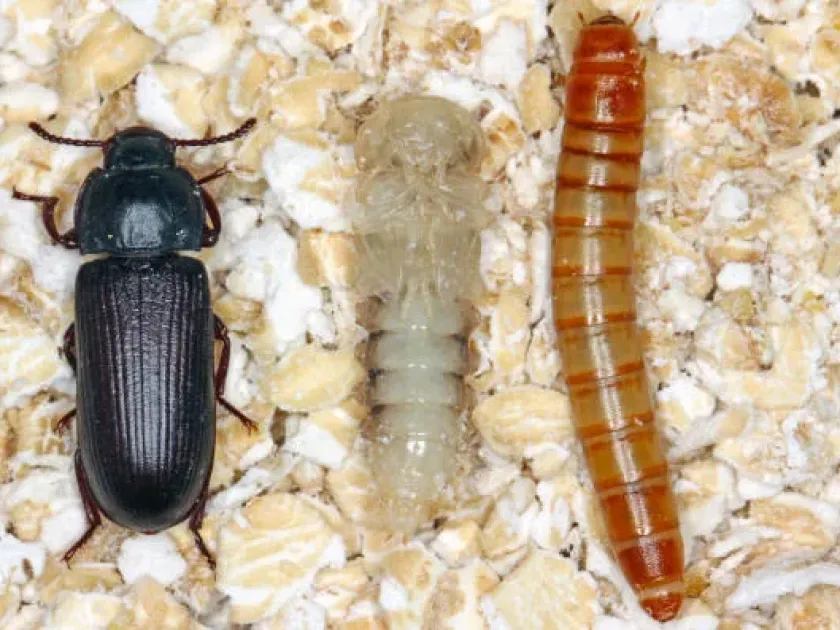
The dark flour beetle Tenebrio obscurus is a species of the Tenebrionidae family. Adults are dark brown to black, typically reaching lengths of 15 to 18 mm.
Larvae are elongated, cylindrical, and yellowish-brown in color, reaching up to 25 mm in length. They are highly mobile and have tough, chitinous body coverings.
Adult beetles are cryptic and prefer dark, secluded environments. They are well-adapted to surviving in the crevices of storage facilities and grain processing plants.
The lifecycle includes egg, larva, pupa, and adult stages. Development duration depends heavily on ambient temperature and food source accessibility.
These beetles exhibit high resistance to fluctuating environmental conditions, making them a persistent threat to agricultural warehouses and grain storage centers.
What it damages
This beetle is a significant pest of stored cereals, including wheat, oats, barley, and rice. It also infests flour, processed cereals, and dried fruits.
The larvae feed on the grain kernels, often focusing on the germ, which impacts the nutritional value and viability of the seeds. This leads to substantial product loss.
Infestation is characterized by the presence of frass, larvae skins, and dead insects, which contaminate the food supply and lower its quality standards.
The odor produced by the beetles and the presence of their byproducts make the infested grain unacceptable for food consumption and industrial processing.
Furthermore, their activity can promote the growth of mold and moisture accumulation, which causes localized heating of the grain mass in the store.
When it appears
In temperature-controlled storage facilities, the lifecycle of the dark flour beetle continues year-round without significant interruptions.
In unheated environments, development slows down during winter months, though larvae are capable of surviving in the grain bulk for extended periods.
The peak activity period typically occurs during warmer months when internal storage temperatures rise, facilitating faster reproduction and larval growth.
Generations of the beetle often overlap, meaning that eggs, larvae, and adults are frequently present in the grain at the same time, complicating pest management.
The female beetle can lay hundreds of eggs throughout her lifespan, which are usually deposited in cracks, crevices, or directly within the food source.
Signs of infestation
A primary indicator of infestation is a distinct, unpleasant odor caused by the insects' secretions. The grain mass may also show signs of uneven heating.
Visible signs include a fine, floury powder on the surface of the grain, caused by the fragmentation of kernels during feeding by the larvae.
Examination of cracks and warehouse equipment often reveals shed larval skins, confirming the presence and established population of the pest.
Flashlight inspections conducted at night can reveal adult beetles, as they move along the surfaces of bags and storage bins to forage for food.
- Musty odor in the storage area.
- Localized heating in grain piles.
- Accumulation of larval skins and insect fragments.
- Presence of flour dust at the base of storage structures.
Control measures
Rigorous warehouse sanitation is the primary defense. All machinery, floors, and corners must be thoroughly cleaned of grain dust and debris regularly.
Effective management includes moisture control; keeping grain moisture below 14% significantly hinders the survival and reproduction rate of the beetle.
In cases of heavy infestation, fumigation of the grain mass using registered chemical agents is necessary to eliminate all life stages of the insect.
The use of pheromone traps serves as an effective early warning system, allowing for targeted intervention before the infestation becomes widespread.
Empty storage facilities should undergo professional cleaning and aerosol disinfection to prevent the persistence of the pest between harvest cycles.
Taxonomy
- Latin name
- Tenebrio obscurus
- Order
- Coleoptera (beetles)
- Family
- Tenebrionidae
- EPPO code
- TENBOB
Discussion
No discussions yet — be the first.