
Castor leaf miner
Stomphastis plectica
Description
How to identify
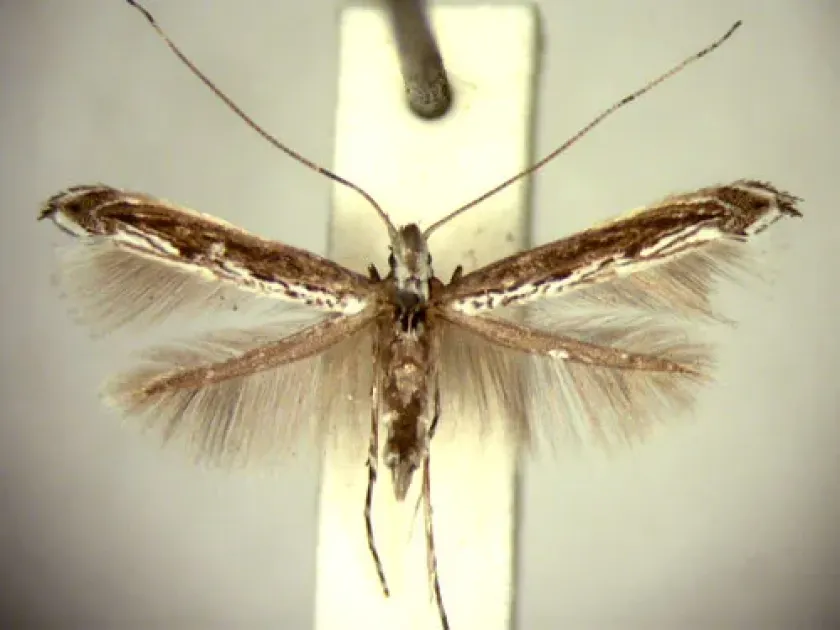
The castor leaf miner (Stomphastis plectica) belongs to the Gracillariidae family of moths. These are small insects whose adult stage is characterized by narrow, intricately patterned wings, providing excellent camouflage against the foliage of host plants.
The larvae of this species undergo several developmental stages, each significantly impacting the physiological state of the host. Adult moths are primarily nocturnal, making them difficult to detect during standard daytime scouting operations.
The life cycle is highly dependent on regional climate and host availability. In tropical environments, the species can breed continuously, resulting in overlapping generations throughout the entire growing season of the castor bean plant.
Pupation typically occurs either within the leaf mines or on the surface of the soil, depending on the microclimate. The presence of pupal cocoons on leaves is a critical observation point for field agronomists assessing infestation levels.
Precise identification requires morphological examination of adult genitalia or molecular analysis. This is essential to distinguish Stomphastis plectica from other related micro-lepidoptera found in similar agricultural ecosystems.
What it damages
The primary host for this pest is the castor bean (Ricinus communis). The damage is caused by the larval stage, which feeds exclusively on the internal tissues (mesophyll) of the leaves, sparing the epidermal layers.
This feeding behavior creates characteristic "mines" that disrupt the photosynthetic efficiency of the plant. As a result, the plant's metabolic processes are impaired, leading to stunted growth and reduced vigor during critical development phases.
Heavy infestations often lead to premature leaf drop, which is particularly detrimental during the seed-filling stage. This significantly reduces both the yield quantity and the oil content quality of the castor crop.
Damage to the leaf structure often causes the leaves to curl, yellow, and eventually die. The cumulative stress from continuous leaf loss significantly weakens the plant, making it more susceptible to environmental stressors like drought.
The economic impact is most severe when infestation occurs at the seedling or early vegetative stage. Protecting early-season foliage is crucial to ensure the plant establishes enough biomass to support successful seed production.
Signs of infestation
The most visible symptom is the development of light-colored, serpentine mines on the leaf surface. These trails gradually expand as the larva grows, eventually turning into necrotic brown patches that cover large portions of the leaf.
Inside these mines, one can observe larval frass, appearing as fine dark granular deposits. The presence of this frass is a reliable way to differentiate leaf miner damage from localized fungal pathogens or abiotic stress.
Upon closer inspection, particularly on the underside of the leaf, small exit holes are visible, indicating where the larva emerged to pupate or move to another site. Infected leaves often lose their green pigmentation and become brittle.
Under direct sunlight, the mined areas appear silvery or translucent because the air-filled space between the epidermis layers reflects light differently than healthy leaf tissue.
- Characteristic winding silver or white trails on leaves.
- Brown necrotic lesions resulting from merged mines.
- Premature leaf senescence and wilting.
- Visible tiny exit pores on the leaf blades.
Control measures
Cultural control is the first line of defense: clearing and burning crop residues after harvest is essential to break the life cycle and destroy overwintering pupae. Deep tillage helps bury and eliminate residual populations from the soil.
Biological control methods include the application of Bacillus thuringiensis (Bt) based formulations, which are highly effective against younger larval stages while preserving natural predatory populations.
Chemical control should be implemented using systemic insecticides upon reaching the economic threshold. Rotational use of different pesticide classes is mandatory to prevent the development of resistance within local pest populations.
Integrated Pest Management (IPM) programs rely on pheromone traps to monitor adult moth activity. By timing treatments to coincide with peak moth flights, growers can significantly reduce the total number of insecticide applications.
Routine monitoring of plot borders is recommended to identify focal points of infestation. Spot-treating these areas before the pest spreads across the entire field is a cost-effective strategy for large-scale castor production.
Taxonomy
- Latin name
- Stomphastis plectica
- Order
- Lepidoptera (butterflies)
- Family
- Gracillariidae
- EPPO code
- STSTPL
Discussion
No discussions yet — be the first.