
Stegodyphus
Stegodyphus
Description
How to identify
Stegodyphus is a genus of spiders belonging to the family Eresidae. They are known as social spiders that build large, communal nests made of silk, often encompassing branches and foliage.
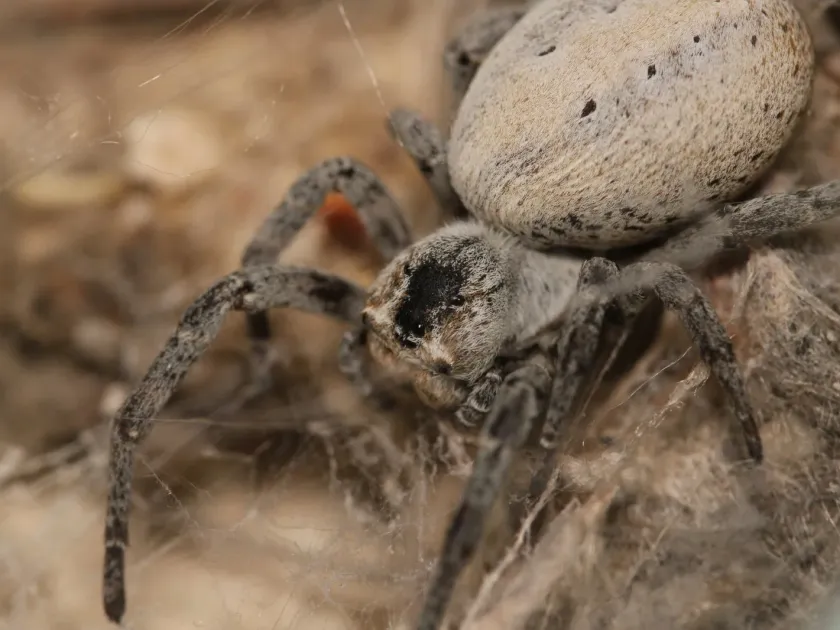
Physically, they have stout, hairy bodies that give them a velvet-like appearance. Their coloration ranges from gray to brown and black, allowing them to blend into their silk nests.
A defining characteristic is their social behavior. Unlike most solitary spiders, they live in large colonies, cooperating in hunting and brood care, which makes their nests highly visible.
The size of individuals varies by sex and age, with females generally being larger. They possess strong chelicerae capable of subduing a wide variety of insect prey.
They prefer arid or semi-arid regions where their nests can expand to cover significant portions of vegetation, often creating large structures on shrubs and trees.
What it damages
Stegodyphus spiders do not feed on plant tissues directly; however, their presence can cause significant physical damage to agricultural crops and ornamental plants.
The primary issue is the creation of dense, massive silk nests that wrap around young shoots, leaves, and flowers, preventing normal growth and development.
This heavy webbing restricts photosynthesis by covering the foliage, preventing it from receiving adequate sunlight and air circulation, which leads to leaf chlorosis or wilting.
From an agricultural standpoint, these spiders affect the aesthetic value of ornamental plants and can interfere with routine maintenance and pruning operations.
Large colonies may inadvertently attract other secondary pests or pathogens that find shelter within the silk structure, causing indirect harm to the plant host.
When it appears
The activity of Stegodyphus spiders is closely linked to regional temperature and humidity levels, with most activity occurring during warmer months.
During the active season, colonies expand rapidly as the spiders build new sections of their communal nest to accommodate the growing population.
In arid environments, these colonies can persist for long periods, slowly increasing in volume as they integrate more plant material into their webs.
Their life cycle involves egg-laying within the protected interior of the nest, which ensures high survival rates for offspring even in harsh external conditions.
Colonies can persist across multiple generations, making early detection and removal of budding nests essential for maintaining control.
Signs of infestation
The most prominent sign of a Stegodyphus infestation is the presence of large, messy, grayish-white silk webs draped over branches or shrubs.
If you observe dense silk tunnels or chambers tightly enclosing terminal buds or leaf petioles, it indicates that a colony has established itself.
The presence of insect exoskeletons and prey remains accumulated near or inside the webbing is a clear indicator of active feeding by the colony.
Stunted shoot growth or deformation of foliage trapped within the web are visible signs that the plant is struggling due to the physical obstruction.
During peak activity, you may observe clusters of spiders moving on the surface of the web, especially when disturbed or during specific light conditions.
Control measures
The most effective management strategy is the physical removal of the silk nests along with the spider colony to clear the host plant.
Pruning of infested shoots is highly recommended if they are heavily tangled or deformed, as this encourages the plant to recover and produce new, clean growth.
Standard chemical insecticides are often ineffective against Stegodyphus because the dense, layered structure of their silk nests acts as a physical shield against contact sprays.
As a preventive measure, maintaining open plant crowns through proper pruning and thinning improves air circulation and light penetration, making the plant less appealing to spiders.
Biological control through natural predators exists, but utilizing these strategies requires a deep understanding of the local ecosystem to avoid disrupting beneficial insect populations.
Taxonomy
- Latin name
- Stegodyphus
- Family
- Eresidae
- EPPO code
- STGDSP
Discussion
No discussions yet — be the first.