
Ladybird spider
Eresus niger
Description
How to identify
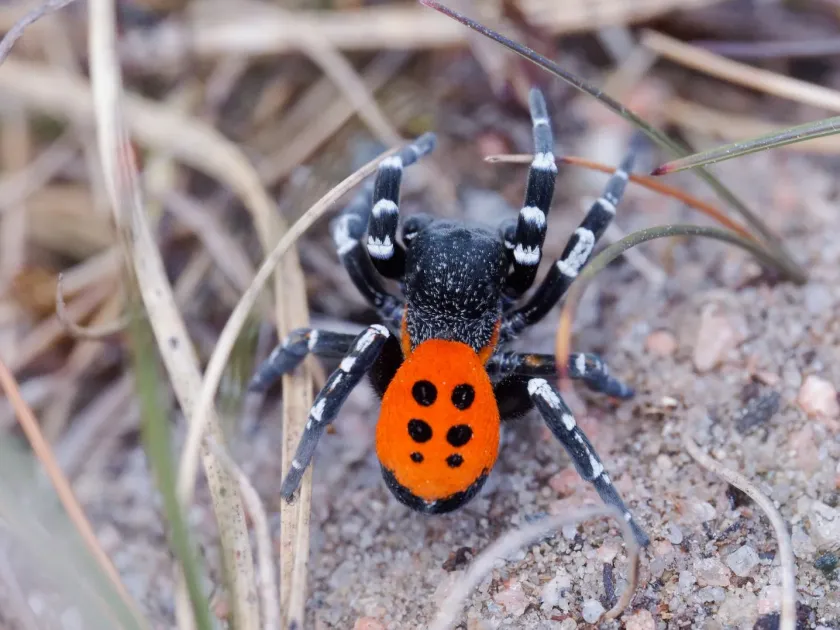
The ladybird spider (Eresus niger) is a striking arachnid belonging to the Eresidae family, known for the brilliant red abdomen of the male adorned with black spots.
Females are distinctly different, being entirely black in color and larger in size, and they spend most of their lives hidden away from sight.
They inhabit arid, warm areas such as steppes, where they construct deep, silk-lined burrows that provide protection against heat and physical disturbances.
The lifecycle is notably long for a spider; reaching sexual maturity can take several years, which highlights the unique biological development of this species.
Due to its rarity and specific habitat requirements, this spider is frequently protected by environmental conservation laws in many countries.
What it damages
The ladybird spider is not a plant pest because it does not consume agricultural crops, leaves, fruits, or any other part of the cultivated vegetation.
Any impact on agriculture is strictly ecological, as the spider functions as a predator that consumes various soil-dwelling insects within its habitat range.
There is no economic damage associated with this spider, and it does not affect crop yields, plant health, or the quality of the harvested product.
The species acts as a generalist predator, contributing to the balance of the local ecosystem by regulating the populations of smaller arthropods.
Therefore, it is misidentified as a pest by those unfamiliar with its ecology, as it poses absolutely no threat to agrarian activities or farming operations.
When it appears
Adult males are most active during the late spring and early summer months, typically emerging in May and June to search for mating opportunities.
During this period, males move across the surface of the soil, making them visible to observers, while females remain largely subterranean throughout the season.
The colder months are spent in a state of diapause, with spiders retreating deep into their burrows to survive winter conditions safely.
Seasonal activity is highly temperature-dependent, with warmer and drier weather patterns encouraging more visible movement during the breeding season.
For the remainder of the year, the spiders remain in their burrows, making them almost impossible to detect without specialized environmental research methods.
Signs of infestation
The primary sign of the ladybird spider's presence is the existence of small, neatly constructed burrows in the ground, often reinforced with silk.
Remains of prey insects near the burrow entrance can sometimes indicate a site of high predatory activity, though this is rarely linked to agricultural fields.
Visual spotting of the brightly colored males crawling on the ground during the mating season is the most common way to identify the species' presence.
There are no signs of crop destruction, such as wilting, chlorosis, or necrotic spots, because the spider has no interaction with the plant metabolism.
Identification is primarily carried out by entomologists for biodiversity monitoring rather than by farmers searching for signs of crop damage.
Control measures
No control measures are needed for this species because it is not an agricultural threat; in many regions, it is a protected and ecologically valuable species.
The use of broad-spectrum pesticides intended for other pests will indirectly lead to the decline of ladybird spider populations on the field.
Standard agricultural practices like regular deep tilling can disrupt their burrows, which serves as a natural deterrent if their presence is undesirable.
It is recommended to promote biodiversity on farmland, as spiders contribute to the natural biological control of genuine insect pests in the ecosystem.
Maintaining balanced pest management practices ensures that beneficial species like the ladybird spider remain a part of the local environment.
Taxonomy
- Latin name
- Eresus niger
- Family
- Eresidae
- EPPO code
- ERESNI
Discussion
No discussions yet — be the first.