
Spulerina simploniella
Spulerina simploniella
Description
How to identify
Spulerina simploniella is a small moth species belonging to the family Gracillariidae. It is a well-known pest that specifically targets oak species within forest and urban ecosystems.
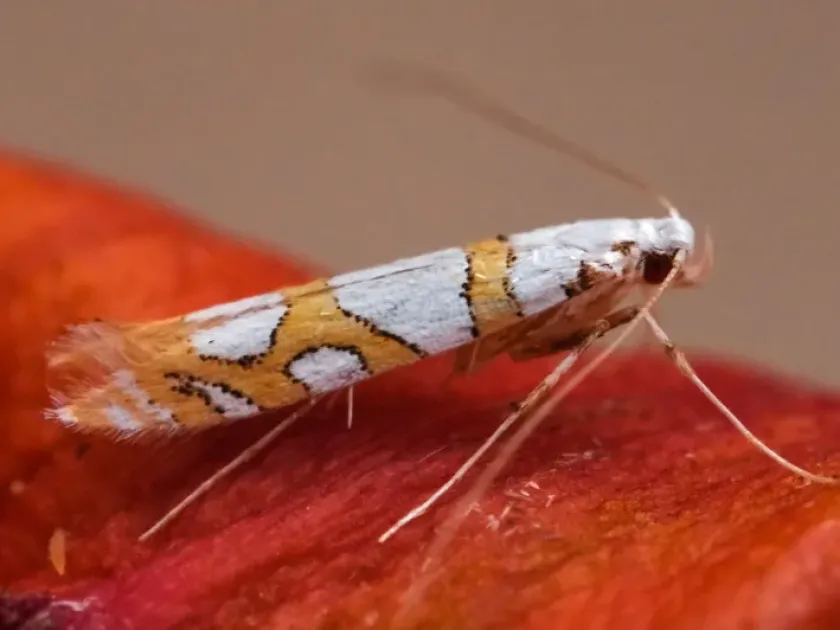
The adult moth is tiny, with a wingspan of only 7–9 mm. Its forewings exhibit a distinct bronze-gold coloration with intricate white patterns, enabling it to blend perfectly into oak bark.
The biological cycle consists of four distinct stages: egg, larva, pupa, and adult. The insect typically undergoes one or two generations per year depending on regional climatic conditions.
Pupation occurs within leaf mines or among leaf litter during the winter months. As temperatures rise in spring, the adults emerge to mate and initiate a new cycle of egg-laying.
Female moths deposit individual eggs onto the underside of oak leaves. Upon hatching, the young larvae immediately bore into the leaf epidermis to begin feeding.
What it damages
The primary host for Spulerina simploniella is the English oak (Quercus robur). The larvae feed on the internal parenchyma tissue, creating characteristic mines.
Feeding damage reduces the leaf's total photosynthetic surface area. This stress can lead to premature leaf yellowing and shedding, particularly during hot and dry summer months.
While mature trees can usually tolerate moderate infestation, young saplings and ornamental trees are significantly impacted, suffering from stunted growth and reduced vigor.
The damage caused by these larvae can weaken the tree's overall defense mechanisms, making it more susceptible to drought, fungal diseases, and secondary insect attacks.
In forest nurseries, a heavy infestation can cause severe aesthetic and economic losses, necessitating prompt intervention to save the young planting stock.
Signs of infestation
The most diagnostic sign of an infestation is the appearance of blotch mines on the leaf surface. These mines are pale, transparent patches that later turn brown.
Larvae often construct these mines along the major veins of the oak leaf. Over time, the mines expand as the larva increases in size, causing the leaf tissue to ripple.
If you examine the underside of an affected leaf, you may spot the dark frass (excrement) pellets left behind by the larva as it navigates through the leaf interior.
Severe infestation results in the wilting and curling of the affected foliage. When multiple mines are present on a single leaf, the tissue dries out and eventually dies.
During autumn, fallen leaves containing dormant pupae provide clear evidence of a previous infestation, which can help in planning control efforts for the following season.
Control measures
Sanitation is a critical control measure. Removing and burning infested leaf litter during the dormant season destroys the overwintering pupae and reduces the next generation.
In cases where chemical control is required, systemic insecticides are the most effective because they translocate into the leaf tissue, reaching the hidden larvae.
Biological control using pheromone traps can be useful for monitoring adult flight activity, helping to time insecticide applications precisely for maximum effectiveness.
Promoting the population of natural predators, such as parasitic wasps, can help keep moth populations below the economic injury threshold in natural forest environments.
- Regular inspection of oak foliage during late spring and summer.
- Avoiding excessive use of broad-spectrum insecticides that kill beneficial wasps.
- Encouraging mixed forest stands to decrease host density for the moth.
Taxonomy
- Latin name
- Spulerina simploniella
- Order
- Lepidoptera (butterflies)
- Family
- Gracillariidae
- EPPO code
- DILCSI
Discussion
No discussions yet — be the first.