
Stonefly of the genus Skwala
Skwala
Description
How to identify
The Skwala genus belongs to the order Plecoptera and the family Perlodidae. These insects are characterized by a hemimetabolous development cycle and a strong dependence on aquatic environments.
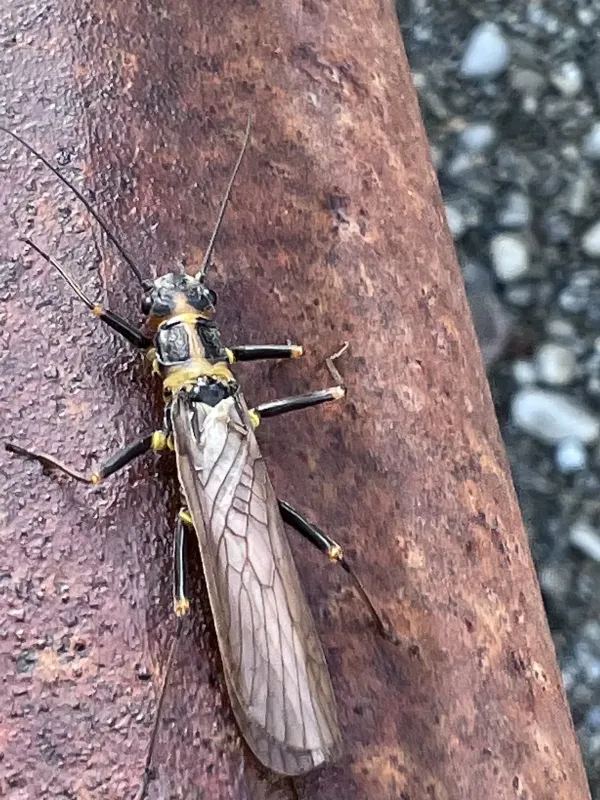
Adult stoneflies have an elongated body with two pairs of membranous wings, folded flat over their back. They are easily identified by their long antennae and two tail-like structures called cerci.
The coloration of adults is generally dark, ranging from brown to black, which serves as camouflage against riparian substrates like rocks and timber.
Nymphs of the Skwala genus are aquatic and possess strong legs designed for crawling along the stream bed. Their chewing mouthparts are adapted to consume organic debris or small aquatic organisms.
These insects are highly sensitive to water quality, often serving as indicators of clean, flowing water systems in agricultural landscapes.
What it damages
While stoneflies are primarily aquatic, their nymphs can cause indirect damage to crops grown in hydroponic systems or flood-irrigated fields.
Damage often occurs when nymphs feed on the delicate root systems of young seedlings, weakening the plant and creating entry points for fungal or bacterial pathogens.
Adult Skwala stoneflies cause minimal direct damage to crops, as they do not feed extensively during their short terrestrial life stage.
In greenhouses and nurseries, the nymphs can physically clog irrigation pipes and filtration systems, disrupting the uniform distribution of water and nutrients.
Seedlings in close proximity to irrigation sources are the most vulnerable, as they are exposed to the direct activity of nymphs in the water supply.
When it appears
The lifecycle of the Skwala stonefly is typically univoltine, meaning they complete one generation per year.
Adult emergence occurs in early spring, often shortly after the ice thaws, which gives these insects their common group name.
Females deposit eggs directly into the water, where they incubate for several weeks before hatching into nymphs.
The nymphal stage is the longest part of their life, spanning most of the year as they grow through successive molting cycles.
Water temperature is the primary factor driving the rate of larval development, ensuring high activity levels during the early spring planting season.
Signs of infestation
One of the primary indicators of a population is the presence of exuviae—the shed exoskeletons left behind on stems or rocks during the final molt.
Unexpected wilting of plants despite adequate water availability can indicate root damage caused by nymph feeding at the base of the plant.
Mechanical damage on submerged parts of the plant often appears as uneven, jagged bite marks on the root or stem tissue.
A sudden, large-scale appearance of adult stoneflies in the surrounding vegetation during spring is a strong sign of a local breeding population.
Finding insect debris or molted parts in water filtration or irrigation emitters confirms the presence of the pest within the water source.
Control measures
Mechanical management, such as the use of fine-mesh filters in irrigation lines, is the most effective way to prevent nymphs from entering crop systems.
Chemical control is generally not recommended, as stoneflies are highly sensitive to pesticides and such applications can harm the surrounding aquatic ecosystem.
Promoting a healthy ecosystem with native predators like fish and amphibians helps keep the nymph population in check naturally.
Crop rotation and selecting water sources away from natural streams can significantly reduce the risk of infestation in sensitive planting areas.
Regular monitoring of irrigation sources during the early spring emergence period allows for the proactive implementation of filtration safeguards.
Taxonomy
- Latin name
- Skwala
- Family
- Perlodidae
- EPPO code
- SKWASP
Discussion
No discussions yet — be the first.