
Stonefly
Perlodes
Description
How to identify
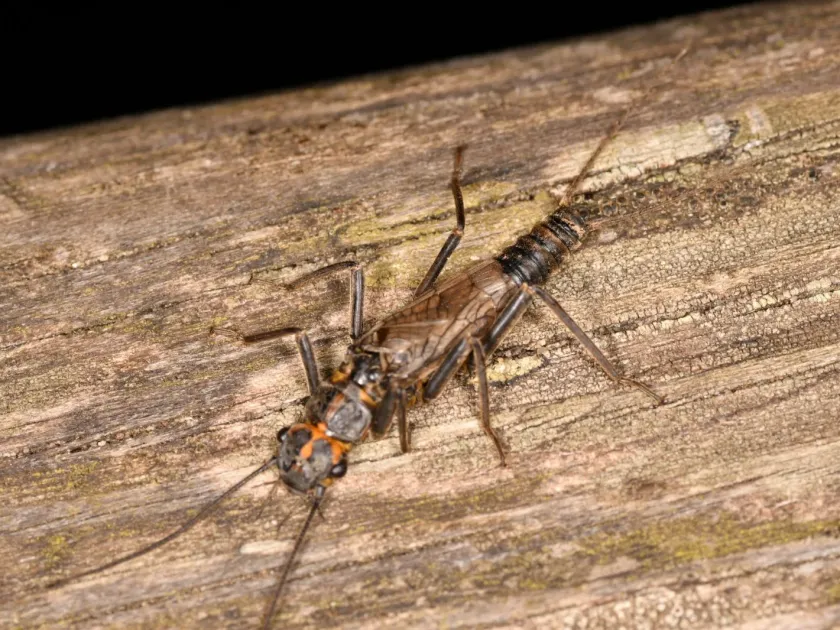
Stoneflies (order Plecoptera, family Perlodidae) are insects that undergo incomplete metamorphosis. Adult forms feature two pairs of membranous wings that fold flat over the abdomen when at rest.
The adults typically possess long, slender antennae and mouthparts that are often reduced in functionality, as many species focus primarily on reproduction during their short aerial lifespan.
The larvae, known as nymphs, are strictly aquatic. They exhibit an elongated body shape, well-developed legs for crawling on the substrate, and prominent cerci extending from the rear of the abdomen.
The mouthparts of the Perlodes genus larvae are adapted for predation. They are equipped with robust, chewing structures that allow them to consume aquatic invertebrates and, occasionally, vegetative material.
Identification at the larval stage is based on the specific arrangement of thoracic segments and the characteristic dark pigmentation patterns often present on the dorsal side of the body.
What it damages
Stoneflies rarely cause significant damage to commercial crops. However, they can become a nuisance in fields directly adjacent to irrigation canals, ponds, or slow-moving streams.
Damage typically occurs when nymphs climb onto shorelines to pupate or forage, accidentally feeding on the young seedlings of vegetables, berries, or grain crops planted near the water edge.
The damage manifests as irregular chewing marks on leaves and stems. This physical trauma can create entry points for secondary fungal or bacterial infections in young plants.
In high-density populations, localized damage can lead to reduced plant vigor. However, this is largely situational and dependent on the proximity of the field to the water source.
It is important to remember that Perlodes are primarily predatory. Any consumption of plant tissue is considered facultative, usually occurring when their preferred prey is unavailable.
When it appears
The life cycle of a stonefly begins with eggs laid in water. Depending on the species and water temperature, the incubation period can last for several weeks.
Nymphs spend their entire development period underwater, passing through multiple molts. This stage can take up to several years to reach maturity, depending on environmental stability.
Adult emergence typically occurs in the spring. This phase is characterized by a mass exodus of adult stoneflies from the water, often coinciding with the prime growing season for crops.
The adult phase is short-lived, lasting only a few weeks. Their main activity is mating, and they are usually found resting on nearby vegetation during the day.
Warmer spring temperatures accelerate the emergence of adults. Agricultural managers should monitor nearby water bodies during these temperature spikes to assess potential activity levels.
Signs of infestation
The most common sign of stonefly presence is the visual observation of adults on plants or nearby surfaces. They are often found in groups on the underside of leaves near the water's edge.
Leaf damage consists of small, irregular holes or notched leaf margins. Unlike specialized agricultural pests, stonefly damage is generally uneven and scattered across the plant foliage.
The presence of shed larval skins (exuviae) attached to plant stems near the water is a definitive sign that a development cycle has been completed in that specific location.
Aggregated nymphal activity in irrigation channels can often be spotted by checking submerged debris or stones where the larvae seek shelter and prey.
Weakened plant seedlings along the field perimeter, showing signs of stem epidermis injury, may indicate feeding by nymphs that have recently emerged from adjacent water sources.
Control measures
The primary control measure is the implementation of buffer zones. Planting crops at a sufficient distance from water sources significantly mitigates the risk of stonefly interaction.
Regular maintenance of irrigation systems, including the removal of dense aquatic weeds, reduces available habitats for stonefly larvae and limits their reproductive success.
Biological control methods, such as the use of selective entomopathogenic sprays, can be applied to perimeter vegetation to manage populations without harming beneficial insects.
Chemical intervention is rarely necessary and should be treated as a last resort. If required, use insecticides sparingly, applying them only to the immediate perimeter near water.
Proper soil management and land clearing near canal banks can disrupt the life cycle of the insect, preventing nymphs from successfully transitioning or feeding on newly planted crops.
Taxonomy
- Latin name
- Perlodes
- Family
- Perlodidae
- EPPO code
- PELDSP
Discussion
No discussions yet — be the first.