
Ash whitefly
Siphoninus phillyreae
Description
How to identify
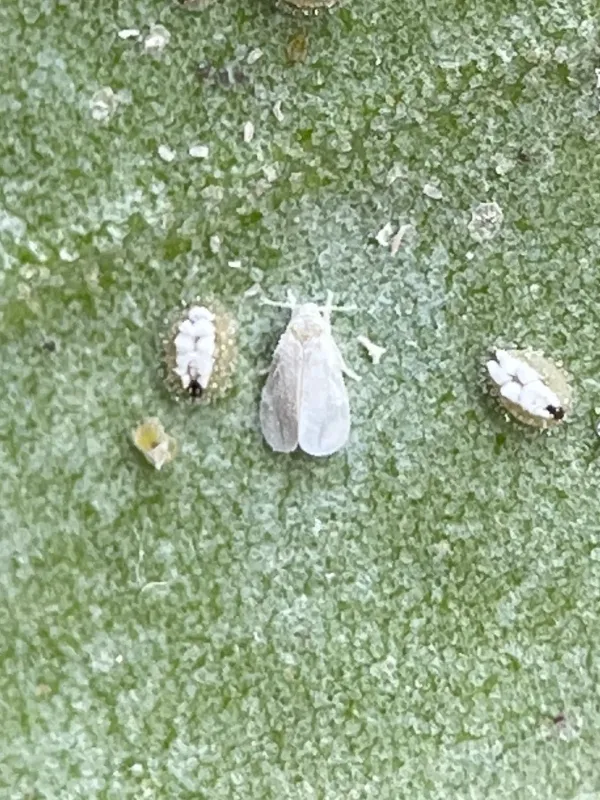
The Ash whitefly (Siphoninus phillyreae) belongs to the family Aleyrodidae in the order Hemiptera. Adult insects are minute, measuring roughly 1–1.5 mm, with wings covered in a dusty, ash-like white wax.
The lifecycle consists of eggs, several larval instars (nymphs), and adults. The nymphs are typically sedentary and covered with waxy filaments, often appearing as tiny white cottony spots on the underside of leaves.
Morphologically, adults have a characteristic feature where their compound eyes are divided into two distinct parts, allowing for a wide field of vision to detect threats.
Reproductive rates are highly dependent on ambient temperatures. In temperate and tropical climates, the species can complete multiple generations per year, leading to rapid population explosions.
Overwintering usually occurs as mated females or late-stage nymphs on the bark of host trees or protected leaf litter, allowing the species to survive colder months effectively.
What it damages
This pest is highly polyphagous, meaning it feeds on a wide range of woody hosts. It is particularly notorious for damaging fruit trees and ornamental landscaping species.
Common hosts include apple, pear, quince, pomegranate, and species of the Oleaceae family such as olive and ash trees. Nurseries are particularly vulnerable to total crop loss if left untreated.
Damage is caused by both adults and larvae piercing plant tissues and sucking sap, which significantly drains the plant's vital energy and hinders its physiological processes.
The secretion of honeydew promotes the growth of sooty mold, which creates a dark coating on leaves, drastically reducing the tree's ability to perform photosynthesis.
Severe infestations cause defoliation, stunted shoot growth, and a reduction in fruit size and quality, making the trees susceptible to other diseases and environmental stress.
Signs of infestation
The primary symptom is the appearance of white, powdery patches on the undersides of leaves. If a branch is shaken, a noticeable cloud of white adults will fly out.
Sticky residue on the upper leaf surface indicates the presence of honeydew produced by the whitefly nymphs. This residue soon turns black as sooty mold colonizes the area.
Leaf curling, yellowing (chlorosis), and premature drop are classic indicators that the infestation has reached a critical stage of damage for the tree.
A careful inspection of the bark and underside of leaves will reveal the sessile nymphs, which look like small white discs or scales attached to the surface.
Increased ant activity around a tree is often a sign of whitefly presence, as ants protect the nymphs to feed on the sugary honeydew they secrete.
Control measures
Managing the Ash whitefly requires an Integrated Pest Management (IPM) approach to maintain populations below economic injury levels.
Biological control is the most successful long-term strategy, particularly the introduction of the parasitoid wasp Encarsia inaron, which is highly specialized in predating upon this species.
Cultural practices, such as proper pruning to ensure light penetration and air circulation, make the tree canopy less hospitable to whitefly colonies.
Chemical control using systemic insecticides can be effective during heavy outbreaks, but it should be used sparingly to protect natural predator populations.
- Installing yellow sticky traps to monitor adult flight and reduce the overall population density.
- Washing the tree canopy with high-pressure water to physically remove larvae and honeydew.
- Applying dormant horticultural oils during the winter to eliminate overwintering females on the bark.
Taxonomy
- Latin name
- Siphoninus phillyreae
- Order
- Hemiptera (bugs, aphids, leafhoppers)
- Family
- Aleyrodidae
- EPPO code
- SIPOPH
Discussion
No discussions yet — be the first.