
Ash whitefly
Siphoninus finitimus
Description
How to identify
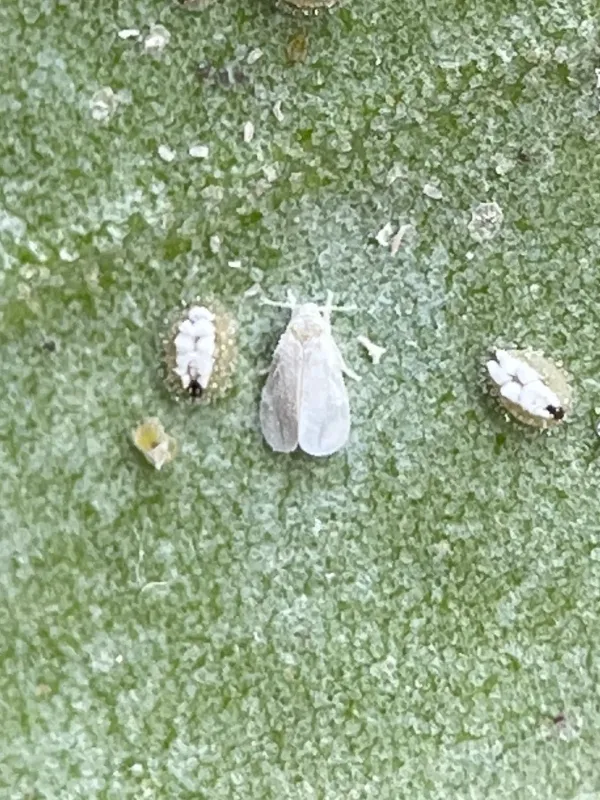
The Ash whitefly Siphoninus finitimus is a small insect belonging to the Hemiptera order and the Aleyrodidae family. Adult specimens are approximately 1-1.5 mm long, with wings covered in a fine, white powdery wax, resembling tiny moths.
The immature stages, known as nymphs, are sedentary and oval-shaped. They are typically found on the undersides of leaves, where they remain attached to the plant surface while feeding on vascular sap.
Due to their minute size, infestations can be hard to spot in the early stages. However, as the population grows, the distinctive white waxy secretions become clearly visible, often looking like scattered flour or cotton.
A key feature of the Ash whitefly is the presence of hollow dorsal tubes on the nymphs. These tubes produce the waxy filaments that serve as a protective shield against environmental stressors and predators.
Eggs are deposited in small clusters by the females. As the larvae hatch and transition through their developmental stages, they progressively consume nutrients, weakening the host plant's vital functions.
What it damages
The Ash whitefly primarily targets various species of Fraxinus (ash trees). However, under favorable environmental conditions, it can spread to other ornamental and fruit-bearing trees, such as pears or citrus.
By feeding exclusively on the undersides of leaves, the insect extracts vital plant sap. This feeding process causes leaves to yellow, curl, and potentially suffer from premature senescence or deformation.
Heavy infestations force the tree to lose its foliage prematurely, which severely hampers the tree's ability to undergo photosynthesis and store energy reserves needed for surviving winter dormant periods.
The insects secrete large amounts of honeydew, a sticky substance that coats the leaves and branches. This honeydew serves as a growth substrate for sooty mold, a dark fungus that blocks sunlight.
Chronic damage leads to stunted growth and increased susceptibility to secondary pests and fungal infections, eventually endangering the overall health and structural integrity of the tree.
When it appears
The activity cycle of the Ash whitefly is strictly synchronized with the plant's growing season. Emergence typically begins in early spring as soon as foliage starts to appear and temperatures rise.
Throughout the summer, the pest can complete several generations. Warm, dry weather conditions significantly accelerate their life cycle, leading to rapid population explosions if left unchecked.
Peak population density is usually observed in mid-to-late summer. During this time, the undersides of leaves become heavily infested, and the presence of honeydew becomes noticeable on the bark and ground.
As autumn arrives and temperatures drop, the whitefly activity begins to wane. Nymphs and pupae prepare for winter by hardening their protective casings to endure the colder temperatures.
Hibernation often occurs on the bark or within protected crevices of the tree, ensuring that the population can persist and re-emerge the following spring when growth resumes.
Signs of infestation
The earliest sign of an infestation is the appearance of small, pale chlorotic spots on the upper leaf surface, which gradually expand as the insect colony continues its feeding activity.
A dusty, white powdery residue on the undersides of leaves is a definitive diagnostic sign. Closer inspection will reveal the presence of tiny, tubular waxy structures secreted by the nymphs.
The presence of ants is a common indirect indicator. Ants are attracted to the sugary honeydew excreted by the whiteflies and often guard these colonies, which can interfere with natural predator control.
Sooty mold growth, appearing as black soot-like patches on leaves and stems, indicates that the infestation has been present for a significant amount of time.
Early leaf drop during late August or early September is a critical sign of severe stress. When ash trees lose their foliage prematurely, it is a clear indicator of heavy pest pressure.
Control measures
- Regular tree inspection focusing on the undersides of leaves during the growing season.
- Application of systemic insecticides that are translocated throughout the tree's vascular system.
- Pruning and removing infested branches to reduce the overall population during the dormant phase.
- Encouraging natural biological controls, such as lady beetles, lacewings, and parasitic wasps.
- Ensuring optimal tree hydration and nutrition to help the plant withstand and recover from pest-induced stress.
Taxonomy
- Latin name
- Siphoninus finitimus
- Order
- Hemiptera (bugs, aphids, leafhoppers)
- Family
- Aleyrodidae
- EPPO code
- SIPOFI
Discussion
No discussions yet — be the first.