
Summer mayfly
Siphlonurus aestivalis
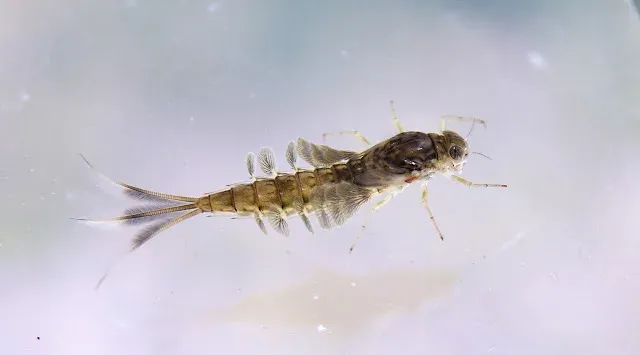
Description
How to identify
Siphlonurus aestivalis, known as the summer mayfly, is a species of insect belonging to the order Ephemeroptera and the family Siphlonuridae.
Adult mayflies possess delicate, transparent wings and are easily recognized by their slender bodies and three long, thread-like tails attached to the abdomen.
The nymph stage is fully aquatic. These nymphs have a streamlined, elongated body shape adapted for life in flowing or stagnant water environments.
Their coloration typically ranges from brown to olive green, providing excellent camouflage against aquatic vegetation and bottom substrates.
The adult lifespan is famously short, lasting from a few hours to a couple of days, serving only the purpose of mating and population dispersal.
What it damages
Siphlonurus aestivalis is not an agricultural pest. It does not cause damage to crops, vegetables, or ornamental plants grown on land.
In aquatic environments, nymphs may graze on algae and young aquatic plants, but this activity rarely reaches the level of economic damage.
The species plays a positive role in nature by acting as a primary consumer of organic matter, thus supporting the overall health of the ecosystem.
Any perceived impact on aquatic flora is generally considered a normal part of the ecological balance rather than a sign of infestation.
These insects are vital as a food source for fish, amphibians, and other aquatic predators, making them beneficial rather than harmful.
When it appears
The life cycle of the summer mayfly is highly dependent on water temperature, with peak emergence occurring during the warmer summer months.
Nymphs remain active throughout the year, with the final stages of development often accelerating as water temperatures rise in late spring.
Adult emergence typically happens in swarms during calm, warm evenings, which is characteristic of the Ephemeroptera order.
Overwintering usually occurs during the nymphal stage, where they remain submerged and continue to grow slowly in colder temperatures.
The total duration of the lifecycle can vary, usually taking around one year to complete, depending on regional climatic conditions.
Signs of infestation
Mass emergence of adult flies over the water surface during twilight is the most noticeable sign of their presence in an ecosystem.
Exuviae, the discarded shells left behind when nymphs molt into adults, can often be found attached to reeds or plants at the water's edge.
Underwater observation reveals the presence of nymphs, which can be identified by their distinctive, jerky swimming motion when disturbed.
Increased fish surface activity is a common biological indicator that a hatch of mayflies is occurring nearby.
Using a fine-mesh aquatic net to sample the substrate is the most reliable way to detect and identify the nymphal stages.
Control measures
There is no need for chemical control measures against Siphlonurus aestivalis, as they are not pests and are crucial for the aquatic food web.
If population control is desired for private pond management, promoting a healthy fish population that predates on nymphs is the most natural method.
Managing the density of submerged weeds can help reduce available habitats for the nymphs without harming the wider ecosystem.
Avoid any use of insecticides near water bodies, as these products will indiscriminately harm beneficial aquatic insects and fish populations.
- Promoting biodiversity in aquatic habitats
- Maintaining water quality and aeration
- Natural biological control through predator presence
Taxonomy
- Latin name
- Siphlonurus aestivalis
- Family
- Siphlonuridae
- EPPO code
- SPHUAE
Discussion
No discussions yet — be the first.