
Black grass aphid
Sipha maydis
Description
How to identify
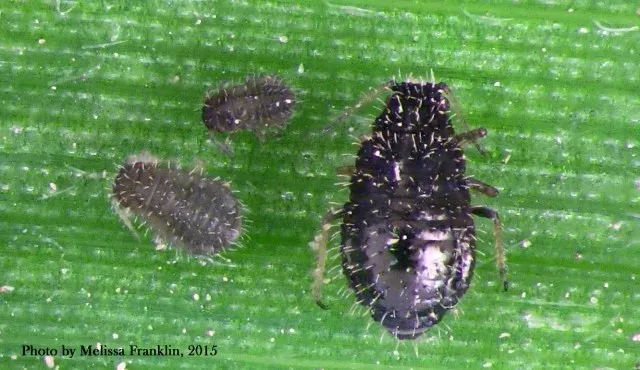
The Black grass aphid (Sipha maydis) is a small insect belonging to the family Aphididae. Adults are typically 1.5–2.5 mm in length, possessing a dark, brownish-black color which makes them easy to distinguish from other aphid species.
The species exhibits polymorphism, with both wingless and winged forms. Wingless adults are often characterized by a coating of fine bristles on their bodies and relatively short antennae. Winged forms feature well-developed veins on their wings to facilitate flight and colonization.
Nymphs resemble the adults but are smaller in size and lack sexual maturity. They undergo several molting stages, gradually increasing in size and developing the morphological characteristics of adults throughout their development.
As a member of the Aphididae family, Sipha maydis possesses specialized piercing-sucking mouthparts. These organs are adapted to penetrate plant tissues and extract phloem sap, which is the primary food source for all developmental stages.
These aphids prefer environments with moderate temperatures and sufficient humidity. They are generally found on the undersides of leaves, where they establish colonies that can rapidly expand under optimal climatic conditions.
What it damages
The primary hosts of the Black grass aphid are plants within the Poaceae family. Important economic crops such as wheat, barley, oats, corn, and sorghum are frequently targeted by this pest.
In addition to agricultural crops, the aphid thrives on various wild grasses. These grasses act as essential reservoirs, allowing the pest population to survive and move onto cultivated land once the season begins.
The damage caused by the aphid stems from the mass extraction of plant sap. This process impairs the plant's metabolic functions, leading to reduced growth, yellowing of leaves, and a decrease in the overall photosynthetic capacity of the crop.
Furthermore, Sipha maydis is a known vector for various cereal viruses, most notably the Barley Yellow Dwarf Virus (BYDV). Even low populations of aphids can trigger widespread viral outbreaks within a field, causing significant yield losses.
During periods of drought, the impact of aphid infestation is significantly magnified. The plants struggle to maintain water balance, and the additional stress caused by feeding results in rapid wilting and potential plant mortality.
When it appears
The life cycle of the Black grass aphid is closely synchronized with the phenology of cereal crops. Overwintering occurs primarily as eggs deposited on crop residues, roots of perennial grasses, or established winter cereal crops.
In spring, as temperatures climb to approximately +8°C to +10°C, the eggs hatch. The first generation of nymphs begins feeding on early plant growth, initiating the expansion of the population across the fields.
The peak population density usually aligns with the stem elongation and heading stages of cereals. During these periods, the plants provide the most abundant nutrient sources, allowing for explosive population growth.
Multiple generations occur within a single growing season. While extreme summer heat can temporarily suppress activity, the population is highly resilient and recovers quickly once moderate conditions return.
As the season nears its end and temperatures begin to drop, the aphids shift their reproductive strategy toward the production of winter eggs, ensuring the survival of the species until the following spring.
Signs of infestation
The most immediate sign of infestation is the presence of aphid colonies on the leaves and stems of cereal plants. Initially, these are found in the lower canopy before spreading throughout the entire plant.
Affected plant tissue begins to yellow and curl. This reaction is often caused not just by nutrient loss, but also by toxic saliva injected into the plant during the feeding process, which disrupts cell integrity.
A secondary sign is the presence of honeydew on the leaf surface. This sugary secretion often promotes the growth of sooty mold, appearing as black patches on the foliage, which is a classic indicator of long-standing aphid pressure.
In severe cases, plants exhibit stunted growth, stem twisting, and premature death of foliage. The heads may fail to fill properly, resulting in shriveled or missing grains, which directly impacts the harvest quality and yield.
Increased ant activity on the plants is a common indicator of an aphid infestation. Ants frequently tend to aphid colonies to collect the sugary honeydew, effectively protecting the aphids from predators and parasites.
Control measures
Crop rotation remains the most fundamental cultural control method. By avoiding continuous planting of cereals, growers can disrupt the pest's cycle and significantly lower the initial population pressure on the field.
Rigorous weed control, particularly in field margins and surrounding areas, is essential. Removing wild grass hosts prevents the buildup of aphid populations that would otherwise migrate into the primary crops.
Integrated pest management relies heavily on biological control. Preserving natural enemies, such as lady beetles, lacewings, and parasitic wasps, is vital for keeping aphid numbers below economic injury levels.
Chemical intervention is required when populations exceed the economic threshold. Systemic insecticides, particularly those that provide long-lasting residual protection, are the most effective choice against this pest.
- Monitor fields early using yellow sticky traps to detect initial arrivals.
- Use insecticide-treated seeds to provide protection during the critical seedling stage.
- Apply selective insecticides to minimize harm to beneficial predator populations.
- Ensure spatial isolation between newly planted fields and older, infested crops.
Taxonomy
- Latin name
- Sipha maydis
- Order
- Hemiptera (bugs, aphids, leafhoppers)
- Family
- Aphididae
- EPPO code
- SIPHMA
Discussion
No discussions yet — be the first.