
Yellow sugarcane aphid
Sipha flava
Description
How to identify
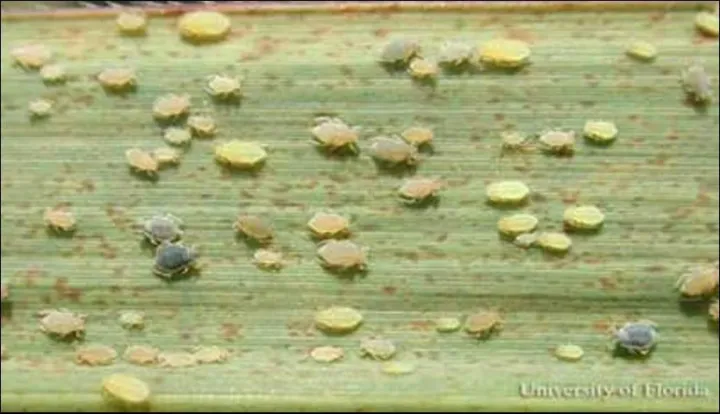
The yellow sugarcane aphid (Sipha flava) belongs to the order Hemiptera and the family Aphididae. It is a small insect characterized by its distinct yellow or lemon-colored body, which distinguishes it from other aphid species.
Individuals can exist in both winged and wingless forms, facilitating both local movement and long-distance dispersal. The body features dark markings on the abdomen and characteristic hair-like structures (setae) across its surface.
Nymphs resemble adults but are smaller in size and lack functional reproductive organs. The entire life cycle occurs on the host plant, where they aggregate in large, dense colonies on the undersides of leaves.
Reproduction is primarily through parthenogenesis, allowing populations to expand rapidly under favorable conditions. A single generation can complete its development in as little as one to two weeks.
Because of this rapid life cycle, the population of the yellow sugarcane aphid can reach damaging levels very quickly, particularly in warm and dry climates that favor their activity.
What it damages
The primary host is sugarcane, but the aphid also attacks other grasses, including sorghum, corn, millet, and various volunteer grasses. These plants serve as essential food sources throughout the growing season.
Aphids feed by inserting their stylets into the leaf tissue and extracting sap. During feeding, they inject salivary enzymes that interfere with plant metabolism and inhibit photosynthesis.
This feeding process results in characteristic yellowing or reddening of the leaves. Severe infestations lead to stunted plant growth, reduced biomass, and a significant decrease in sugar content in sugarcane stalks.
Secondary damage occurs when the aphids facilitate the transmission of viral diseases. Furthermore, the honeydew they excrete creates a substrate for sooty mold, which blocks sunlight and reduces plant vigor.
Under heavy pressure, the crop may suffer from leaf death, which weakens the plant's structural integrity and impacts its ability to store energy for yield production.
Signs of infestation
Initial signs of an infestation include the appearance of yellow, orange, or purple patches on the leaves. These patches usually start at the tips or margins and progress inward.
Closer inspection of the lower leaf surface often reveals colonies of yellow aphids. The presence of sticky honeydew or black sooty mold on the foliage is a diagnostic indicator of advanced infestation.
Leaf curling and deformation are common, especially in young, actively growing leaves. Affected plants may show visible signs of dehydration or stress despite adequate soil moisture levels.
A high density of ants patrolling the plants is another sign, as they are often attracted to the honeydew produced by the aphids and actively protect the colony from predators.
Field-wide, the infested area may appear chlorotic or brownish, standing out from healthy sections of the field. This indicates a loss of chlorophyll and significant stress to the crop.
Control measures
Biological control is highly effective, as numerous natural enemies like lady beetles, lacewings, and parasitic wasps feed on or parasitize the aphid colonies, helping to maintain natural balance.
Integrated pest management includes the removal of alternative host weeds within and around the field to reduce the aphid's survival opportunities between planting cycles.
Chemical control is required when the infestation threshold is exceeded. Systematic insecticides are preferred, though they should be applied carefully to minimize impact on beneficial insects.
Early detection through systematic field scouting is critical. Checking the lower leaves of plants in various parts of the field allows for timely intervention before the damage becomes irreversible.
- Monitor fields weekly during peak growth periods.
- Promote biodiversity at the field edges to support beneficial predators.
- Apply insecticides only when the economic threshold is met.
- Avoid excessive nitrogen fertilization, which can promote succulent growth favored by aphids.
Taxonomy
- Latin name
- Sipha flava
- Order
- Hemiptera (bugs, aphids, leafhoppers)
- Family
- Aphididae
- EPPO code
- SIPHFL
Discussion
No discussions yet — be the first.