
Hibiscus whitefly
Singhius hibisci
Description
How to identify
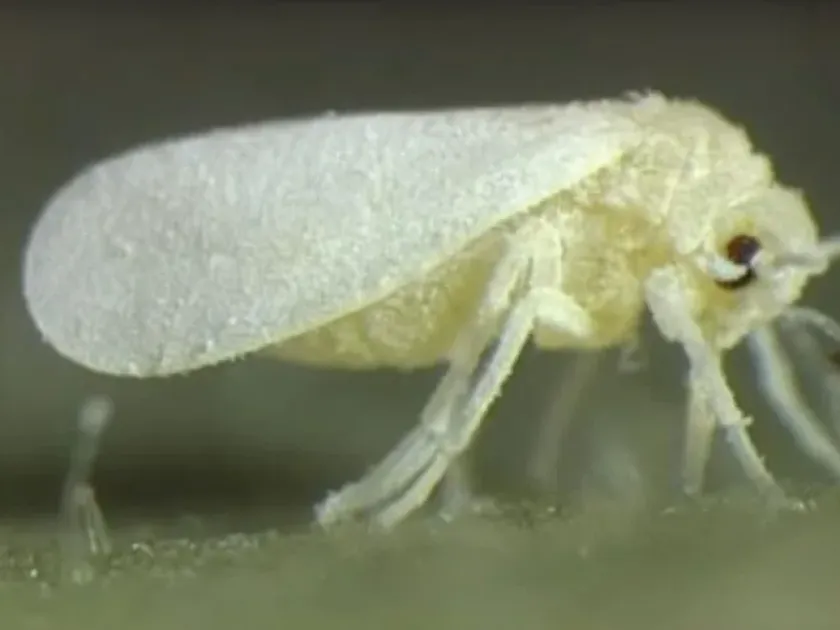
Hibiscus whitefly (Latin: Singhius hibisci) is a small insect belonging to the Aleyrodidae family, order Hemiptera. Adults are characterized by their white wings covered in a dusty white waxy powder.
The nymphs (larvae) of this species are generally sessile, flattened, and oval-shaped, often appearing as scale-like structures on the underside of host leaves.
The life cycle encompasses the egg stage, four larval instars, and the adult stage, with development speed significantly influenced by temperature.
These insects are highly adaptable to greenhouse conditions, where they can reproduce rapidly throughout the year if temperatures remain favorable.
Correct identification is essential, as Singhius hibisci can be easily confused with other common whitefly species without proper examination of their morphological features.
What it damages
As the name suggests, the primary hosts are plants within the Malvaceae family, with Hibiscus species being particularly susceptible.
The pest can also infest a variety of other ornamental plants and crops, potentially causing significant economic damage in nurseries and commercial greenhouses.
The primary damage is caused by the extraction of plant sap, which leads to chlorosis, stunted growth, and a general decline in plant vigor.
The whitefly acts as a vector for various plant viruses, which are often more destructive than the direct feeding damage itself.
Large populations produce copious amounts of honeydew, leading to the growth of sooty mold, which blocks sunlight and reduces the efficiency of photosynthesis.
Signs of infestation
An initial infestation is often detected when adults fly away in small clouds upon shaking or touching the host plant's foliage.
Leaves often exhibit curling and yellowing, and in severe cases, premature leaf drop occurs as the plant loses its vitality.
The presence of a sticky, shiny film (honeydew) on the leaves or stems is a classic indicator of high whitefly activity.
Sooty mold growth, appearing as a black, powdery substance on the leaves, usually follows the presence of honeydew.
Close inspection of the leaf undersides reveals clusters of nymphs, which look like small, flat, semi-transparent scales attached to the veins.
Control measures
Integrated pest management (IPM) is the most effective approach, starting with strict quarantine procedures for new plant material entering the greenhouse.
Yellow sticky traps should be deployed to monitor adult populations and provide a mechanical way to reduce their numbers.
Biological control using parasitoid wasps (such as Encarsia formosa) is highly effective and widely used in greenhouse environments.
Chemical control should rely on systemic insecticides, applied when the pest population reaches an economic threshold to prevent resistance.
Cultural practices, such as removing heavily infested leaves and maintaining proper plant spacing, help to limit the spread of the infestation.
Taxonomy
- Latin name
- Singhius hibisci
- Order
- Hemiptera (bugs, aphids, leafhoppers)
- Family
- Aleyrodidae
- EPPO code
- PEALHI
Discussion
No discussions yet — be the first.