
Citrus whitefly
Singhiella citrifolii
Description
How to identify
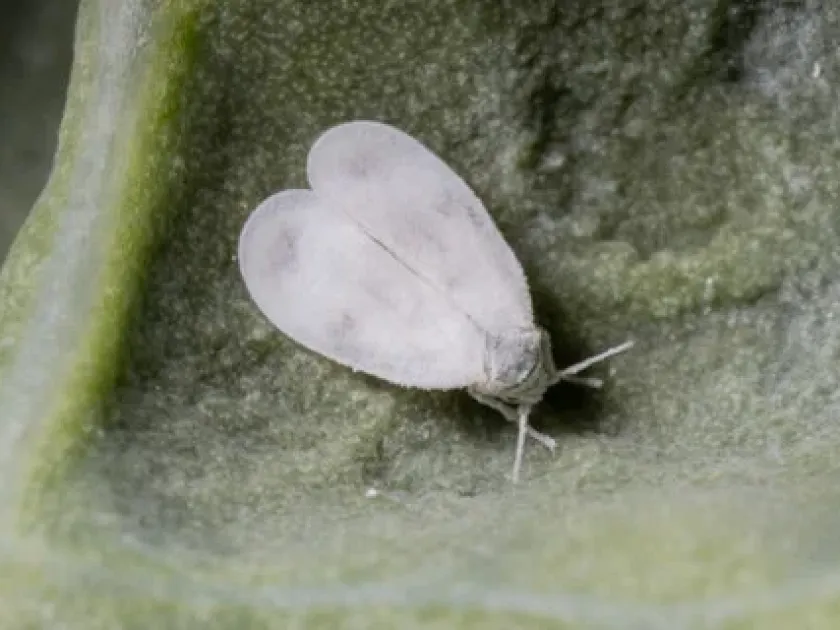
The citrus whitefly (Singhiella citrifolii) belongs to the order Hemiptera and the family Aleyrodidae. Adult insects are tiny, white, moth-like creatures measuring roughly 1.5 to 2 mm in length.
Their life cycle includes egg, nymph, and adult stages. The nymphs undergo significant morphological changes, transitioning from mobile crawlers to stationary puparia that are firmly attached to the leaf underside.
The body of the adult is covered with a waxy, white, powder-like substance, which gives it a characteristic appearance. They are typically found in clusters on the abaxial surface of citrus leaves.
Development is highly dependent on ambient temperature and relative humidity. In warm climates or greenhouse conditions, they can produce multiple overlapping generations throughout the year.
Adults are capable of flight, which facilitates their spread between individual trees or adjacent orchards, making them difficult to contain once established in an area.
What it damages
This pest is a major threat to citrus production, primarily attacking various species of the genus Citrus, including lemon, orange, lime, and grapefruit trees.
Feeding occurs by piercing the plant tissue with specialized mouthparts to extract sap. This depletion of nutrients causes the tree to weaken significantly over time.
Severe infestations often lead to chlorosis, stunted growth, and premature leaf drop. The reduction in leaf area directly impairs the photosynthetic efficiency of the tree.
The stress caused by the feeding activity often manifests as poor fruit quality, reduced size, and lower total yield, which is a major concern for commercial growers.
Furthermore, the citrus whitefly acts as a vector for various plant pathogens, which can introduce diseases that are often fatal to the host plant if left untreated.
Signs of infestation
The presence of honeydew on the upper leaf surface is the first visual indication. This sugary excretion is a byproduct of the whitefly feeding on the underside.
Sooty mold, a black fungus, thrives on the honeydew deposits. This mold covers the leaves in a black layer, which inhibits photosynthesis and gives the tree a dirty look.
A cloud of white flies taking flight when the tree canopy is disturbed is a hallmark sign of a heavy infestation that requires immediate pest control actions.
Examination of the underside of leaves reveals clusters of small, pale-yellow to white nymphal scales, which appear as flat oval structures stuck to the leaf surface.
Early leaf yellowing and curling, particularly on younger flush growth, serve as indicators that the pest population has reached a level requiring intervention.
Control measures
Management of the citrus whitefly requires an integrated pest management (IPM) strategy that combines cultural, biological, and chemical control methods.
Cultural control involves proper pruning to improve canopy airflow, which makes the microclimate less suitable for the development of whitefly populations.
Biological control includes the utilization of natural predators and parasitoids, such as the Encarsia species, which are effective at keeping whitefly levels in check.
Chemical control should rely on systemic insecticides applied thoroughly to the underside of the foliage, as contact sprays have limited effectiveness against the waxy nymphs.
Regular monitoring with yellow sticky cards is highly recommended to track population surges and determine the precise timing for applying selective chemical treatments.
Taxonomy
- Latin name
- Singhiella citrifolii
- Order
- Hemiptera (bugs, aphids, leafhoppers)
- Family
- Aleyrodidae
- EPPO code
- DIALCT
Discussion
No discussions yet — be the first.