
Bicoloured whitefly
Singhiella bicolor
Description
How to identify
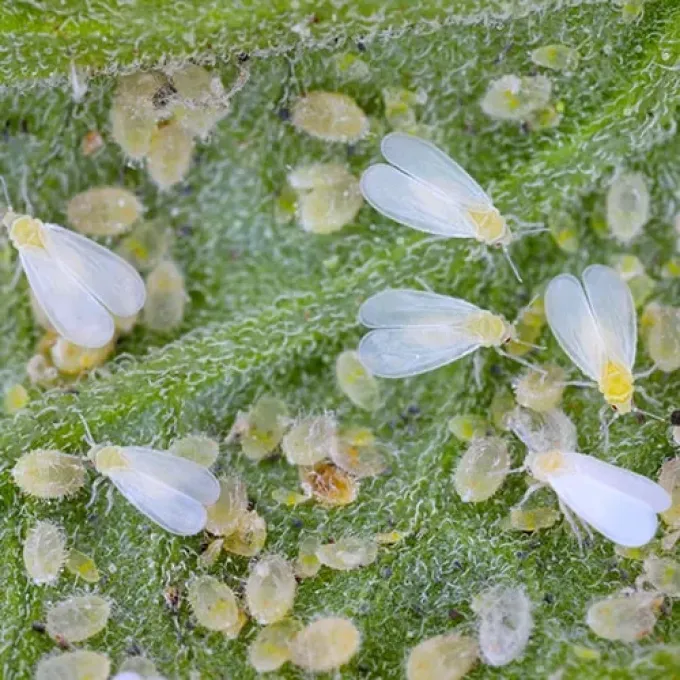
The bicoloured whitefly Singhiella bicolor belongs to the Aleyrodidae family. It is a distinct species characterized by dark markings on the wings of the adult insects, which sets it apart from many other common whitefly species.
Adults are tiny insects, measuring approximately 1.5–2 millimeters in length. They are covered in a fine waxy secretion that provides protection against dehydration and certain environmental stressors.
The life cycle includes the egg stage, three larval instars, and the adult stage. The first larval instar, known as the "crawler" stage, is mobile and actively searches for a suitable feeding site on the host plant.
Once settled, the subsequent larval stages become sessile and flattened, appearing as small, scale-like structures on the underside of the leaves, making them difficult to detect without careful inspection.
Eggs are typically deposited in clusters on the underside of young, tender leaves, where they undergo development before the crawlers emerge.
What it damages
The primary hosts of the bicoloured whitefly are members of the Rutaceae family, particularly citrus trees such as lemons, oranges, and mandarins.
By feeding on the plant's phloem sap, the whitefly extracts essential nutrients, which weakens the plant's overall health and reduces its vigor significantly.
A major indirect damage factor is the excretion of honeydew, a sugary substance that accumulates on the leaves and supports the growth of sooty mold fungi.
The presence of sooty mold inhibits photosynthesis by blocking sunlight, leading to chlorosis, stunted growth, and in severe cases, premature leaf drop.
High infestation levels can result in reduced fruit set and poor fruit quality, posing a substantial economic threat to commercial citrus orchards and nurseries.
When it appears
The bicoloured whitefly is highly sensitive to environmental conditions, thriving in warm and humid climates where it can complete multiple generations per year.
In greenhouses or controlled indoor environments, the pest can remain active throughout the year, as it does not require a cold-induced diapause to complete its life cycle.
Peak population growth typically coincides with the spring and summer flushes of new plant growth, providing a steady supply of food for the emerging larvae.
In outdoor settings, populations tend to increase during the warmer months and may decline significantly during cooler periods, though they can overwinter in milder regions.
Rapid generation turnover allows for quick population explosions if the initial infestation is not managed early in the growing season.
Signs of infestation
The most immediate sign of an infestation is the presence of small, white, moth-like adults taking flight when the branches of the host plant are disturbed.
Observing the underside of the leaves reveals tiny, scale-like larvae, often found in clusters along the leaf veins where the nutrient supply is most abundant.
A sticky, shiny residue on the upper surfaces of leaves located below the feeding sites is a classic indicator of the presence of honeydew-producing insects.
The development of a black, velvety fungal mat (sooty mold) covering the foliage is a late-stage symptom indicating heavy infestation.
Leaves may show signs of chlorosis or may become curled and distorted due to the continuous withdrawal of sap by the insect colony.
Control measures
Cultural control practices, such as pruning the crown to improve air circulation and light penetration, are essential for creating an environment less favorable to the pest.
Chemical management often involves the use of systemic insecticides, which are absorbed by the plant and provide effective control as the whiteflies feed on the sap.
Biological control agents, including specific parasitoid wasps like Encarsia formosa, are successfully used in protected cultivation to regulate population numbers.
Regular maintenance, including washing leaves to remove honeydew and sooty mold, can help keep the plant healthy and reduce the risk of secondary fungal infections.
- Use yellow sticky traps to monitor adult population levels.
- Promptly remove and destroy heavily infested plant material.
- Rotate different insecticide classes to prevent the development of resistance.
- Practice strict sanitation of tools to prevent cross-contamination.
Taxonomy
- Latin name
- Singhiella bicolor
- Order
- Hemiptera (bugs, aphids, leafhoppers)
- Family
- Aleyrodidae
- EPPO code
- TRIABI
Discussion
No discussions yet — be the first.