
Bulb mite
Schwiebea similis
Description
How to identify
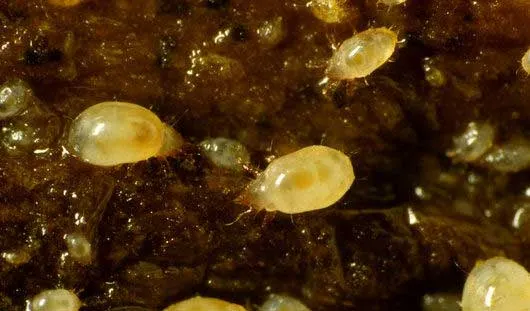
The bulb mite (Schwiebea similis) is a member of the Acaridae family. It is a tiny, microscopic mite that measures approximately 0.5 to 0.7 mm in length. Its body is oval, whitish-transparent, and has brownish legs, making it difficult to spot with the naked eye.
These mites have a highly specialized developmental stage known as the hypopus. This hardy, mobile nymphal stage allows the mite to survive in the soil during periods of drought, food scarcity, or low temperatures, ensuring population persistence.
Reproduction is highly dependent on environmental conditions. Schwiebea similis thrives in moist soil environments with temperatures ranging between 20°C and 25°C. These conditions are most commonly found in poorly ventilated storage facilities or over-watered garden beds.
Unlike some other mite species, this mite is specifically adapted to living in soil and within the internal tissues of bulbs. They require high relative humidity to complete their life cycle, which usually takes about a month under optimal conditions.
Field identification is rarely successful without diagnostic tools. Farmers usually rely on laboratory analysis of soil samples or infested bulb tissues to confirm the presence of this specific mite species.
What it damages
This mite is a polyphagous pest affecting numerous bulbous and cormous plants, including onions, garlic, tulips, lilies, and gladioli. Both commercial fields and storage warehouses are susceptible to significant economic losses.
The mites primarily feed on the basal plate of the bulb. By destroying the roots and internal tissues, they prevent the plant from absorbing nutrients and water, eventually leading to the plant's collapse and death.
In storage, bulb mites can devastate entire batches of produce. They consume the bulb's interior, leaving behind tunnels and debris. This process also creates entry points for secondary bacterial and fungal pathogens.
Infested seedlings often fail to emerge or appear weak and stunted. If they do grow, the yield is significantly reduced, and the remaining bulbs are often unmarketable due to rot and structural damage.
The damage is cumulative. Mites move between bulbs, spreading pathogens and multiplying rapidly, which can lead to total crop failure if left unmanaged during the storage period.
Signs of infestation
In the field, infested plants show signs of chlorosis and wilting. When pulled from the ground, the plant often detaches easily from its root system, which appears decayed or missing entirely.
Visual inspection of the bulb's basal plate reveals a soft, decaying mass, often accompanied by a foul-smelling rot. A dusty, brownish substance consisting of excrement and tissue debris is typically found around the damage site.
During storage, the primary indicator is the presence of a light-colored dust on the shelves and around the bulbs. Infested bulbs lose their firmness and become soft or spongey to the touch.
When planted, infested bulbs exhibit poor germination rates. If growth does occur, the resulting plant is thin, yellowing, and significantly more susceptible to environmental stressors.
A confirmed diagnosis requires a microscopic examination of the tissue at the junction of the basal plate and the bulb scales, where high densities of mites are usually gathered.
Control measures
Preventive agricultural practices are the most effective way to manage bulb mites. Long crop rotation cycles, ideally 4–5 years, help to reduce the population density in the soil.
Proper harvest management is crucial. Bulbs should be thoroughly dried and cured before storage. Maintaining storage temperatures near or below 2°C significantly inhibits mite activity and prevents rapid population growth.
Chemical control involves treating the planting material with acaricides or fungicides before planting to protect the bulbs during the initial growth phase. Always follow local regulations regarding chemical use.
In greenhouse settings, irrigation management is essential. Avoiding saturated soil conditions helps deny the mites the humidity levels they require for rapid reproduction and development.
Sanitation practices, such as removing and destroying infested plant material immediately after harvest, prevent the mite from carrying over to the next season in the field or in storage containers.
Taxonomy
- Latin name
- Schwiebea similis
- Order
- Mites
- Family
- Acaridae
- EPPO code
- SCHWSI
Discussion
No discussions yet — be the first.