
Bulb mite (Schwiebea)
Schwiebea
Description
How to identify
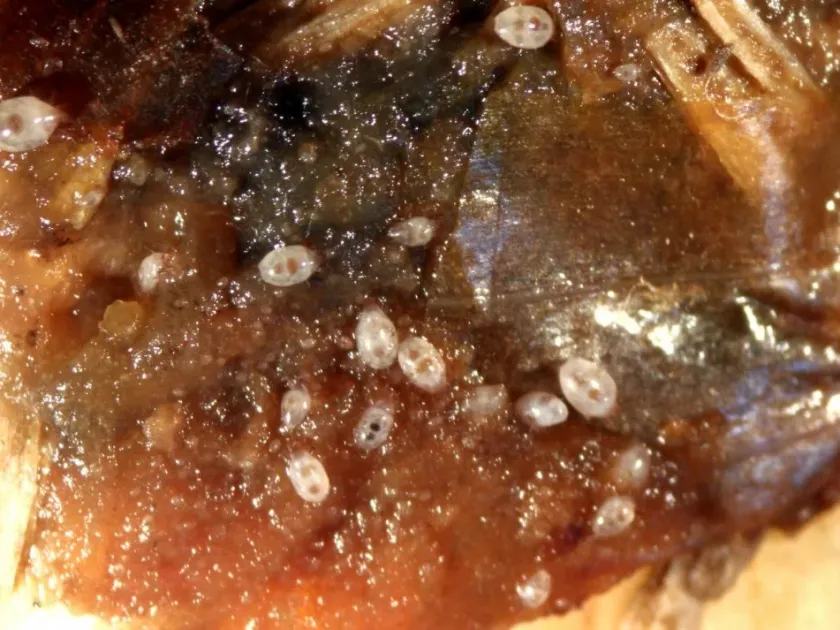
The root mite Schwiebea belongs to the family Acaridae. These are microscopic organisms, typically about 0.5 mm in length, with a translucent, creamy-white body that allows them to thrive in narrow soil spaces and plant crevices.
While often found in decaying organic matter, these mites shift to living tissues under high-moisture conditions, making them a serious agricultural pest for bulbs and tubers. They possess short legs specialized for crawling through moist substrate.
Their life cycle consists of egg, larva, protonymph, deutonymph, and adult stages. The deutonymph stage, known as the hypopus, is a highly resistant phase that allows the mite to survive extreme drought or starvation by attaching to other insects.
Reproduction is rapid, with a single generation potentially completing in 10 to 14 days under temperatures of +20°C to +25°C. This quick turnaround enables populations to explode in greenhouses or storage facilities.
Because they are translucent and tiny, positive identification usually requires microscopic analysis. Agronomists often distinguish them from other bulb mites by the specific morphology of their dorsal setae and gnathosoma.
What it damages
Schwiebea primarily infests bulbous and tuberous plants such as tulips, lilies, gladioli, and potatoes. Greenhouse vegetables like cucumbers and tomatoes are also susceptible if soil conditions are neglected.
The mites bore into the basal plate or root zone, consuming healthy tissue. This feeding creates entry points for secondary pathogens like Fusarium, Erwinia, and other rot-causing bacteria and fungi.
Affected seedlings show stunted growth, leaf chlorosis, and general weakness. Severe infestations often result in the total destruction of the root system, causing the plant to wither and collapse suddenly.
In storage, mites can destroy entire batches of planting material. They leave behind fine powdery debris, which consists of their frass and plant tissue remnants, while the bulbs become soft and hollowed out.
The economic impact is significant because damaged bulbs are often unmarketable, and the infection can spread quickly if humidity levels in the storage area are not strictly managed.
When it appears
In open fields, Schwiebea activity begins when soil temperatures rise above +10°C in spring and continues until the onset of winter. However, they remain a constant threat in greenhouses.
The pest is most active during periods of high humidity and moderate heat. Excessive irrigation is the primary factor that triggers population spikes and facilitates their movement through the soil.
Winter survival is achieved through the hypopus stage or by hiding in protected, warmer areas. In climate-controlled storage, they remain active throughout the entire winter season.
Mite dispersal happens via contaminated tools, infested soil, or infected plant material. Water runoff from irrigation also acts as a primary vehicle for moving mites from one area of the field to another.
The peak period of damage often occurs during the early establishment phase of the crop, as young roots and tender tissues are easily compromised by the mites' feeding activities.
Signs of infestation
The first sign is usually an uneven crop stand or plants that do not respond to fertilization. Leaves may show yellowing (chlorosis) or tip burn, signaling impaired nutrient uptake due to root damage.
When an infected plant is pulled, the root system is often found to be missing, with the remaining basal tissue looking brownish, wet, or frayed. A characteristic foul odor of decay is often present.
During storage, the presence of powdery "dust" on the surface of bulbs or in the trays is a strong indicator of mite activity. This dust is actually the waste product of the mite population.
If a bulb is cut open, one might find hollow cavities filled with small, white, slow-moving mites. These cavities often show signs of dark, wet rot, which is indicative of combined mite and fungal activity.
- Stunted plant growth and lack of vigor.
- Roots being brown, soft, or absent at the base.
- Unpleasant, rotting smell emanating from the root zone.
- Whitish powdery debris on storage bulb surfaces.
Control measures
Prevention is the best strategy. Use only certified healthy planting material and ensure that all soil, substrates, and tools are properly sterilized before planting or storage.
For chemical control, soaking bulbs in systemic acaricide solutions before planting can provide protection against initial infestations. Rotating different chemical classes helps prevent the development of resistance.
Cultural management involves maintaining optimal drainage in fields and ensuring ventilation in greenhouses. Avoiding waterlogged conditions prevents the environment from becoming suitable for Schwiebea.
Heat treatment is highly effective for bulbs. A short hot-water dip at specific temperatures can kill mites without damaging the plant, provided the protocols are followed precisely.
Regular monitoring of stored bulbs is essential. If infestation is detected, infected batches should be immediately removed and destroyed to prevent the spread of the pest to healthy materials.
Taxonomy
- Latin name
- Schwiebea
- Order
- Mites
- Family
- Acaridae
- EPPO code
- SCHWSP
Discussion
No discussions yet — be the first.