
Greenbug
Schizaphis
Description
How to identify
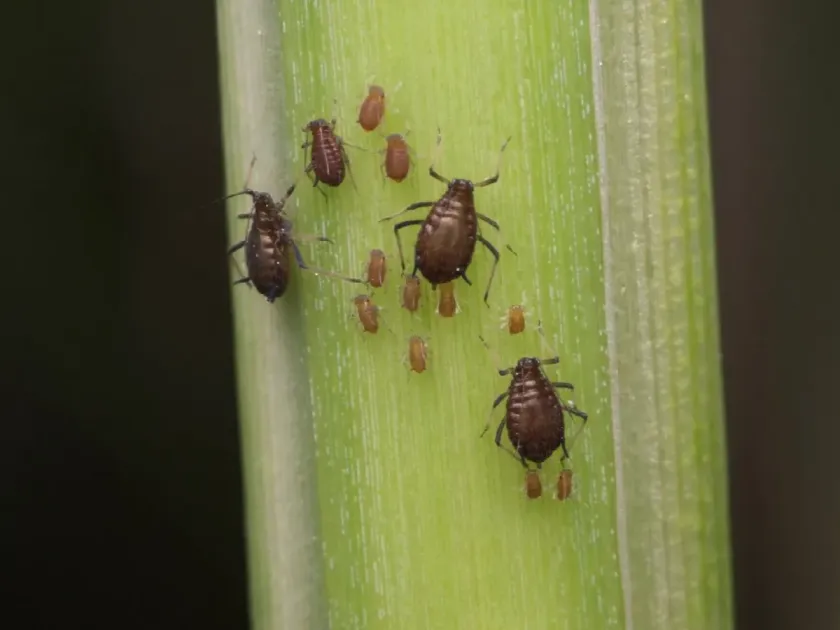
The Greenbug (Schizaphis graminum) is a small aphid belonging to the order Hemiptera. Adult individuals are characterized by a light green body with a distinct dark green stripe along the center of the abdomen.
This species exhibits a complex life cycle, alternating between asexual parthenogenetic reproduction in the summer and sexual reproduction in the fall to produce overwintering eggs.
Winged forms, known as alates, develop under crowded conditions or declining food quality, allowing for rapid colonization of new fields and distribution across larger areas.
Development is highly temperature-dependent, with populations capable of increasing rapidly in mild, temperate climates when the weather is favorable for reproduction.
Natural enemies such as lady beetles, lacewings, and parasitic wasps play a significant role in limiting population explosions in many agricultural environments.
What it damages
Greenbugs attack a wide range of cereals including wheat, barley, oats, rye, sorghum, and corn, as well as various wild grasses that serve as hosts.
By feeding on plant sap, they remove essential nutrients and introduce toxic salivary enzymes into the plant tissue, causing localized cell death and chlorosis.
A major economic impact of Schizaphis graminum is its ability to vector dangerous plant viruses, particularly the Barley Yellow Dwarf Virus (BYDV).
Heavy infestations lead to significant yield losses due to reduced plant vigor, delayed development, and, in severe cases, the complete destruction of the crop stand.
Stunted growth, reduced grain filling, and leaf necrosis are typical physiological outcomes of prolonged feeding by large aphid colonies.
Signs of infestation
The first signs of infestation are small yellow or red spots on the leaves, which gradually coalesce into large yellow patches as the colony grows.
Upon close inspection, one can observe colonies of green aphids clustered on the undersides of leaves or along the stem, often surrounded by sticky honeydew.
Leaf curling and the eventual browning or death of foliage are clear indicators of high aphid pressure, often misdiagnosed as drought stress or nutrient deficiency.
The presence of sooty mold on the leaf surface is a secondary sign, growing on the honeydew secreted by the aphids, which blocks light and hinders photosynthesis.
Ant activity on the plants is often a strong indicator, as ants frequently tend to aphids to harvest the honeydew they produce.
Control measures
Cultural practices like tillage and the removal of volunteer grasses significantly reduce the reservoir of eggs and early-season infestations in the field.
The use of aphid-resistant crop varieties is the most effective long-term strategy for managing populations and reducing the need for insecticide applications.
Monitoring fields regularly for aphid density is essential to determine if the economic threshold for treatment has been reached to minimize crop losses.
Chemical control should be implemented using selective insecticides that provide effective suppression of aphids while sparing beneficial predator and parasitoid populations.
Biological control, by conserving natural enemies and implementing habitat management, provides sustainable long-term regulation of Greenbug numbers in cereal fields.
Taxonomy
- Latin name
- Schizaphis
- Order
- Hemiptera (bugs, aphids, leafhoppers)
- Family
- Aphididae
- EPPO code
- SCHPSP
Discussion
No discussions yet — be the first.