
American grapevine leafhopper
Scaphoideus titanus
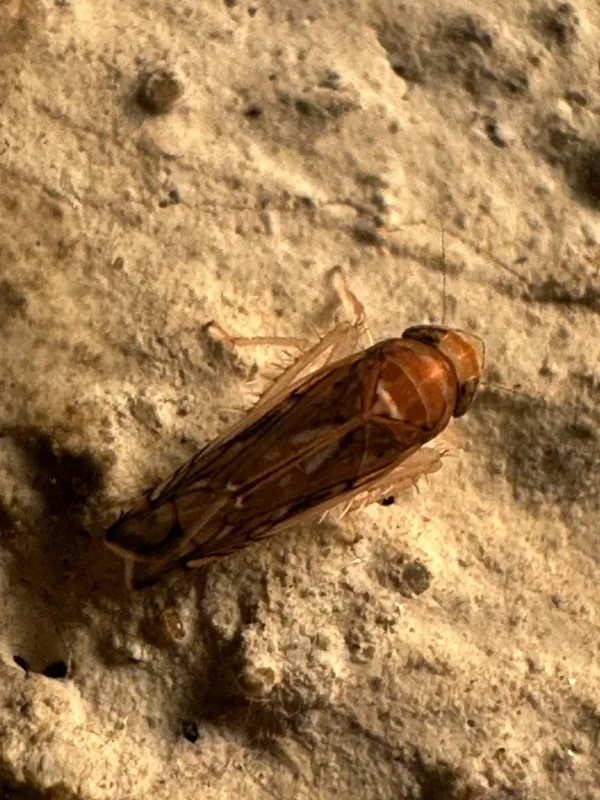
Description
How to identify
The American grapevine leafhopper (Scaphoideus titanus) belongs to the order Hemiptera, family Cicadellidae. It is a small insect, approximately 5 millimeters long, with a characteristic light brown to yellowish coloration marked by distinct transverse bands.
Adult insects are known for their jumping ability and rapid movement within the grapevine canopy when disturbed. Their wings are transparent with prominent reticulate venation, serving as a key diagnostic feature for field identification.
Nymphs of this leafhopper pass through five developmental stages (instars), gradually increasing in size. They typically exhibit a paler, often yellowish-white color and appear as smaller, wingless versions of the adults.
To accurately identify and monitor populations, agronomists utilize yellow sticky traps placed within vineyard rows. This allows for precise tracking of emergence times and population density, essential for informed decision-making regarding pest control measures.
The primary habitat is the grapevine foliage, where the pest leads a secretive lifestyle, preferring the underside of the leaves, especially within dense, unpruned areas of the vine canopy.
What it damages
This leafhopper species is the sole known vector of the dangerous phytoplasma disease known as flavescence dorée. The phytoplasma circulates within the insect, transmitting the pathogen to healthy plants through feeding on the sap.
While mechanical damage from sap extraction is generally minor and does not cause vine mortality, the primary damage is the systemic phytopathological infection that leads to the degradation of entire vineyard plantings.
Infected vines exhibit symptoms such as chlorosis, leaf curling, and the premature shedding of flower clusters and berries. Long-term, this results in total loss of productivity and the eventual death of the vineyard block within a few years.
Infection spreads rapidly, as a single infected leafhopper can inoculate a healthy vine after only a few hours of feeding. The insect is an obligate parasite, making population control a critical priority for viticulture.
Almost all cultivars of the European grapevine (Vitis vinifera) are highly susceptible to the phytoplasma transmitted by this pest, representing a significant threat to global wine production.
When it appears
The leafhopper completes one generation per year, overwintering in the egg stage under the bark of two-year-old vine shoots. Embryonic development begins in early spring as temperatures rise consistently.
Nymph hatching typically begins in late May or early June. The exact timing of this process is heavily dependent on local climatic conditions and the accumulation of degree-days in the vineyard environment.
The nymphal stage lasts for approximately 40 to 50 days, during which the pest progresses through five successive molts. This is the optimal window for targeted insecticide applications when the insects are most vulnerable.
Adult leafhoppers are usually observed from mid-July through early autumn. This is the period of maximum dispersal throughout the vineyard and the peak window for the transmission of the phytoplasma pathogen.
With the onset of autumn frosts, the adults lay eggs into the crevices of the woody bark of the vine, after which they perish, completing the life cycle until the following growing season.
Signs of infestation
In the early stages of infestation, visual signs of leafhopper presence may be subtle. Initial indicators often include localized leaf damage that can easily be confused with minor nutrient deficiencies.
Signs of flavescence dorée include the bleaching of leaf veins, followed by yellowing or reddening of the leaf blade, which typically begins to roll downward into a triangular shape.
Another sign is the poor maturation of shoots; affected shoots remain green until late autumn and are frequently killed by winter frosts due to a lack of proper lignification and cold hardiness.
The presence of an unusual quantity of withered or undeveloped clusters on otherwise healthy-looking vines should alert the grower and trigger an immediate inspection for leafhopper activity.
A specific symptom is the mass shedding of berries and flowers, rendering the vine nearly infertile during the current vegetative season.
Control measures
Management strategies for this pest rely on mandatory phytosanitary practices and rigorous population monitoring using sticky traps to ensure timely intervention.
- Exclusive use of certified virus-free planting material to prevent primary infection.
- Implementation of prophylactic insecticide treatments during the critical nymphal emergence window.
- Immediate removal and incineration of heavily infected vines to prevent the spread of the epidemic.
- Regular pruning and disposal of old bark where eggs overwinter.
- Clearing adjacent areas of wild grapevines that serve as an environmental reservoir for the disease.
Chemical control is only effective if application timing is strictly synchronized with the nymphal development stages, before the insects mature into winged adults.
Insecticide use must be systematic: neonicotinoid or pyrethroid treatments are common, provided that dosage rates are strictly followed and active ingredients are rotated to mitigate the development of insecticide resistance.
Taxonomy
- Latin name
- Scaphoideus titanus
- Order
- Hemiptera (bugs, aphids, leafhoppers)
- Family
- Cicadellidae
- EPPO code
- SCAPLI
Discussion
No discussions yet — be the first.