
Oak aphid
Sarucallis
Description
How to identify
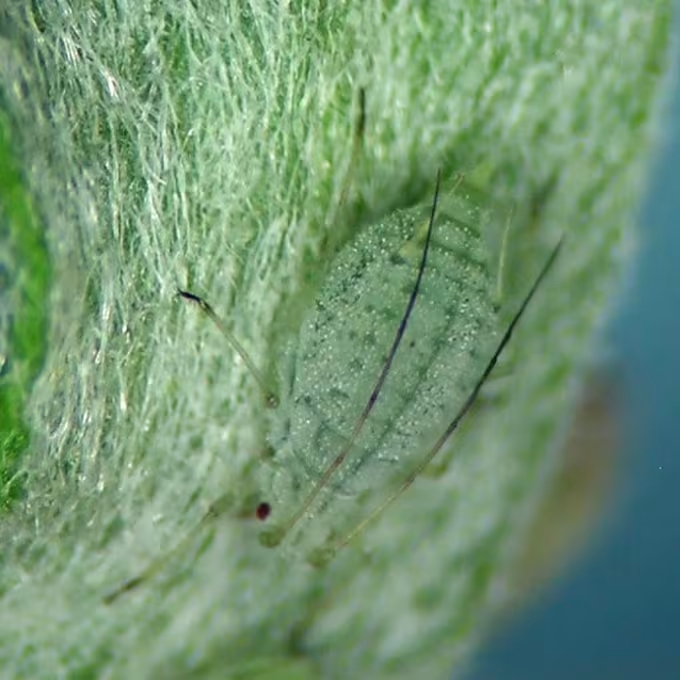
The oak aphid (lat. Sarucallis) is a specialized insect belonging to the family Aphididae that feeds primarily on oak species. These small, soft-bodied insects are usually 1.5–2.5 mm in size.
Their coloration is typically pale yellow or light green, allowing them to blend in with the undersides of leaves where they reside.
They possess a piercing-sucking mouthpart used to extract phloem sap from the host plant, which is the primary source of their nutrition.
The life cycle is complex, involving multiple generations of wingless females in spring and summer, and winged forms that allow for dispersion to other trees.
The species overwinters as eggs, which are deposited in bark crevices and remain dormant until the following spring.
What it damages
These aphids target various oak species, causing damage by draining plant resources from young shoots and developing leaves.
By consuming large quantities of sap, they weaken the tree's physiological processes, leading to reduced growth rates and impaired wood development.
The feeding activity results in the curling, yellowing, and premature senescence of foliage, which diminishes the tree's overall vigor.
Large colonies produce copious amounts of honeydew, a sugary substance that promotes the growth of sooty mold on leaf surfaces.
The presence of sooty mold blocks sunlight, further reducing the photosynthetic capacity of the oak tree and affecting its long-term health.
When it appears
The activity of the oak aphid begins early in spring, synchronizing with the bud burst phase when nutrient-rich sap is abundant.
Population density typically peaks between May and June, corresponding with the period of most active vegetative growth of the host tree.
Environmental factors, such as temperature and humidity, significantly influence population dynamics, with moderate weather favoring rapid reproduction.
In late summer, the aphid colony shifts towards producing sexual individuals to ensure the survival of the species during the winter.
Eggs are laid in autumn, marking the end of the seasonal infestation cycle and ensuring the next generation persists through the cold season.
Signs of infestation
The most noticeable sign of an infestation is the visible deformation of leaves, which often appear curled, crinkled, or yellowed.
The presence of honeydew creates a sticky surface on the foliage and branches, which is easily detected by touch or by the presence of foraging ants.
- Dark, powdery sooty mold covering leaf surfaces.
- High ant activity traveling along the tree trunk and branches.
- Premature yellowing or shedding of leaves during the growing season.
- Accumulation of shed white skins (exuviae) left behind by developing aphids.
A closer inspection of the undersides of leaves reveals small clusters of aphids gathered along the veins of the leaf.
Control measures
Biological control agents, including lady beetles, lacewings, and hoverflies, play a crucial role in maintaining aphid populations below damaging levels.
For severe infestations, systemic insecticides can be applied to the soil or as a foliar spray to provide targeted relief to the affected tree.
Good cultural practices, such as adequate watering and soil health management, improve the tree's resilience to pest stress.
Early intervention is essential; treating the tree before the leaves become severely deformed yields the best results for plant recovery.
When applying pesticides, ensure thorough coverage of the leaf undersides, as this is where the majority of the population hides and feeds.
Taxonomy
- Latin name
- Sarucallis
- Order
- Hemiptera (bugs, aphids, leafhoppers)
- Family
- Aphididae
- EPPO code
- SARUSP
Discussion
No discussions yet — be the first.