
Manchurian root mite
Sancassania mandzhur
Description
How to identify
The Manchurian root mite (Sancassania mandzhur) belongs to the Acaridae family within the order Sarcoptiformes. It is a soil-dwelling pest that primarily affects root systems and storage organs of various agricultural crops.
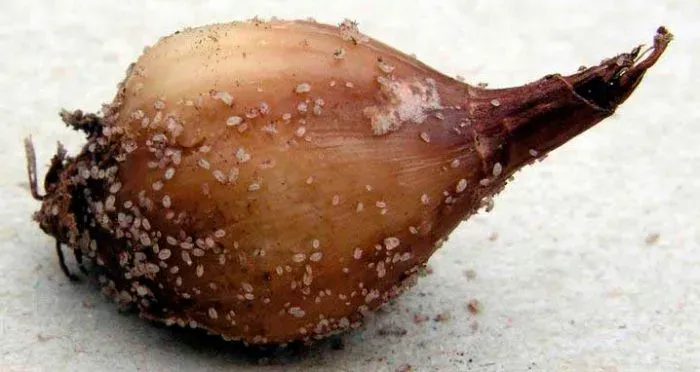
Adult mites are microscopic, oval-shaped organisms measuring between 0.3 and 0.7 millimeters. Their body color is generally whitish or pale yellowish, making them almost invisible against the soil particles and plant tissues.
A key biological trait of this species is the ability to form a hypopus stage. This specialized nymphal stage is resistant to harsh environmental conditions, such as dehydration or chemical treatments, ensuring the mite's survival during unfavorable periods.
The mite thrives in moist, organic-rich soil. Females deposit eggs directly onto the plant roots or within the substrate gaps near the plant base, ensuring immediate food access for emerging larvae.
The development cycle progresses through egg, larva, protonymph, deutonymph (hypopus), and adult stages. Under optimal conditions (20–25°C and high humidity), a complete generation can be produced in less than two weeks, leading to rapid population outbreaks.
What it damages
The Manchurian root mite attacks a diverse range of crops, including root vegetables, potatoes, bulbous ornamental plants, and greenhouse seedlings. The primary damage occurs underground, where the mite feeds on roots, tubers, and basal tissues.
By boring into plant tissues, mites create entry points for secondary pathogens, such as fungi and bacteria. This often results in soft rot, which is frequently the true cause of crop failure observed by the grower.
Bulb crops are particularly vulnerable; mites feed on the basal plate, causing the bulb to decay from the inside out. In severe cases, the entire root structure is destroyed, leading to plant collapse and premature death.
In storage facilities, the mites are highly destructive. They can spread quickly from infected produce to healthy ones, causing extensive losses in stockpiled vegetables throughout the winter months.
- Wilting of plants due to destroyed root systems.
- Necrotic lesions and decay at the plant base.
- Hollowing out of bulbs and tuber tissues.
- Rapid rot spread during storage.
Signs of infestation
Sudden wilting of plants that does not recover after irrigation is a primary indicator of root mite infestation. When inspected, the root system often appears brown, fragile, or partially decayed.
Cross-sections of infested bulbs or roots reveal internal cavities or tunnels created by the mites. These areas are often filled with debris and may show evidence of secondary mold growth.
In greenhouse environments, poor establishment of seedlings is a common sign. The stems may appear thin or blackened at the soil level, and the growth rate is significantly lower compared to healthy plants.
Under laboratory examination, mites can be detected in soil samples or plant material. Often, the presence is discovered only after significant damage has occurred, making early diagnosis crucial.
A distinct, musty or sweet-decaying odor is often associated with heavy infestations, caused by the combined activity of the mites and the resulting rotting plant matter.
Control measures
Effective management requires strict crop rotation and the thorough removal of crop residues, which serve as overwintering sites for the mites. Maintaining soil drainage is critical to prevent the moisture levels the mites prefer.
Prior to planting, seeds, bulbs, and seedling roots should be treated with appropriate acaricides or heat-disinfected to eliminate potential infestations. This preventative measure is vital for sensitive high-value crops.
During the growing season, systemic acaricides may be applied upon detection of the pest. Treatments must be targeted at the root zone to ensure the product reaches the hidden population.
In storage areas, hygiene is paramount. Disinfecting containers and maintaining low-temperature, low-humidity storage conditions effectively suppress mite reproduction and spread.
Biological control, including the use of entomopathogenic fungi, can be an effective way to suppress mite populations in the soil without the use of heavy chemicals, offering a sustainable approach to pest management.
Taxonomy
- Latin name
- Sancassania mandzhur
- Order
- Mites
- Family
- Acaridae
- EPPO code
- SANCMA
Discussion
No discussions yet — be the first.