
Bulb mite
Sancassania berlesei
Description
How to identify
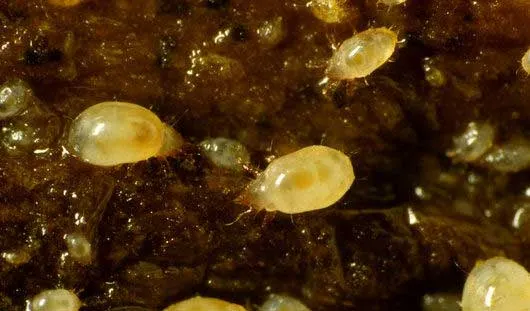
The bulb mite (Sancassania berlesei) is a member of the Acaridae family. It is a tiny, microscopic mite that thrives in moist, organic-rich environments, commonly found in soil and storage facilities.
The adult mite has an oval, creamy-white or light brown body with numerous long, bristly hairs. Their small size makes them invisible to the naked eye, often requiring a microscope for accurate identification.
A distinctive feature of their life cycle is the ability to produce a resistant stage known as a hypopus. This stage is highly durable and allows the mites to survive adverse conditions like low moisture or starvation.
The developmental process is temperature-dependent. Under optimal conditions (high humidity and temperatures around 20-25°C), the mite can complete its life cycle in less than two weeks, leading to rapid outbreaks.
These mites are essentially opportunistic feeders that gravitate toward decaying plant tissues, making them a major secondary threat following initial mechanical injury or infection by other pathogens.
What it damages
Bulb mites affect a wide range of monocotyledonous plants, including onions, garlic, lilies, tulips, hyacinths, and daffodils. They are equally dangerous in field conditions and vegetable warehouses.
They typically attack the basal plate (the bottom) of the bulb. By feeding on the internal tissues, they compromise the structural integrity of the bulb and inhibit root development.
In addition to physical damage, the mites act as vectors for various fungal and bacterial pathogens. They transport spores into the bulb, accelerating rot and destruction of the crop.
In infested plants, growth is stunted, leaves show signs of chlorosis (yellowing), and the plant may eventually wilt and collapse entirely. In storage, the spread of the mite can lead to the total loss of the entire harvest.
The feeding activity creates hollow cavities and tunnels within the bulb scales, which are often filled with brownish, powdery excrement and fungal decay.
Signs of infestation
Early-stage detection is difficult because the mites are hidden within the bulb. The first visible symptoms are usually retarded development and poor plant vigor compared to healthy neighbors.
By inspecting the base of the bulb, one can notice structural damage. The tissue becomes soft and spongy, and in advanced cases, the basal plate may detach completely.
During storage, the surface of the bulbs may appear dusty or dirty due to the accumulation of mite debris and waste products mixed with fungal spores.
Yellowing of the leaves is a common symptom, which progresses from the tips downwards. This is often confused with nutrient deficiencies or fungal wilt, so closer examination is required.
If a suspected bulb is cut, a characteristic earthy, putrid smell is often present, and the internal tissue will look brownish and disintegrated, often revealing the mites themselves.
Control measures
Successful management begins with sanitation. Removing plant debris from the field and maintaining proper crop rotation are critical steps to prevent the buildup of mite populations in the soil.
Post-harvest care is equally important; bulbs should be properly cured and dried before storage to keep humidity low, as moisture is essential for mite survival and reproduction.
Chemical control using acaricides is effective for seed bulbs. Soaking bulbs in authorized acaricide solutions before planting can drastically reduce the initial mite pressure.
In storage, environmental control is the primary defense. Maintaining low temperatures and low relative humidity prevents the mite population from reaching damaging levels.
- Utilize only clean, disease-free planting material.
- Disinfect storage facilities and crates regularly.
- Implement strict moisture control in warehouses.
- Avoid over-watering in field conditions to reduce the prevalence of rot.
Taxonomy
- Latin name
- Sancassania berlesei
- Order
- Mites
- Family
- Acaridae
- EPPO code
- CALNBE
Discussion
No discussions yet — be the first.