
Egyptian fruit bat
Rousettus aegyptiacus
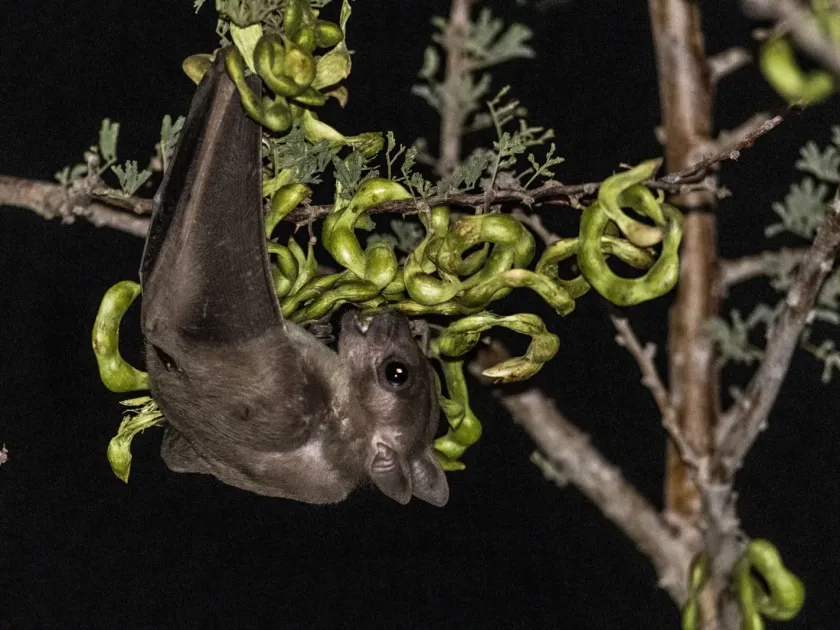
Description
How to identify
The Egyptian fruit bat (Rousettus aegyptiacus) is a large, frugivorous mammal belonging to the Pteropodidae family, often referred to as a flying fox.
They are characterized by their dog-like face, large dark eyes, and a significant wingspan that can extend up to 60 centimeters in length.
Unlike most bats, they do not rely solely on echolocation but also utilize excellent night vision to navigate and locate fruit sources in orchards.
These animals are highly social, living in large colonies in caves or man-made structures, and they travel long distances every night to feed.
Their biological adaptation to a fruit-based diet makes them a formidable agricultural pest in subtropical and tropical farming regions.
What it damages
Egyptian fruit bats target a wide variety of commercial crops, primarily causing damage to ripening fruits such as dates, figs, citrus, and various stone fruits.
The bats damage fruit by biting into the pulp, frequently leaving uneaten portions that quickly spoil and attract other secondary pests like insects and fungi.
In cases of severe infestation, a single colony can decimate a substantial portion of an orchard's production over just a few nights of feeding.
In addition to fruit consumption, they can cause physical harm to tree structures by breaking young branches while maneuvering through the canopy.
- Date palms
- Fig trees
- Grapes and vineyards
- Citrus orchards
- Stone fruit trees
When it appears
The impact of this pest is highly seasonal, peaking when local fruit crops reach their maturity and sugar content levels become most attractive.
During the harvest period, farmers face the highest risk, as the bats exhibit intense foraging behavior to maximize their nutritional intake.
In many regions, these bats remain active year-round, but their agricultural impact is most devastating during the peak fruiting months of late summer and autumn.
Migratory patterns influence their arrival in farming areas, making it difficult for growers to predict exactly when control measures need to be ramped up.
Constant vigilance is required throughout the ripening season, as the nocturnal nature of the bats allows them to cause damage unnoticed until the morning.
Signs of infestation
The most reliable sign of a fruit bat presence is the discovery of half-eaten fruit on the orchard floor, showing distinct, jagged tooth marks.
Orchards infested with these pests often emit a distinct, musky scent characteristic of their colonies, which becomes particularly strong near roosting sites.
Broken twigs and damaged foliage in the upper canopy areas of the trees are common indicators that a large group has been feeding in the orchard.
Nocturnal observations, such as hearing loud flapping wings or high-pitched social vocalizations, often confirm the presence of a colony.
Massive quantities of waste or droppings found under the trees provide further evidence of high activity levels within the orchard space.
Control measures
The most effective strategy for orchard protection is the installation of high-quality exclusion netting, which prevents bats from reaching the fruit.
Acoustic deterrents that emit high-frequency pulses can be used to disturb the bats' navigation, though they are most effective when used in combination with other methods.
Good orchard management, including the rapid collection of dropped or overripe fruit, is essential to reduce the availability of easy food sources.
Bright lighting systems or reflective materials can provide temporary relief by creating an uncomfortable environment for the nocturnal visitors.
An integrated pest management approach, combining physical barriers and sensory deterrents, is necessary to minimize losses in high-value fruit production areas.
Taxonomy
- Latin name
- Rousettus aegyptiacus
- Family
- Pteropodidae
- EPPO code
- ROUSAE
Discussion
No discussions yet — be the first.