
Straw-colored fruit bat
Eidolon helvum
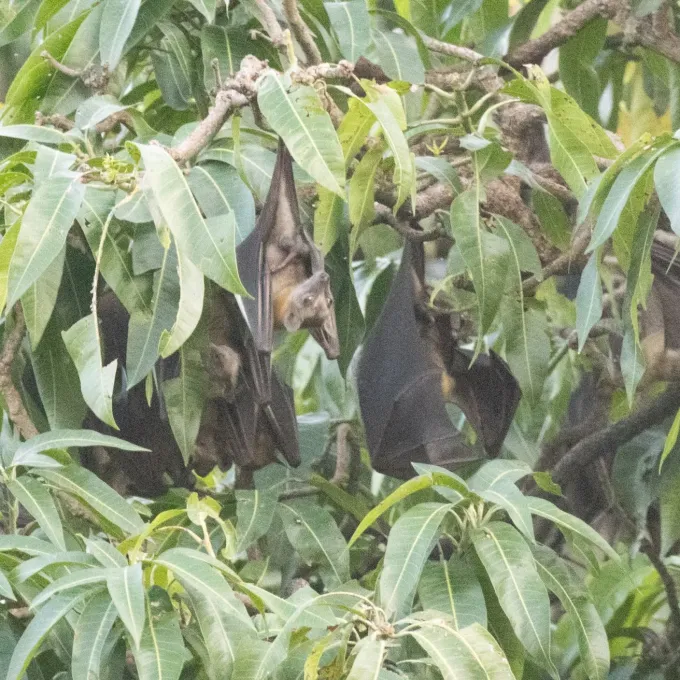
Description
How to identify
The straw-colored fruit bat (Eidolon helvum) is a large megabat belonging to the Pteropodidae family. It is one of the most widely distributed bats in Africa, known for its significant ecological and agricultural impact.
These bats are quite large, with a wingspan reaching up to 75–80 cm and an average body weight of 250–350 grams. They have a distinct fox-like face and large eyes adapted for nocturnal vision.
They are highly gregarious animals, forming massive colonies that can contain hundreds of thousands or even millions of individuals roosting together in large trees or urban settings.
Straw-colored fruit bats are known for their high mobility and capacity for long-distance migration, which allows them to track the phenology of fruit ripening across large geographic areas.
As social creatures, they coordinate their movements to locate food sources, making them a recurring challenge for fruit producers in tropical and subtropical regions.
What it damages
The straw-colored fruit bat is considered a significant agricultural pest as it feeds on a wide variety of cultivated fruits, including mangoes, guavas, papayas, and citrus.
The damage is caused by the bats chewing on fruits to extract juice, which leaves the remaining pulp exposed to oxidation, fermentation, and secondary fungal infections.
Beyond fruit consumption, these bats can damage the structural integrity of trees. Their heavy weight and tendency to roost in large numbers can cause branches to break, reducing tree productivity.
In cases of severe infestation, a large colony can consume or spoil a significant percentage of an orchard's annual production in just a few nights of intensive feeding.
Furthermore, they often feed on flowers and young buds, which hampers the reproductive cycle of the fruit trees and results in lower yields during the following harvest seasons.
When it appears
The presence of these bats in an orchard is closely tied to the ripening cycle of their preferred food crops. They follow the harvest seasons, arriving when fruits reach maturity.
The period of maximum risk occurs when crops like mangoes are ripening, as the high sugar content of the fruit acts as a strong attractant for migrating bat colonies.
Because their movements are driven by food availability, arrival at a specific plantation is often sporadic and difficult to predict without monitoring the regional fruiting patterns.
During dry seasons, bats are more likely to concentrate in irrigated orchards where succulent fruit remains available, increasing the pressure on these managed systems.
Farmers must be vigilant during the maturation phase of their crops and monitor for signs of increased nocturnal activity to deploy mitigation strategies in time.
Signs of infestation
The most obvious signs of infestation include the presence of partially eaten fruits scattered beneath the trees and the accumulation of bat droppings in the orchard floor.
Upon inspection, fruits display deep, distinctive bite marks and ragged edges. Many fruits are dropped to the ground before being fully consumed by the animals.
Physical damage to the canopy is also common, including broken twigs and stripped bark, resulting from the cumulative weight of dozens of bats roosting on a single branch.
A strong, musky odor often permeates the orchard when a large colony is present, serving as a clear indicator of their activity nearby.
- Partially eaten fruit found on the ground.
- Distinctive tooth marks on ripe fruit surfaces.
- Broken branches within the canopy.
- Loud vocalizations heard during night-time hours.
Control measures
The most effective physical control method is the installation of protective netting over orchard trees to prevent the bats from accessing the maturing fruit.
Acoustic deterrents, such as high-frequency ultrasonic emitters or devices that play recorded distress calls, may provide short-term relief by creating an uncomfortable environment for the colony.
Good orchard sanitation is essential; removing fallen, overripe, or damaged fruit prevents the creation of attractants that draw bats to the plantation in the first place.
Visual deterrents, such as reflective streamers or shiny objects, may offer some utility in scaring bats away, though their effectiveness is limited as the animals habituate quickly.
Managing the perimeter with non-commercial fruit trees can sometimes act as a distraction, diverting the foraging pressure away from the main valuable crop harvest.
Taxonomy
- Latin name
- Eidolon helvum
- Family
- Pteropodidae
- EPPO code
- EIDLHE
Discussion
No discussions yet — be the first.