
Rivellia viridulans
Rivellia viridulans
Description
How to identify
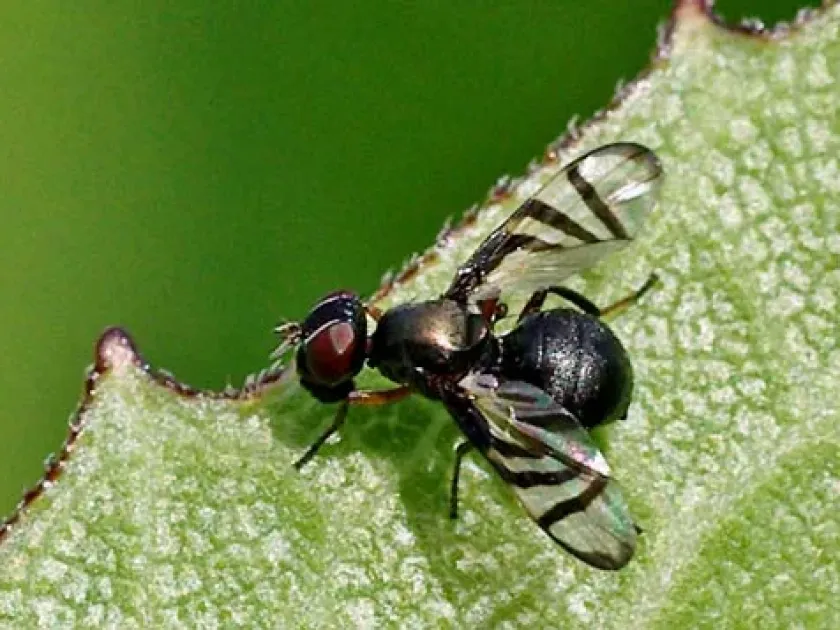
Rivellia viridulans belongs to the order Diptera, family Platystomatidae. This small fly features a distinct metallic or greenish-bronze sheen on its body.
Adult specimens possess transparent wings with dark transverse bands, which serves as a key diagnostic feature when inspecting fields.
The larvae are typical of many fly species: they are legless, maggot-like, whitish or cream-colored, and reach 5–7 millimeters in length.
The insect's life cycle is closely tied to the plant's root system, where the larvae develop by feeding on plant tissues and root nodules.
These pests primarily overwinter as puparia in the soil at a depth of 10–15 centimeters, ensuring high survival rates throughout the winter months.
What it damages
The primary crop affected by this pest is soybean, though it may occasionally attack other leguminous plants.
Rivellia viridulans larvae feed on the nitrogen-fixing nodules of soybean roots, disrupting nitrogen fixation and weakening the plant's overall development.
Damage to the root system reduces the plant's ability to absorb water and essential nutrients from the soil during critical growth stages.
When pest populations are high, significant thinning of the stand and stunted seedling growth are observed, inevitably leading to yield losses.
Beyond direct mechanical injury, damaged roots become entry points for secondary fungal and bacterial infections.
When it appears
Adult flight usually occurs during the soybean flowering and pod-filling stages, when the plant is most vulnerable.
Mass emergence of flies often coincides with the onset of warm weather, which stimulates reproduction and egg-laying near the root zone.
Depending on the climatic region, the pest may complete one or several generations per season, extending the window of potential threat.
Maximum insect activity is observed during the morning and evening hours when they move from plant to plant.
Environmental conditions such as high soil moisture can contribute to more intensive larval development within the root zone.
Signs of infestation
In the early stages of infestation, plants appear stunted, with slow growth and leaf yellowing not attributable to micronutrient deficiencies.
When uprooting plants, one can observe the absence or destruction of nitrogen-fixing nodules on the roots.
The larvae themselves can often be found upon close inspection of the root collar or in the immediate vicinity of damaged roots.
In areas of intense damage, the root system may appear gnawed, often accompanied by tissue decay processes.
- General lag in plant development.
- Premature wilting during hot weather.
- Lack of active nodules on the roots.
Control measures
Effective protection begins with proper crop rotation, avoiding the continuous cultivation of soybeans on the same field for several years.
High-quality soil tillage, including deep plowing, plays an essential role in destroying the overwintering puparia stages.
Applying insecticidal seed treatments prior to planting helps protect seedlings from larval damage during the early stages of vegetation.
Monitoring adult populations using yellow sticky traps allows for timely decisions regarding the application of systemic insecticides.
Spatial isolation of new soybean fields from previous years' legume plantings significantly reduces the risk of mass pest migration.
Taxonomy
- Latin name
- Rivellia viridulans
- Order
- Diptera (flies)
- Family
- Platystomatidae
- EPPO code
- RIVEVI
Discussion
No discussions yet — be the first.