
Four-banded fly
Rivellia quadrifasciata
Description
How to identify
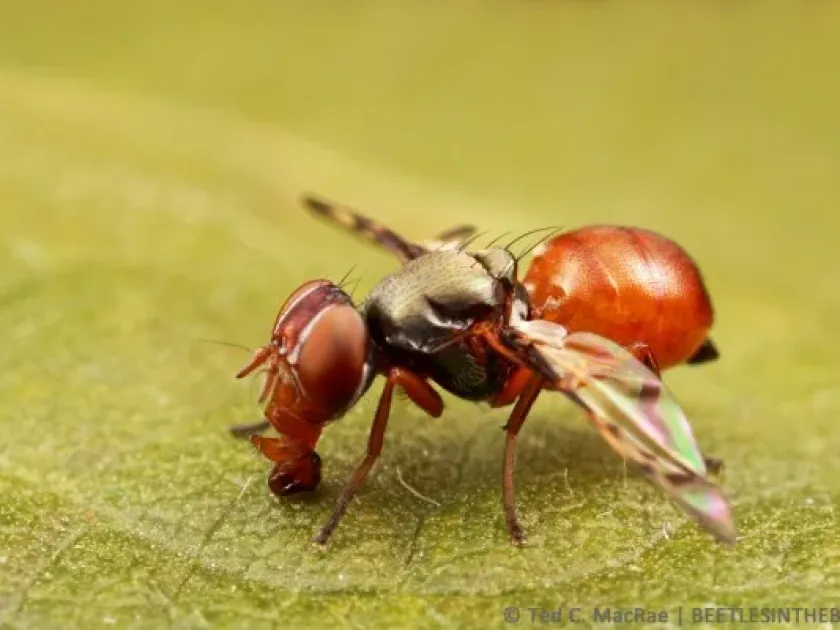
The Four-banded fly (Rivellia quadrifasciata) is a dipteran insect belonging to the Platystomatidae family, known as a specific pest of legume crops.
The adult fly is easily recognizable by its dark brown body and the four distinct dark transverse bands present on its wings, which give it its common name.
Larvae of this species are legless, cylindrical, and pale-colored, making them perfectly adapted for a life hidden within the soil profile.
The head of the larva is significantly reduced, which is a common adaptation among dipteran larvae living in buried or secluded environments.
For identification purposes in the field, entomologists use yellow sticky traps to capture adults, providing a reliable count of population density during the season.
What it damages
The primary host plant of Rivellia quadrifasciata is soybean (Glycine max), where it causes damage primarily through its larval stage.
The larvae feed on the roots of soybean plants, causing lesions and compromising the integrity of the root system, which affects nutrient and water uptake.
A significant aspect of the damage is the destruction of nitrogen-fixing root nodules, which directly interferes with the plant's ability to fix atmospheric nitrogen.
This root damage leads to reduced plant vigor, stunted growth, and a noticeable decrease in seed yield when infestation levels are high.
In addition to cultivated soybeans, the pest can also impact various wild legumes, maintaining the population within the agricultural landscape.
When it appears
The life cycle of the Four-banded fly is synchronized with the phenology of soybean crops, starting with adult emergence during the early vegetative stages.
Females lay their eggs in the soil near the base of the soybean plants, ensuring that the hatched larvae have immediate access to the root zone.
Depending on regional climatic conditions, the pest can undergo multiple generations during a single growing season, often peaking in mid-summer.
Pupation occurs within the soil, and the insect typically overwinters in the puparial stage, waiting for warmer conditions to trigger the next emergence cycle.
Monitoring for adults is critical, as the population levels often fluctuate based on soil moisture and the developmental stage of the soybean crop.
Signs of infestation
Plants affected by larval feeding often show signs of chlorosis, which is frequently mistaken for water stress or nutrient deficiencies in the field.
Stunted development compared to neighboring healthy plants is a primary field symptom that indicates potential subterranean pest activity.
When roots are excavated, the absence of nitrogen-fixing nodules or the presence of larval feeding tunnels provides clear evidence of infestation.
Plants may exhibit premature wilting during hot afternoons because the damaged roots are unable to keep up with the plant's water transpiration demands.
In severe cases, localized patches of yellowing and poor-performing soybeans can be observed, which often follow the distribution of the larval population.
Control measures
Crop rotation is the cornerstone of managing this pest, as it prevents the buildup of larval populations in the soil over successive seasons.
Seed treatments with systemic insecticides provide an effective barrier, protecting the developing root system during the early stages of soybean growth.
Maintaining high soil fertility and optimal agricultural practices ensures vigorous plant growth, which helps soybeans better withstand light root damage.
Regular monitoring using sticky traps allows for precise timing of chemical applications if the adult population reaches the economic injury threshold.
- Implementing crop rotation.
- Using insecticide seed coatings.
- Monitoring with sticky traps.
- Ensuring proper soil nutrition.
Taxonomy
- Latin name
- Rivellia quadrifasciata
- Order
- Diptera (flies)
- Family
- Platystomatidae
- EPPO code
- RIVEQU
Discussion
No discussions yet — be the first.