
Bean fly
Rivellia apicalis
Description
How to identify
The bean fly (Rivellia apicalis) belongs to the family Platystomatidae within the order Diptera. It is a significant pest that affects various legume crops, particularly in intensive farming areas.
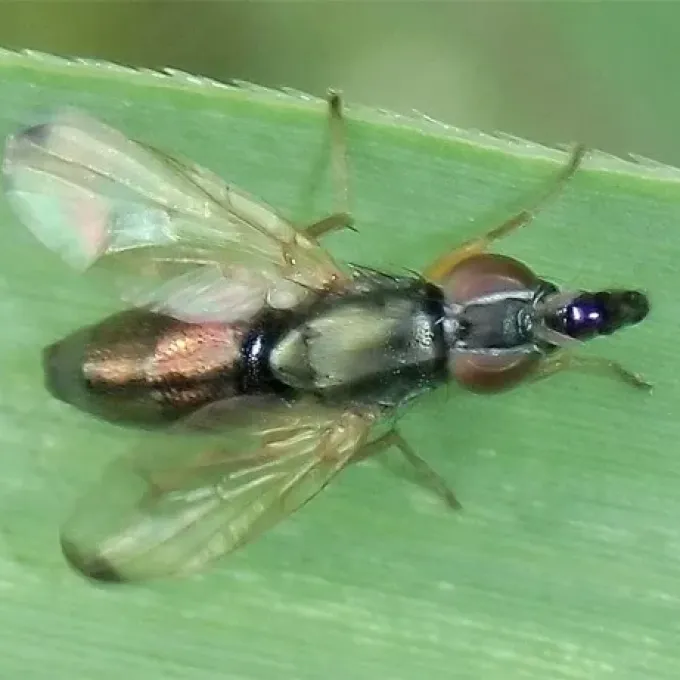
Adult flies are approximately 5–6 mm long and feature a distinct dark, sometimes metallic body coloration. They are frequently observed near host plants during the early vegetative stages.
A key identifying feature of this species is the specific banded or spotted wing pattern. This visual characteristic helps agronomists distinguish it from other fly species in the field.
Larvae are legless, maggot-like, and typically off-white or creamy in color. They reach about 7 mm in length and reside in the soil, focusing their feeding activity on the root zone.
The life cycle encompasses four stages: egg, larva, pupa, and adult. Environmental factors such as soil moisture and temperature are critical in determining the rate of population growth.
What it damages
Soybeans are the primary hosts for this pest. The larval stage is responsible for the damage, as they feed directly on the root system and nitrogen-fixing nodules of the plants.
By consuming the root tissues, the larvae disrupt the plant's ability to fix nitrogen and absorb essential nutrients, which is vital for the health of legume crops.
Plants affected by larval feeding exhibit stunted growth and yellowing of the leaves. Severe infestations often lead to a reduction in the overall vegetative mass and crop vitality.
During dry conditions, the impact is intensified as the impaired root system cannot support the water requirements of the growing plant, leading to premature wilting.
The feeding sites created by the larvae serve as entry points for soil-borne pathogens, leading to secondary infections such as root rot, which can cause total plant death.
Signs of infestation
Initial signs of infestation include patchy areas in the field where plants are significantly shorter and less vigorous compared to healthy sections.
Mid-day wilting of foliage is a common symptom in infested fields, indicating that the root system has been compromised and cannot keep up with transpiration rates.
Upon inspecting the roots, one will find visual evidence of tissue erosion and the presence of larvae. The absence of healthy, pinkish nodules is also a strong indicator of damage.
Leaves on heavily infested plants may show signs of chlorosis, which progresses to necrosis as the root system fails to provide necessary nutrients to the canopy.
In cases of high infestation density, seedling mortality is common, leading to irregular plant stands and a substantial decrease in the harvestable population.
Control measures
Crop rotation is the most effective cultural practice to manage the bean fly population. Avoiding sequential planting of legumes helps break the pest's life cycle.
Deep plowing after harvest helps expose the pupae to unfavorable environmental conditions, significantly reducing the population that survives until the next season.
Seed treatment with systemic insecticides is a standard recommendation to protect seedlings during the first few weeks of development when they are most susceptible.
Foliar insecticide applications may be necessary during the peak flight period of the adult flies to minimize egg-laying and prevent the next generation from establishing.
Maintaining field sanitation, including the removal of volunteer legume weeds, is crucial, as these can serve as reservoirs for the pest when primary crops are absent.
Taxonomy
- Latin name
- Rivellia apicalis
- Order
- Diptera (flies)
- Family
- Platystomatidae
- EPPO code
- RIVEAP
Discussion
No discussions yet — be the first.