
Rhizophagus bipustulatus
Rhizophagus bipustulatus
Description
How to identify
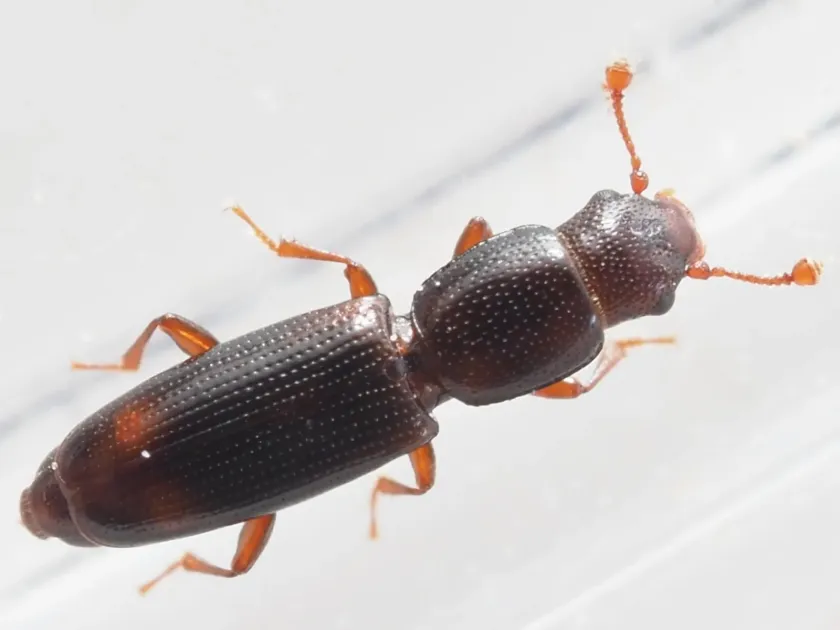
Rhizophagus bipustulatus belongs to the family Rhizophagidae, order Coleoptera. It is a small beetle, measuring about 2–3 mm in length, with an elongated, slightly flattened body of a shiny dark brown or black color.
A distinctive feature of this species is two large reddish-orange spots on the elytra, located in the anterior part. The head and pronotum are covered with fine punctures, giving the body a specific texture.
The larvae of this beetle have an elongated shape, a white or cream color, and a sclerotized head. They lead a cryptic lifestyle, living under the bark of trees, where they find suitable conditions for feeding and development.
The beetles are highly mobile and capable of moving quickly across the surface of tree trunks. Externally, they resemble some bark beetle species, but their role in the ecosystem is significantly different.
The species is widely distributed in Europe and Northern Asia. It prefers coniferous and deciduous stands where it finds an abundance of wood weakened by secondary pests or fungal diseases.
What it damages
The primary food source for Rhizophagus bipustulatus consists of the galleries and larvae of various bark beetle and wood-boring species. Thus, this beetle acts as an entomophage, regulating the population of forest pests.
Under certain conditions, the beetle may damage the weakened tissues of the cambium and phloem of young trees if its natural food source is insufficient. This makes it a conditionally harmful object in forest nurseries.
Trees that are weakened by mechanical injuries or drought are most sensitive to the presence of these insects. However, direct damage by the adult beetle is often secondary compared to the harm caused by primary pests.
Damage manifests as small depressions under the bark and injuries to the bast layer. If the beetle colony is large, they can contribute to the further dying off of bark patches, which weakens the overall condition of the tree.
The economic significance of the species is dual: on one hand, it helps control bark beetle outbreaks, on the other, mass concentrations in nurseries require monitoring to prevent damage to healthy seedlings.
When it appears
The mass flight of Rhizophagus bipustulatus occurs in spring, usually in April or May, when the average daily air temperature rises to 12–15 degrees Celsius. This time coincides with the activity period of major bark pests.
During the summer, the development of generations occurs under the tree bark. The life cycle includes egg, larva, pupa, and imago stages, with all stages being closely linked to wood humidity and air temperature.
In autumn, adults prepare for hibernation by hiding in forest litter, bark crevices, or wood residues. Primarily adults overwinter, allowing them to start reproduction immediately when favorable spring conditions return.
The number of generations per year depends on the climatic zone. In southern regions, two generations are possible, while in northern forests, the species usually produces one complete generation per season.
Insect activity noticeably decreases during prolonged rain or sudden cold snaps, although they are capable of maintaining viability across a wide range of weather conditions.
Signs of infestation
A visual sign of the beetle's presence is the trace of activity under the bark: the existence of winding galleries unrelated to typical bark beetle tunnels. Often, remains of other insects' shells can be found nearby.
When peeling back the bark of weakened trees, one can notice the beetles themselves with characteristic "two spots" on their elytra. They try to retreat deep into the damage quickly, avoiding direct light.
The presence of a large number of beetles on a tree trunk in spring may indicate a high degree of infestation by bark beetles, as this predator concentrates exactly where its food source is located.
The dying off of bark patches, accompanied by fungal growth, is often an indirect sign of activity by a complex of subcortical insects, including this species.
- Darkening of bark patches.
- Presence of holes in the bark left by other pests.
- Clustering of beetles in bark crevices.
Control measures
To prevent excessive reproduction of this beetle in nurseries and forestries, it is important to observe sanitary rules: timely removal of deadwood and windthrown trees that serve as breeding substrates.
The biological method of control consists of preserving and attracting birds and other beneficial entomophages to the stands, which can naturally reduce the population of the predator.
The use of insecticides is advisable only in exceptional cases when mass damage to young seedlings in nurseries is observed. It is recommended to use systemic preparations permitted for forestry use.
Agrotechnical measures include maintaining optimal planting density, regular watering, and fertilizing plants, which increases their immunity and makes them less attractive to subcortical inhabitants.
Monitoring population numbers using pheromone traps or trap trees allows for a timely assessment of the situation and decisions regarding the necessity of protective measures.
Taxonomy
- Latin name
- Rhizophagus bipustulatus
- Order
- Coleoptera (beetles)
- Family
- Rhizophagidae
- EPPO code
- RHISBI
Discussion
No discussions yet — be the first.