
Bulb mite
Rhizoglyphus echinopus
Description
How to identify
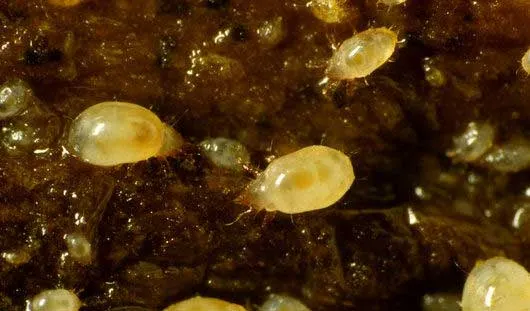
The bulb mite (Rhizoglyphus echinopus) is a serious agricultural pest belonging to the family Acaridae. These mites are microscopic, typically measuring about 0.5 to 1.0 mm in length, and possess a translucent, creamy-white or yellowish body.
Morphologically, they are characterized by their stout, brownish legs and relatively slow movement. Their bodies are smooth but equipped with several long setae (hairs) that help them navigate through soil crevices and plant tissue.
The life cycle consists of the egg, larva, two nymphal stages, and the adult stage. In unfavorable conditions, they can produce a specialized mobile stage called a 'hypopus', which is resistant to chemicals and allows the mite to hitchhike on insects or remain dormant.
Bulb mites thrive in warm, humid conditions, with temperatures between 20°C and 25°C being ideal for rapid population growth. Under such circumstances, the entire generation cycle can be completed in as little as 10 to 14 days.
Because they are soil-borne and thrive in decaying organic matter, they are often found in high densities in fields with poor drainage or in poorly ventilated storage facilities where humidity levels are elevated.
What it damages
This pest has a wide host range, primarily attacking various bulbous and tuberous plants. Common hosts include onions, garlic, shallots, and ornamental bulbs like lilies, tulips, hyacinths, gladioli, and dahlias.
The mites generally enter the bulb through the basal plate or existing wounds. Once inside, they feed on the inner tissues, causing the bulb to become soft, mushy, and eventually rot completely if left unchecked.
A significant aspect of the damage is the introduction of secondary pathogens. As mites feed, they create pathways for various soil-borne bacteria and fungi, such as Fusarium or Erwinia, which often accelerate the total destruction of the plant.
In the field, damage often appears as stunted growth, yellowing foliage, and premature wilting. Plants that are already stressed by heat, poor soil conditions, or other pests are significantly more susceptible to attack.
Storage damage is particularly severe. Large numbers of mites can quickly reduce healthy bulbs to dust-like debris, causing significant economic losses for commercial flower growers and vegetable farmers alike.
Signs of infestation
The earliest signs of infestation are often subtle, such as a decrease in the vigor of the plant, pale leaf color, and tips of leaves turning yellow and dying back prematurely during the growing season.
If you inspect an affected plant, you will find that the root system is poorly developed or completely absent, as the mites have consumed the basal plate and the roots. The bulb itself will feel spongy to the touch.
Upon cutting an infested bulb, one will notice brown, hollowed-out cavities filled with decaying tissue and a dusty, powdery residue. In advanced stages, a distinct unpleasant smell of decomposition is present.
In storage, infested bulbs may show a gray, powdery coating near the basal plate. This coating is actually a cluster of thousands of mites at various stages of development, sometimes visible under a standard hand lens.
Ornamental plants often exhibit distorted growth or failure to produce flowers. If they do flower, the blooms are typically smaller, deformed, and of poor commercial quality, rendering them unsellable.
Control measures
Cultural control is the most critical first step. This includes strict crop rotation, removing and destroying all infested crop residues from the previous season, and ensuring excellent soil drainage to prevent stagnant moisture.
Hot water treatment is an effective non-chemical method for planting stock. Submerging bulbs in water heated to 43°C–45°C for 10–20 minutes is often sufficient to kill mites within the bulb tissue without damaging the plant.
Chemical control involves the use of specialized acaricides or systemic insecticides. Treating bulbs by dipping them in a chemical solution before planting or storage is a standard practice to prevent population outbreaks.
Proper storage hygiene is essential. Bulbs should be kept in cool (below 5°C), dry, and well-ventilated environments. Reducing humidity below 60% drastically inhibits the mites' ability to reproduce and spread.
- Use high-quality, certified mite-free planting stock.
- Ensure thorough disinfection of storage bins and racks.
- Maintain optimal soil fertility to help plants withstand minor infestations.
Taxonomy
- Latin name
- Rhizoglyphus echinopus
- Order
- Mites
- Family
- Acaridae
- EPPO code
- RHIGEC
Discussion
No discussions yet — be the first.