
Bulb mite
Rhizoglyphus
Description
How to identify
The bulb mite (genus Rhizoglyphus) belongs to the family Acaridae within the order Acariformes. These microscopic pests are significant threats to various ornamental and vegetable crops, often measuring less than 1 mm in length.
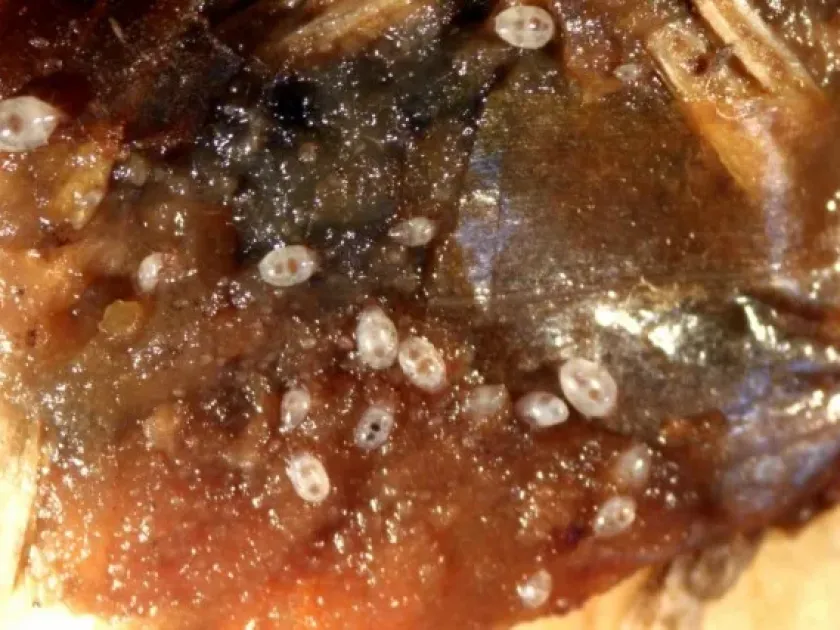
Their bodies are smooth, oval-shaped, and usually translucent white to pale yellow, with brownish legs. They possess specialized mouthparts designed to pierce plant tissues and extract nutrients from the bulb scales and roots.
The life cycle encompasses several stages: egg, larva, protonymph, deutonymph, and adult. Under unfavorable environmental conditions, they can enter a specialized survival stage known as a hypopus, which allows them to persist without food for extended periods.
Bulb mites thrive in moist conditions and moderate temperatures, often exploiting human-managed environments like greenhouses, storage facilities, and agricultural fields with poor drainage or organic matter buildup.
Their high reproductive rate allows them to reach damaging population levels very quickly, particularly in overcrowded storage settings where humidity remains high.
What it damages
Bulb mites are polyphagous, attacking a wide range of hosts including onions, garlic, tulips, lilies, hyacinths, and other bulbous plants. The damage is primarily internal, making it difficult to detect during the early stages.
Feeding usually begins at the basal plate, where mites tunnel into the plant tissue. This activity destroys the root initiation zone and weakens the structural integrity of the bulb.
The primary damage is often compounded by secondary infections from bacteria and fungi. Once the mite has compromised the bulb's surface, these pathogens enter freely, causing rapid decay and complete loss of the bulb.
In the field, infested plants exhibit stunted growth, yellowing foliage, and a lack of vigor. If the roots are destroyed before the plant is established, the plant will eventually collapse and die.
During storage, bulb mites can cause significant economic losses. An infested batch can be entirely destroyed within a single season if the mites are not controlled through proper environmental management.
Signs of infestation
Visible signs of infestation include uneven plant height, slow development, and premature leaf yellowing. When inspecting the bulb, one may observe the basal plate detaching or showing significant necrosis.
Infested bulbs often display a soft, mushy texture and may emit an unpleasant, pungent odor due to rotting tissues. Upon opening an infested bulb, one might see the mites as tiny, dust-like particles moving within the damaged scales.
The accumulation of brown, powdery frass (excrement) around the base of the bulb is a clear indicator of long-term mite activity. In many cases, white or grayish fungal mold grows on the areas damaged by the mites.
Early diagnosis is challenging, so growers should perform destructive sampling of bulbs that show signs of unthriftiness in the greenhouse or field to check for mite presence.
Plants struggling to emerge from the soil often have damaged root systems caused by the mites, leading to a thin, patchy crop stand that is unproductive and prone to further disease.
Control measures
Prevention is the cornerstone of bulb mite management. Ensuring that bulbs are clean, dry, and free of physical damage before storage significantly reduces the risk of infestation.
Maintaining proper humidity (below 60%) and adequate ventilation in storage areas helps prevent the mites from reproducing. Furthermore, crop rotation is essential in preventing the buildup of mite populations in agricultural soil.
For chemical control, soaking bulbs in systemic acaricides before planting or storage is a proven strategy to eliminate existing mite colonies and provide residual protection.
If an infestation is detected in a growing crop, targeted application of appropriate acaricides, ensuring the product reaches the base of the plant, can help mitigate damage and prevent further spread.
- Use certified disease-free and mite-free planting stock.
- Dry bulbs thoroughly immediately after harvest.
- Keep storage temperatures cool and humidity levels low.
- Practice strict sanitation of tools, storage containers, and facilities.
- Monitor crops regularly for early symptoms of infestation.
Taxonomy
- Latin name
- Rhizoglyphus
- Order
- Mites
- Family
- Acaridae
- EPPO code
- RHIGSP
Discussion
No discussions yet — be the first.