
Palm red mite
Retracrus elaeis
Description
How to identify
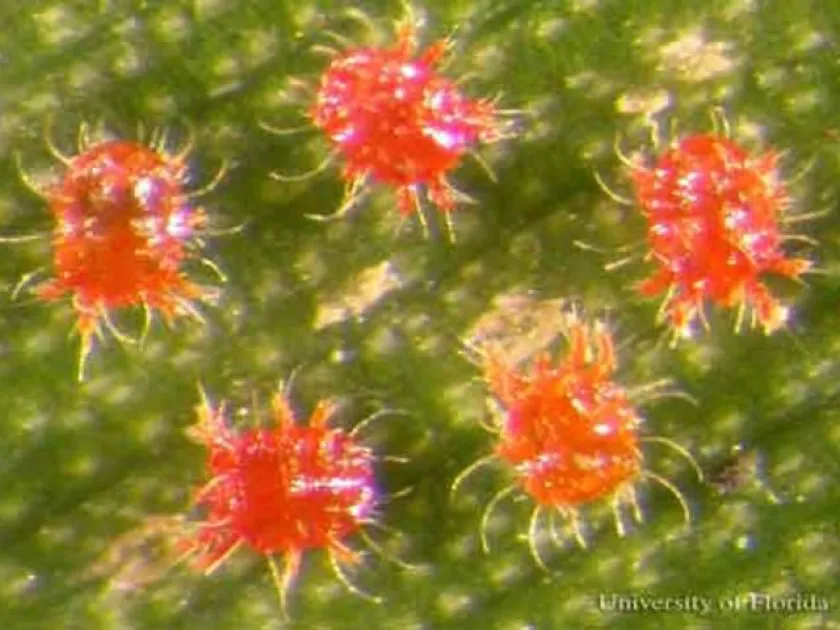
The palm red mite (Retracrus elaeis) is a microscopic pest belonging to the Tenuipalpidae family within the Trombidiformes order. Adults are easily recognized by their vivid red color and flattened, oval-shaped bodies, which allow them to inhabit leaf crevices.
The life cycle involves an egg stage, a larval stage, two nymphal stages, and the adult stage. Development from egg to adult occurs entirely on the leaf surface, typically completing within 15 to 20 days depending on the ambient temperature and humidity levels.
Females lay eggs in clusters along the leaf veins, often reinforcing them with thin silk strands. Their high reproductive rate allows for rapid population growth, especially in the tropical climates where their host plants thrive.
These mites are highly elusive and often go unnoticed until significant damage is already present. Dispersal between plants occurs passively, carried by wind currents, visiting insects, or through the exchange of infested plant material.
Recognized as a significant agricultural pest, Retracrus elaeis is closely monitored in regions where oil palms are commercially cultivated, as its presence can lead to substantial yield losses.
What it damages
The primary host is the oil palm (Elaeis guineensis), though many other ornamental palm species are susceptible. The mites use their piercing-sucking mouthparts to feed on the epidermal cells of the palm leaves.
By removing cellular fluids, the mites cause severe physiological stress to the plant. Colonies are typically concentrated on the underside of leaves, though heavy infestations eventually cover the entire surface area of the frond.
The immediate result of feeding is chlorosis—the yellowing or whitening of leaf tissue. Over time, the affected areas turn bronze or brown, leading to the gradual loss of photosynthetic efficiency in the plant.
Severely infested leaves become brittle and deformed. In addition to direct damage, the puncture wounds provide entry points for opportunistic pathogens, including secondary fungal and bacterial infections that accelerate leaf necrosis.
Chronic infestation severely stunts the growth of the palm. In young nurseries, sustained feeding pressure can lead to complete plant death, necessitating rigorous integrated pest management protocols.
Signs of infestation
Early warning signs include the appearance of tiny yellow or whitish dots on the leaves, which are the focal points of mite feeding. As the infestation grows, these dots expand into large chlorotic patches.
Close inspection of the underside of the leaves often reveals a reddish, dusty-looking coating consisting of live mites, shed skins (exuviae), and eggs. This residue is a clear indicator of a thriving colony.
Leaf curling is a common symptom, as the plant attempts to protect the leaf tissue from the mites. This change in leaf architecture is often one of the first signs visible to an observant grower.
In advanced stages, the foliage takes on a scorched, brown appearance. The leaves may tear or crack under mechanical stress, giving the palm an unkempt and sickly appearance that reduces its aesthetic and agricultural value.
A simple diagnostic test involves shaking an infested leaf over a white sheet of paper. The presence of small, fast-moving red mites confirms the infestation and indicates an urgent need for control measures.
Control measures
Effective management begins with strict sanitation, including the pruning and immediate burning of heavily infested fronds. This reduces the primary inoculum and prevents the mites from spreading to healthy palms.
Chemical control is achieved through the application of selective acaricides. It is critical to rotate between products with different modes of action to prevent the development of pesticide resistance in mite populations.
Biological control methods are increasingly favored, particularly the use of predatory phytoseiid mites or the application of entomopathogenic fungi like Beauveria bassiana to suppress population growth.
Environmental management plays a key role, as red mites thrive in dry conditions. Regular irrigation and overhead misting can create a microclimate that is unfavorable for mite reproduction and dispersal.
Quarantine and exclusion are the most cost-effective methods. Any new plant stock introduced to a plantation or garden should be isolated and carefully inspected for at least 30 days before being placed near existing palms.
Taxonomy
- Latin name
- Retracrus elaeis
- Order
- Mites
- Family
- Phytoptidae
- EPPO code
- RETUEL
Discussion
No discussions yet — be the first.