
Sugarcane planthopper
Pyrilla perpusilla
Description
How to identify
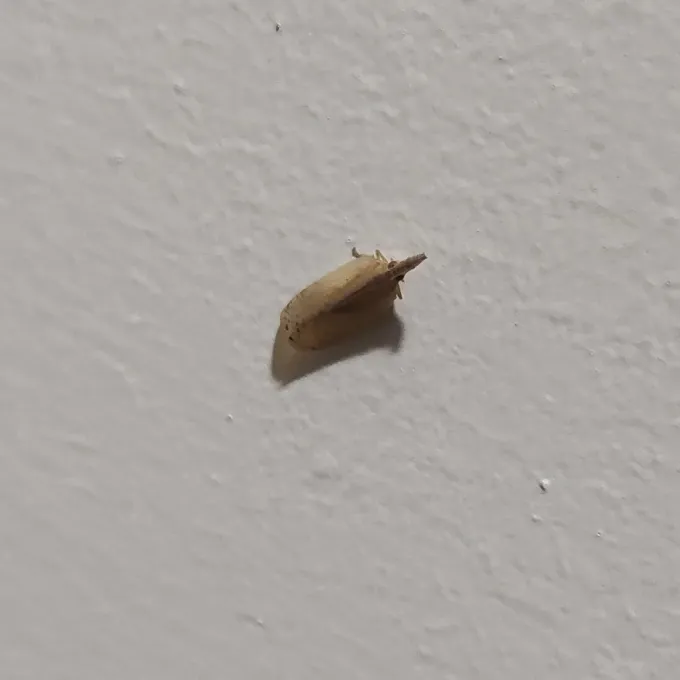
The sugarcane planthopper (Latin: Pyrilla perpusilla) is a jumping insect belonging to the family Lophopidae, order Hemiptera. Adult individuals have a characteristic elongated head process and a straw-yellow color, typically measuring about 7–8 mm in length.
The wings of the insect are semi-transparent with clearly defined venation, folded in a tent-like manner along the body. In a resting position, the pest blends almost perfectly with the leaf color, making it difficult to detect during initial inspections.
Nymphs of the planthopper are distinguished by a tuft of waxy filaments at the tip of the abdomen, which protects them from external environmental stresses and moisture. They are less mobile than adults and prefer to hide at the base of leaves.
The pest's eggs are laid in clusters, usually on the underside of the leaf blade, and are covered with a white, fluffy waxy coating. These distinctive "white patches" are the primary identifying feature during the oviposition period.
The insect develops via incomplete metamorphosis. The life cycle includes the egg stage, five nymphal instars, and the adult (imago), with all developmental stages being dependent on feeding on the sap of the host plant.
What it damages
The main host for the sugarcane planthopper is sugarcane, where the insect can cause catastrophic damage to plantations. Additionally, the pest is frequently found on sorghum, maize, millet, and certain species of grasses.
Mass reproduction of the pest leads to a significant decrease in cane sugar content, which directly impacts the economic efficiency of sugar production. The plant loses vital energy due to the constant drain of plant sap.
Secondary infections develop at the sites of leaf tissue punctures, as insect excrement ("honeydew") provides an ideal medium for sooty molds. This blocks photosynthesis and weakens the overall development of the crop.
Severe infestations result in yellowing, curling, and premature drying of the leaves. The yield of green biomass decreases, and the development of the root system is significantly retarded, making the crop vulnerable to drought conditions.
The accumulation of sooty mold on the leaves also hinders mechanical field operations and reduces the quality of plant raw materials intended for industrial processing at sugar mills.
When it appears
The activity of the sugarcane planthopper is directly dependent on temperature and atmospheric humidity. Conditions characterized by moderately high temperatures and high relative humidity are most favorable for population outbreaks.
At the beginning of the season (spring), the population is typically small and concentrated on weeds or early-planted crops. With the onset of summer months and stable warm weather, reproduction rates increase sharply.
The peak of damage usually occurs during or immediately after the rainy season, as humidity levels facilitate the survival of early-instar nymphs. During this period, overlapping generations can be observed.
In autumn, as average daily temperatures drop, the feeding intensity of the adults decreases. The pest begins seeking shelter for overwintering in plant debris, dry grass, or along the edges of fields.
The number of generations per year varies from three to five, depending on the climatic zone. Constant monitoring of crop health throughout the entire growing season is critically important.
Signs of infestation
The first visual sign of infestation is the appearance of white, cotton-like masses of waxy coating on the underside of leaves. These formations are clearly visible even during a cursory inspection of the crop rows.
The presence of a sticky substance on the leaves, which quickly turns black due to the development of sooty molds, indicates an active feeding phase of a large planthopper population. This phenomenon is often referred to as "black mold" on plantations.
When the plant is physically disturbed, adult insects actively jump or fly to neighboring stalks. The presence of a large number of jumping individuals while walking through the field is a warning sign of an impending outbreak.
Curling leaf margins and the appearance of chlorotic spots in areas where nymphs congregate indicate prolonged feeding damage. In severe cases, the plantation takes on a scorched brown appearance due to tissue necrosis.
Disruption of growth processes, such as stunted height or delayed panicle emergence, is also an indirect but important indicator of the pest's hidden presence in the field.
Control measures
Effective protection is based on an integrated pest management (IPM) approach that combines agrotechnical methods, biological control, and, as a last resort, the application of chemical insecticides.
- Removal of weeds around field margins that serve as reservoirs for the pest.
- Maintaining optimal plant density to ensure adequate air circulation within the canopy.
- Utilization of biological control agents, such as the parasitic wasp species Epiricania melanoleuca.
- Timely harvesting and destruction of post-harvest residues where adults overwinter.
- Application of selective insecticides upon reaching the economic threshold to reduce population density.
It is important to avoid excessive nitrogen fertilization, as succulent, over-fertilized plants are more attractive to planthoppers. Balanced plant nutrition enhances the natural immunity of the crop.
Biological control is the most preferred method as it allows for long-term balance in the agroecosystem and does not harm beneficial insect pollinators.
Chemical treatments should be applied locally, targeting only the hotspots of infestation, to minimize negative environmental impacts and preserve the populations of the pest's natural enemies.
Taxonomy
- Latin name
- Pyrilla perpusilla
- Order
- Hemiptera (bugs, aphids, leafhoppers)
- Family
- Lophopidae
- EPPO code
- PYRLPE
Discussion
No discussions yet — be the first.