
Pyrilla
Pyrilla
Description
How to identify
Pyrilla is a genus of insects belonging to the family Lophopidae within the order Hemiptera. These insects are commonly referred to as sugarcane leafhoppers, characterized by their distinct, elongated snout-like head process.
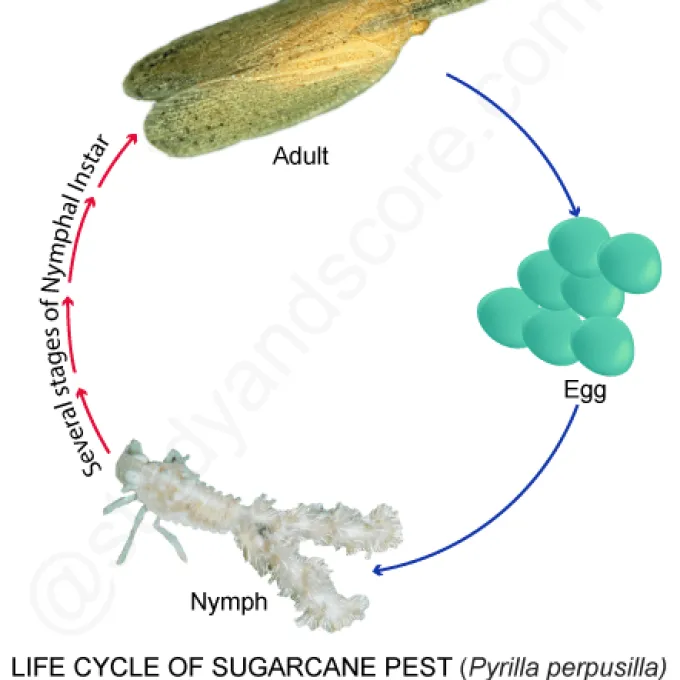
Adult insects are typically 6–8 mm in length, with a straw-colored to light brown body that blends seamlessly into the foliage of host crops. Their wings are transparent with prominent reticulate venation, usually held tent-like over the body.
The nymphs go through five instars; they are lighter in color and often covered with a white, waxy secretion or fine filaments that serve as protection against environmental stressors and predators.
The species Pyrilla perpusilla is the most notorious member, recognized as a significant pest in tropical and subtropical agriculture, capable of causing widespread destruction.
An essential identification tip for agronomists is their erratic jumping behavior, which they exhibit immediately upon being disturbed, making headcount monitoring challenging in the field.
What it damages
Pyrilla primarily feeds on sugarcane, but it is a polyphagous pest that also attacks various grain crops, including maize, sorghum, rice, and wheat, causing substantial yield loss.
Both nymphs and adults cause damage by piercing the plant epidermis and sucking sap, which drains the essential nutrients and water required for healthy plant growth.
During feeding, the pest excretes a sugary substance known as honeydew, which accumulates on the leaves and provides a substrate for the rapid growth of sooty mold fungi.
The presence of sooty mold inhibits photosynthesis by blocking sunlight, leading to the yellowing and necrosis of leaves, which ultimately results in reduced sugar content in the stalks.
Severe infestations can lead to total crop failure, as the cumulative effect of sap loss and fungal growth weakens the plants, making them susceptible to lodging and further diseases.
When it appears
The life cycle of Pyrilla is heavily influenced by humidity and temperature, with peak populations usually observed during the onset of the rainy season and periods of high atmospheric moisture.
Females deposit eggs in clusters on the underside of leaves, covering them with white, fluffy, waxy secretions that protect the eggs from desiccation and parasitism.
A single generation can complete its development in 30 to 50 days, allowing the pest to produce multiple generations within a single cropping season, leading to rapid population spikes.
Moderate temperatures combined with high humidity create the optimal environment for reproduction, whereas extreme heat or prolonged dry spells often suppress larval development.
Pyrilla survives the off-season primarily as adults or late-stage nymphs, hiding in weeds, grasses, or crop residues, and then migrates to new plantings when conditions improve.
Signs of infestation
The earliest indicator of a Pyrilla infestation is the appearance of white, cotton-like egg masses on the underside of host plant leaves during routine field inspections.
The presence of nymphs moving actively across the leaves is a clear sign that the pest is breeding and that the population is entering an active growth phase.
The accumulation of a sticky, sweet honeydew on the foliage, which eventually turns black due to the growth of sooty mold, is a diagnostic sign of advanced infestation.
Progressive yellowing of leaf tips and edges, followed by wilting and drying, indicates that the plant is suffering from the continuous sap loss caused by the pest feeding.
Frequent jumps of insects from the canopy when brushing against plants serve as a warning sign of high density, warranting immediate action and monitoring.
Control measures
Effective management of Pyrilla requires an integrated approach that balances cultural practices, biological control, and judicious use of chemical treatments.
- Field sanitation: Regularly clear crop debris and weed hosts that provide refuge for the pest during the off-season.
- Nutrient management: Avoid excessive application of nitrogen fertilizers, as these promote lush, tender foliage that attracts leafhoppers.
- Biological control: Encourage the presence of natural enemies, specifically the parasitic wasp Epiricania melanoleuca, which is highly effective in suppressing Pyrilla populations.
- Chemical intervention: Utilize systemic insecticides if the population density crosses the economic threshold to prevent substantial crop damage.
- Monitoring programs: Conduct regular field scouting to identify infestation hotspots early, ensuring that treatments are localized and effective.
Taxonomy
- Latin name
- Pyrilla
- Order
- Hemiptera (bugs, aphids, leafhoppers)
- Family
- Lophopidae
- EPPO code
- PYRLSP
Discussion
No discussions yet — be the first.