
Pyrellia vivida
Pyrellia vivida
Description
How to identify
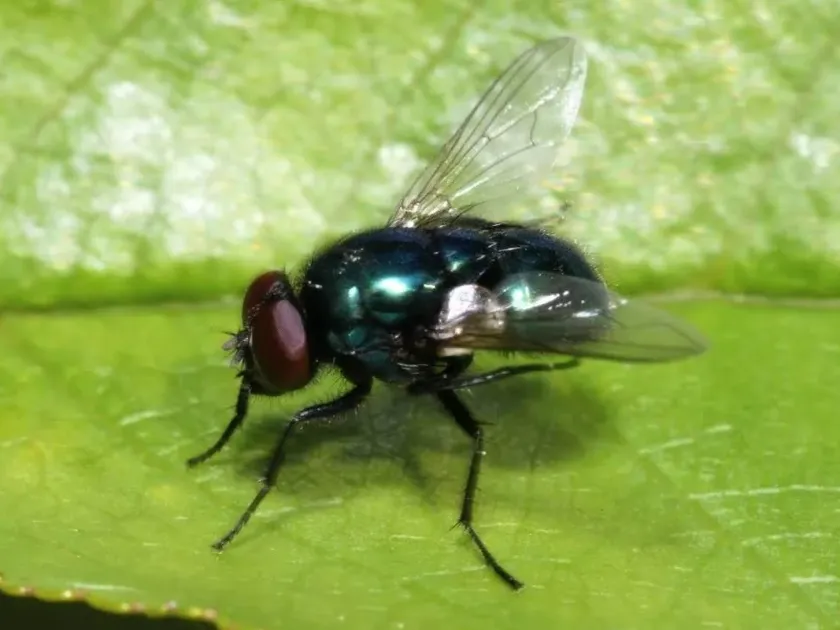
Pyrellia vivida belongs to the Muscidae family of the order Diptera. This insect is of medium size and possesses a characteristic metallic sheen on its body, making it visually distinct in field conditions.
Adult flies are characterized by a complex eye structure and a well-developed lapping-type mouthpart. The coloration of adults often varies from bright green to a blue-green metallic tint, which is a specific trait of the species.
The larvae of this species have a cylindrical body shape typical of muscid flies, tapering towards the front end. They lack a defined head or limbs and reach a length of approximately 8–10 millimeters in their final instar.
The insect undergoes a complete metamorphosis cycle: egg, larva, pupa, and adult. Adults are highly mobile and actively move across plants in search of food sources and suitable egg-laying sites.
For accurate identification, specialists examine morphological features such as thoracic bristles and genital structures, as the fly can externally resemble other members of the Muscidae family.
What it damages
Pyrellia vivida primarily affects vegetable and technical crops, with the main damage associated with larval activity within organic debris and damaged plant tissues.
The fly is frequently associated with secondary plant infections, where larvae develop in decaying tissues, accelerating the decomposition process and the spread of fungal or bacterial pathogens.
Under intensive cultivation conditions, mass reproduction of these flies can lead to a decrease in the quality of commercial produce, rendering root vegetables and crops unsuitable for long-term storage.
The economic harm caused by this species manifests in the weakening of the plant's immune system, making crops more susceptible to environmental stressors such as drought or frost.
The economic threshold for pest control is determined based on adult population density per hectare and the field's history regarding rot processes in the soil.
When it appears
The activity of Pyrellia vivida is directly dependent on temperature and humidity levels. Mass emergence of adults is observed in late spring and continues throughout the summer under favorable conditions.
The development of multiple generations per season allows the population to rapidly adapt to changing environmental conditions, increasing in number where sufficient food sources are present.
In autumn, the flies seek shelter for hibernation, choosing plant debris, soil crevices, or agricultural structures where temperatures remain relatively stable.
The peak of larval damage usually occurs in mid-summer, when the plants' growth phase is most active and organic decomposition processes are accelerated.
The temperature optimum for the development of most generations ranges from +20 to +25 degrees Celsius; at sudden drops in temperature, the metamorphosis processes slow down significantly.
Signs of infestation
The first sign of the pest's presence is the visual detection of adult flies on the leaf surface or near areas with accumulating decomposing organic matter.
Damaged plant parts begin to show signs of premature wilting and characteristic tissue softening, often accompanied by an unpleasant odor due to secondary infection.
When inspecting the root system or the soil surrounding the base of the plant, one may discover fly larvae actively feeding on the decaying tissue fragments.
The presence of fly excrement on leaf surfaces in the form of small dark spots can also indicate the presence of a high pest population within the agroecosystem.
If measures are not taken in time, patches of plant death appear in heavily infested areas, visible as bare spots against the general background of the field.
Control measures
The primary focus of protection should be on agrotechnical methods that prevent the accumulation of plant debris, which serves as a substrate for larval development.
- Timely deep autumn plowing to destroy overwintering sites.
- Implementation of crop rotation excluding plants susceptible to rot.
- Use of high-quality planting material free from pathogens.
- Application of biological control agents during early stages of detection.
Chemical control involves the application of systemic or contact insecticides during periods of maximum adult activity, according to the manufacturer's guidelines.
Monitoring population levels using sticky traps or yellow water traps allows for the efficient timing of protective measures and avoids unnecessary treatments.
Soil health plays an important role; incorporating products that accelerate the mineralization of organic matter deprives larvae of the environment necessary for their development.
Taxonomy
- Latin name
- Pyrellia vivida
- Order
- Diptera (flies)
- Family
- Muscidae
- EPPO code
- MUSCCA
Discussion
No discussions yet — be the first.