

Pest · Lepidoptera (butterflies) · affects Cereals, Winter wheat, Tobacco
Meal moth
Pyralis farinalis
Description
How to identify
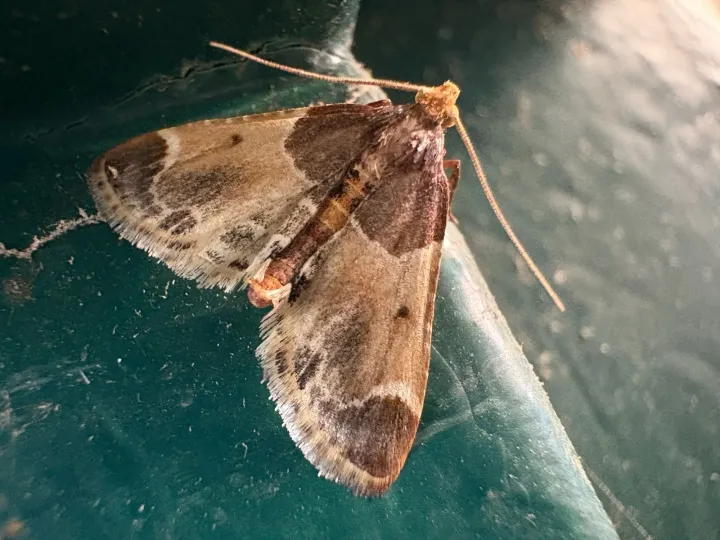
The meal moth (Pyralis farinalis) is a species of snout moth belonging to the family Pyralidae. The adult moth has a wingspan of approximately 25–30 mm. Its forewings are distinctively patterned with brown areas and two white zigzag cross-lines.
The larvae, or caterpillars, can grow up to 25 mm in length. They have a whitish to yellowish-brown body, while the head capsule and the prothoracic shield are dark brown or black.
The pupa is reddish-brown and glossy, housed within a tough, silken cocoon. The caterpillar constructs this cocoon using silk mixed with fragments of food and its own waste, which provides camouflage.
Adult moths are nocturnal. During the day, they remain stationary, often resting on the walls or ceilings of storage areas with their wings folded, mimicking small debris.
The life cycle undergoes complete metamorphosis. In heated warehouse conditions, the meal moth can breed continuously, completing several generations per year depending on temperature and food availability.
What it damages
The damage is primarily caused by the larvae, which are generalist feeders. They infest stored products including flour, cereals, wheat, rye, corn, oats, barley, bran, crackers, and dried pet food.
The moth prefers to infest products stored in areas with poor ventilation or high humidity. These conditions are ideal for the larvae to establish themselves and proliferate within the food source.
The larvae tunnel into the food material, feeding on particles and spinning heavy silk webbing. Large populations can cause significant destruction to the outer layers of grain heaps.
A hallmark of infestation is the webbing, which binds the flour or grain particles into large, matted clumps. This significantly affects the flowability and processing quality of the stored goods.
Besides direct consumption, the products are heavily contaminated with silk, larval excrement, and shed skins, creating an unpleasant odor and rendering the product unfit for human consumption.
Signs of infestation
The primary sign of a meal moth infestation is the presence of silk webbing on the surface of stored grain or flour bags. The webbing often holds particles together in clumps.
Visible "clumping" of flour or grain is a clear indicator of larval activity. When shifting or sifting the product, these clumps do not break apart easily due to the tough silk threads.
Adult moths flying around storage areas are a sign of an existing infestation. They are attracted to the products and are often seen near the infested commodities at night or in dark rooms.
Finding pupal cases in crevices, equipment gaps, or floor joints indicates that the infestation is well-established and that multiple generations may have already developed.
In cases of severe infestation, a musty, stale odor develops in the storage room. This is caused by the combined effect of larval waste and the growth of mold that often thrives alongside the moth.
Control measures
Rigorous sanitation is the first line of defense. Warehouses should be thoroughly cleaned of dust, spilled grain, and residues regularly to eliminate breeding sites for the larvae.
Control of environmental factors is crucial. Maintaining low humidity levels (below 13-14% moisture content in grain) significantly hinders the survival and development of the larvae.
Physical methods, such as regular sifting and cooling of the grain mass, can help prevent population growth by disrupting the environment necessary for the moth's life cycle.
If an infestation becomes widespread, chemical fumigation of the warehouse or stored products by certified professionals is required to eliminate both larvae and adults effectively.
Prevention also includes ensuring the structural integrity of storage bins and using airtight packaging for finished products to minimize the risk of entry by foraging moths.
Content graph
Connections · Meal moth
Most often together:
Marketplace
Products · 1
Biology
Taxonomy
- Latin name
- Pyralis farinalis
- Order
- Lepidoptera (butterflies)
- Family
- Pyralidae
- EPPO code
- PYRAFA
Community
Discussion
No discussions yet — be the first.