
Dark-capped bulbul
Pycnonotus tricolor
Description
How to identify
The Dark-capped bulbul (Pycnonotus tricolor) is a member of the Pycnonotidae family, classified under the order Passeriformes.
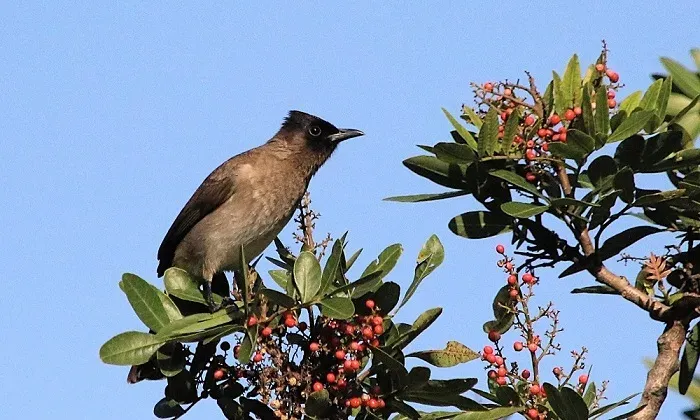
These birds are recognized by their dark-brown caps, greyish-brown upperparts, and a distinct bright yellow vent area under the tail.
They are medium-sized birds, typically measuring around 18–20 cm in length, with a notable crest atop their heads.
Known for their high social nature, they are often found in noisy flocks within gardens, orchards, and forest edges.
Their distribution is primarily across tropical Africa, where they adapt well to human-altered environments like agricultural plantations.
What it damages
Dark-capped bulbuls are significant pests in fruit farming, focusing their feeding habits on succulent berries and fruits.
They feed on a wide variety of crops, including grapes, strawberries, mangoes, papayas, and various small orchard fruits.
The damage is characterized by birds pecking at multiple fruits in a cluster, often abandoning them after minimal consumption.
This feeding behavior causes rapid fruit decay and invites secondary infestations from insects and fungal pathogens.
In commercial orchards, unchecked flocks of these bulbuls can lead to substantial economic losses by ruining a large percentage of the harvest.
When it appears
Their activity levels are highest during the fruit ripening seasons when high-energy food sources are readily available.
Bulbuls are most active during the early morning and late afternoon, utilizing these periods for intense feeding and flock movement.
In tropical climates, they may pose a threat throughout the entire year if a variety of fruits are available sequentially.
Young birds, after fledging, contribute to larger flock sizes, which significantly increases the feeding pressure on cultivated areas.
Dry periods often correlate with increased garden raids, as birds seek fruit pulp as a primary source of hydration.
Signs of infestation
The most common indicator of their presence is finding fruits with irregular peck marks or partially hollowed-out flesh.
Large amounts of droppings underneath fruit trees or near trellis systems often signal a roosting or feeding site.
Constant vocalizations, often described as melodic yet loud chatter, are reliable clues to their presence in the canopy.
A sudden decline in yield or an increase in fallen, damaged fruit under trees indicates active feeding pressure.
Evidence of damaged fruit skin combined with localized rot is a classic sign of bulbul-related agricultural damage.
Control measures
Exclusion is the most effective control method, utilizing fine-mesh bird netting to cover high-value fruit trees and berry bushes.
Visual deterrents such as reflective tape, hanging mirrors, or realistic raptor decoys can provide short-term protection.
Acoustic deterrents that broadcast distress calls are effective, provided they are rotated to prevent the birds from habituating to the sounds.
Sanitation practices, such as clearing fallen fruit and harvesting promptly, remove attractants that bring flocks into the orchard.
Integrated pest management, combining physical barriers with deterrent devices, offers the best chance of minimizing crop loss.
Taxonomy
- Latin name
- Pycnonotus tricolor
- Family
- Pycnonotidae
- EPPO code
- PYKNTR
Discussion
No discussions yet — be the first.