
Pterodontia flavipes
Pterodontia flavipes
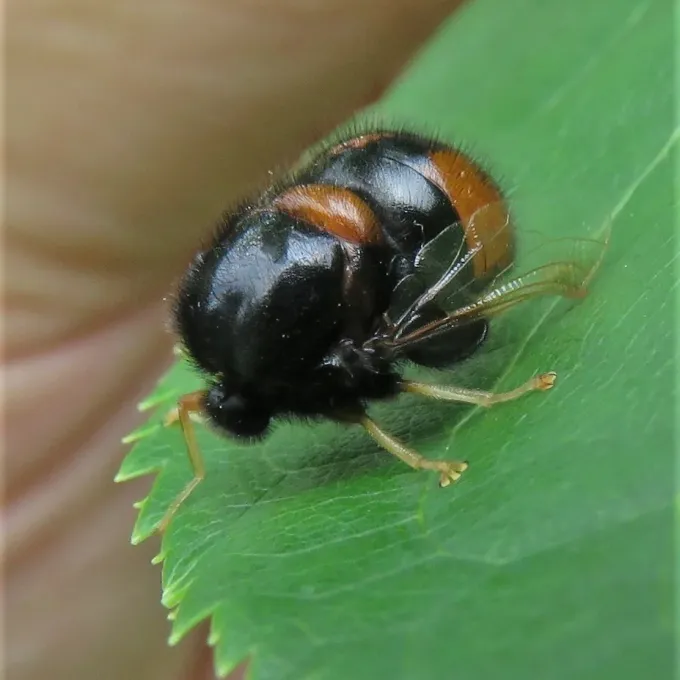
Description
How to identify
Pterodontia flavipes belongs to the family Acroceridae, commonly known as small-headed flies. These insects are easily identified by their highly arched, humped thorax and a very small head relative to the body size.
The species name flavipes refers to the distinct yellow coloration of the legs, which serves as a diagnostic feature for taxonomists and field entomologists.
Adult flies are known for their unique hovering behavior. They often frequent areas with high spider density, as these arachnids are the necessary hosts for their larvae.
The life cycle is complex, involving hypermetamorphosis. First-instar larvae are active and seek out spiders to penetrate their cuticle and develop as endoparasitoids.
Because they are not typical agricultural pests, observing these flies requires specific entomological surveys using malaise traps or netting in habitats rich in spiders.
What it damages
Pterodontia flavipes does not consume plant tissues, roots, or fruits. Consequently, it is not classified as a direct pest of agricultural or horticultural crops.
The primary concern regarding this species is its predatory nature towards spiders. Spiders are vital natural enemies of many crop-damaging insects, such as aphids and leafhoppers.
By parasitizing spiders, Pterodontia flavipes indirectly reduces the efficiency of biological pest control agents within the agroecosystem.
However, the ecological impact of this species is usually localized and does not reach the threshold of economic damage requiring specific remediation.
Farmers should view this insect as a natural component of biodiversity that fluctuates according to the population dynamics of its host, rather than an invasive threat.
Control measures
No formal control measures are recommended for Pterodontia flavipes. Since the species does not target crops, expenditures on specialized eradication are not justified.
The use of broad-spectrum insecticides for primary pest control will inadvertently reduce populations of spider parasitoids, including Pterodontia flavipes.
Integrated Pest Management (IPM) practices focus on preserving overall ecosystem health, which naturally regulates the population of this fly.
Maintaining field margins and avoiding unnecessary chemical applications supports a stable population of spiders, which in turn balances the presence of their parasitoids.
Future research may evaluate the subtle ecological role of spider parasitoids, but current agronomic strategies do not identify this fly as a target for control.
Taxonomy
- Latin name
- Pterodontia flavipes
- Order
- Diptera (flies)
- Family
- Acroceridae
- EPPO code
- PTDTFL
Discussion
No discussions yet — be the first.