
Willow aphid
Pterocomma smithiae
Description
How to identify
The willow aphid, Pterocomma smithiae, is a member of the Aphididae family, known for its specific preference for willow (Salix) and poplar (Populus) species.
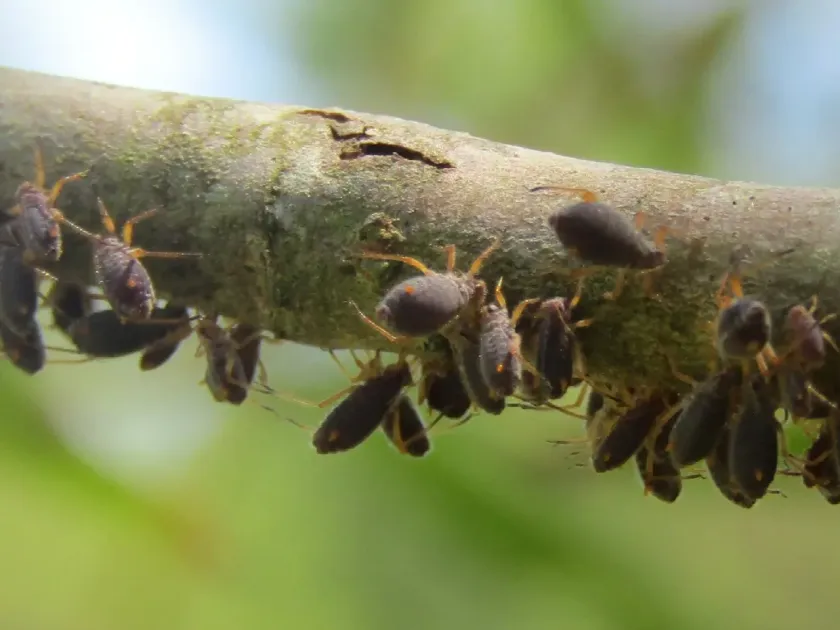
Adults are relatively large, often measuring several millimeters in length, and typically display a dark brown or black coloration, sometimes with a shiny metallic sheen.
A distinctive feature of this species is the presence of long, prominent siphunculi (cornicles) on the dorsal side of the abdomen, which aids in field identification.
They often cluster in dense, stationary groups on the bark of stems or along young shoots, making them relatively easy to spot during regular tree inspections.
The population consists of both wingless individuals that stay within the colony and winged forms that facilitate dispersal to neighboring plants during the growing season.
What it damages
These aphids primarily target the bark and tender new growth of willow trees, piercing plant tissue to extract essential sap.
The damage caused by feeding leads to the twisting and distortion of shoots, which can significantly stunt the growth of young or newly planted trees.
A major indirect threat is the production of honeydew, a sugary waste product that coats the tree and serves as a medium for the growth of sooty mold fungus.
Severe infestations can result in premature leaf drop, which weakens the tree's overall vigor and makes it more susceptible to drought and other environmental stressors.
In nursery settings, persistent aphid presence can severely degrade the quality of stock, leading to stunted or misshapen trees that are unsuitable for sale.
When it appears
The life cycle begins with overwintering eggs, which are securely deposited in bark crevices, near leaf buds, or at twig junctions during late autumn.
As spring arrives and temperatures rise, the eggs hatch into stem mothers, which quickly begin the cycle of asexual reproduction to build up the colony population.
Populations tend to reach their peak density in late spring and early summer, taking advantage of the flush of new vegetative growth on their hosts.
As the summer progresses, natural predators and changes in plant physiology can lead to a decline in aphid numbers, though smaller colonies may persist.
The cycle completes in the autumn, when sexual forms appear, mate, and deposit the eggs that will remain dormant on the host plant until the following spring.
Signs of infestation
Visual identification starts with observing curled or deformed leaves and distorted twigs that are sticky to the touch due to honeydew accumulation.
The appearance of black, sooty mold covering the bark and leaves is a clear indicator that a large aphid colony has been active on the tree for some time.
Increased ant activity around the tree trunk is a reliable sign, as ants often swarm to protect aphid colonies to feed on their nutrient-rich honeydew secretions.
Clusters of dark, immobile insects located along the stems or branches are often visible, especially during the early morning before the heat of the day.
- Stunted growth of new shoots.
- Sticky honeydew residue on foliage.
- Development of black sooty mold.
- High ant traffic on the tree.
Control measures
For small infestations, a high-pressure stream of water can be used to physically wash the aphids off the bark and rinse away the honeydew buildup.
Encouraging natural predators such as lady beetles, lacewings, and hoverflies is highly effective, as these insects can significantly reduce aphid populations.
Systemic insecticides may be necessary for severe infestations in ornamental or nursery environments, providing long-lasting protection against recurring colonies.
Horticultural oils or insecticidal soaps offer a lower-toxicity alternative that can be effective if applied directly to the colonies during the active season.
Proper plant care, including appropriate fertilization and hydration, helps the tree maintain the vigor necessary to recover from aphid-related damage.
Taxonomy
- Latin name
- Pterocomma smithiae
- Order
- Hemiptera (bugs, aphids, leafhoppers)
- Family
- Aphididae
- EPPO code
- PTEOSM
Discussion
No discussions yet — be the first.